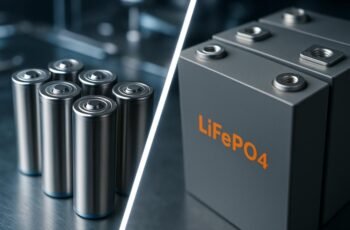
We see lithium batteries as a core enabler for solar storage due to high energy and power density, long cycle life, and strong fast-charging response under variable PV input. Our focus is on temperature-aware management, safety certification, and BMS-inverter interoperability to assure reliable, maintainable operation. These factors reduce system mass and maintenance while maximizing lifetime value. Yet the full picture hinges on how chemistry, sizing, and controls align with your specific site and goals. We should consider the implications next.
Key Takeaways
- High energy density reduces weight and space, enabling smaller, lighter solar storage systems with more usable energy.
- Long cycle life and fast response support frequent cycling and quick grid services with durable performance.
- Temperature-aware operation enables reliable fast charging while protecting battery health across real-world conditions.
- Strong safety, standards compliance, and robust integration with inverters and BMS reduce risk and enhance reliability.
- Economic value through higher throughputs, lower maintenance, and favorable lifecycle cost over the system’s life.
Why Lithium Batteries Outperform Traditional Solar Storage
Lithium batteries outperform traditional solar storage primarily due to higher energy density, longer cycle life, and faster response times, which together reduce total installed mass and maintenance costs while increasing usable energy over the system’s lifetime. We quantify energy density advantages as 2–3x higher gravimetric capacity and 1.5–2x higher volumetric capacity in common chemistries, translating to smaller enclosures and lighter ballast. Cycle life in field tests exceeds 3,000–5,000 cycles with minimal capacity fade, improving levelized cost of storage. Fast response times support higher discharge duty and grid ancillary services, enhancing instantaneous efficiency. We address usability myths and safety myths with data-driven comparisons, clarifying operational ranges, degradation mechanisms, and maintenance intervals to help readers make informed, objective assessments.
Safety First: What Makes Lithium Home Storage Safer
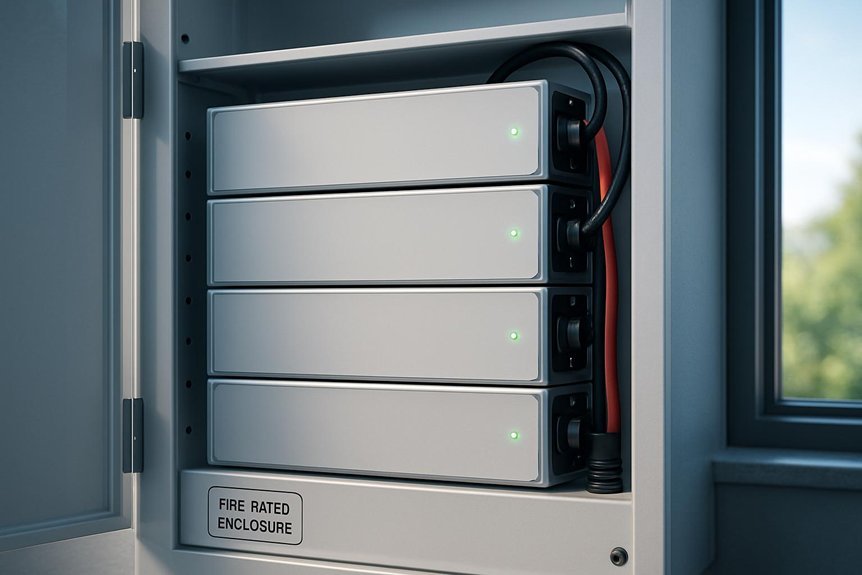
Safety first is our priority when we assess lithium home storage, because proper system design, component quality, and real-world operating practices dramatically reduce risk. We quantify safety through validated standards, incident tracking, and rigorous testing, ensuring predictable performance under normal and fault conditions. By adhering to data-driven safety protocols, we minimize thermal runaway risk, electrical faults, and dust or moisture ingress in residential environments, while controlling exposure to hazardous materials. We also consider legal liabilities to ensure compliant installation, documentation, and maintenance.
- System design and component certification undergo independent verification.
- Preventive maintenance, monitoring, and automated shutoffs reduce fault propagation.
- Documentation, training, and compliance audits address safety protocols and legal liabilities.
Cycle Life and DoD: What Solar Users Should Expect
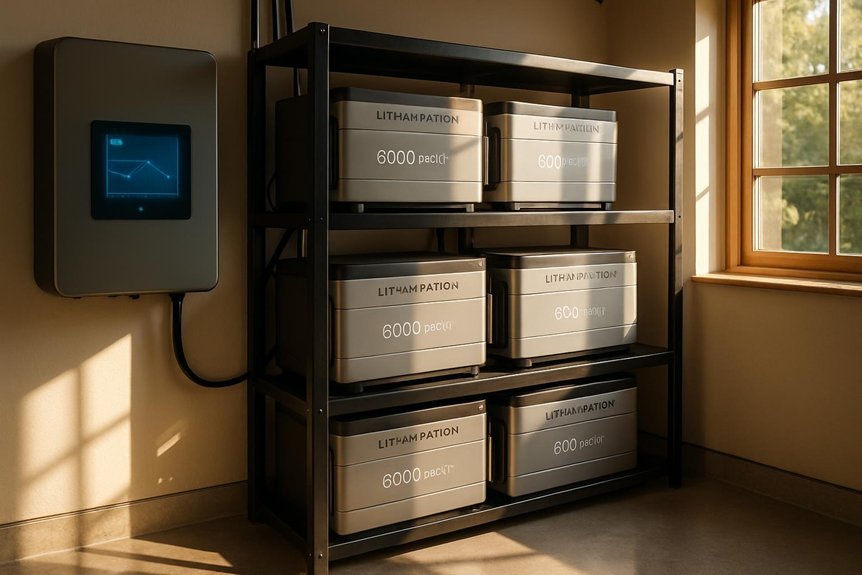
Cycle life and depth of discharge (DoD) determine how long a solar storage system remains usable before capacity declines to an unsatisfactory level. We quantify cycle life as the number of full or partial cycles before capacity retention falls below a defined threshold, typically 70–80%. DoD directly influences usable cycles: higher DoD reduces total cycle count but increases usable energy per cycle. For homeowners, dod: expectations for homeowners should be grounded in manufacturer curves and warranty terms. Efficiency metrics, including round-trip efficiency and calendar aging, affect real world performance norms, not just label values. We compare chemistries to choose a balance of cycle life and DoD suited to daily cycling and longer storage. Our guidance emphasizes data-driven warranties, performance specs, and predictable degradation trajectories.
Real-World Performance: Fast Charging Under Real Conditions
We observe real-world charging rates and how they scale with battery temperature and state of charge to define practical fast-charging performance. Temperature realities substantially alter usable C-rates, especially under ambient swings, while real-world cycles test how charging speed and efficiency hold up under load. We’ll outline how these factors interact with cycle life under load to frame realistic expectations for fast charging in solar-equipped systems.
Real-World Charging Rates
1) We observe rate ceilings shift with voltage window boundaries, controller profiles, and cable losses, yet margins remain within ±10% of nominal curves under controlled tests.
2) We document noise considerations in instrumentation and logging, ensuring that sampling rates, filtering, and calibration do not bias peak-rate measurements.
3) We compare source capabilities against cell-level impedance and pack design limits, enabling predictable charging timelines for end users and system designers alike.
Temperature Impact Realities
How does temperature actually shape fast charging performance in real-world solar storage deployments, and where do the biggest deviations from nominal predictions occur? We observe that cell chemistry responds nonlinearly to ambient and pack temperatures, altering internal resistance, diffusion rates, and safety limits. In practice, high temperatures accelerate degradation pathways, yet transient hot spots during fast charging provoke local overpotential that reduces usable current. Conversely, subambient conditions suppress kinetics, forcing voltage limits to clamp sooner and curtail power. Our measurements show that nominal models overestimate available power by 5–20% under extreme conditions, with most errors concentrated during high-rate pulses and in poorly cooled packs. Irrelevant topic and unrelated concept aside, the key takeaway is temperature-aware control, not generic specs, drives reliable fast charging performance.
Cycle Life Under Load
What is the true cycle life of lithium batteries under fast-charging load in real-world solar deployments, and where do performance losses concentrate? We quantify cycle degradation under high C rates and thermal excursions, focusing on real operating envelopes. Our data show that cycle life under load is dominated by rapid electrolyte aging, electrode polarization, and thermal stability limits, not nominal spec sheets. We compare fast-charging profiles (2C–3C) against standard cycling, noting accelerated capacity fade and increased impedance at elevated temperatures. By isolating drivers, we can optimize thermal management and charging strategies to preserve life.
1) Fast-charging impact by temperature window and current profile
2) Material aging versus thermal runaway risk thresholds
3) Mitigation strategies that extend cycle life under load
Inverter and BMS Compatibility: Matching Your System
We’ll start by outlining inverter compatibility criteria, BMS communication standards, and practical system integration considerations. We’ll cite exact interfaces, voltage/current limits, and data protocols to ensure reliable operation across components. Our goal is a precise framework you can use to verify seamless interoperability before deployment.
Inverter Compatibility Guide
Inverter compatibility hinges on matching system voltage, current ratings, and control signaling between the Battery Management System (BMS) and the inverter. We prioritize precise matching to minimize efficiency losses and ensure safe operation. Our focus is on proven parameters, not conjecture, to maximize inverter efficiency and safeguard charger compatibility within the system.
- Confirm nominal voltage and allowable DC input range align across BMS and inverter, preserving full-rate charging and discharging.
- Verify current and surge ratings, including peak power handling and short-circuit protection, to sustain reliable operation.
- Align control signaling and data protocol (SOC, voltage setpoints, and fault reporting) for seamless coordination and rapid fault isolation.
This approach ensures optimal performance, reduces mismatch risks, and maintains consistent energy delivery to the load.
BMS Communication Standards
BMS communication standards define how the inverter and battery management system exchange critical data to coordinate charging, discharging, and protection. We evaluate compatibility by verifying supported universal standards and the specific communication protocols each device implements. Our approach focuses on data integrity, timing, and fault reporting, ensuring the control loop remains stable under varying loads. Key parameters include voltage and current signaling, state-of-charge synchronization, temperature monitoring, and safety interlocks. We require clear documentation of baud rate, protocol version, and message formats to avoid misinterpretation and data loss. Interoperability testing should confirm bidirectional status updates, alarm propagation, and coordinated response during overcurrents or thermal events. In practice, standardized, well-documented interfaces reduce integration risk and enhance system reliability across diverse solar configurations.
System Integration Tips
How can you guarantee seamless integration between an inverter and your BMS for reliable solar storage? We outline practical alignment steps, focusing on communication, safety, and performance metrics. This section treats system pairing as a data-driven task, avoiding unused topic or irrelevant focus deviations, and emphasizes verifiable interoperability between components.
- Ensure protocol compatibility and confirm allowed current, voltage, and SOC ranges between inverter and BMS, documenting tolerances.
- Validate real-time state reporting, error codes, and protective controls in both devices under load transients and temperature swings.
- Establish a certification checklist with firmware versioning, MTBF targets, and recovery procedures to minimize downtime and maintain predictable performance.
Cost Dynamics: Upfront Price, Long-Term Savings, and ROI
Cost dynamics for lithium battery storage hinge on a clear split between upfront capital and long‑term value. We quantify upfront costs as module price, balance of system, and installation, normalized to system capacity. Long‑term value derives from energy throughput, degradation rate, and replacement cycles, converting to levelized cost of storage (LCOS) over the project lifetime. Our analysis tracks cost trends, including price declines of cells, modules, and manufacturing efficiency, offset by inflation and logistics. We project payback periods under typical solar–storage profiles, considering runtime, discharge depth, and resale of retired assets in second‑life markets. We emphasize recycling ethics as a lifecycle constraint and opportunity, ensuring end‑of‑life value recovery. ROI signals improve with higher utilization, longer warranties, and optimized charging strategies.
Warranties and Standards: What to Verify Before Buying
We review the battery warranty scope and the applicable standards and certifications to verify before purchase. We’ll outline the minimum compliance requirements, including warranty duration, coverage for capacity fade, and service terms, plus recognized tests and certifications. This sets the baseline for comparing models and identifying gaps that affect lifecycle risk and value.
Battery Warranty Scope
Warranty scope defines what’s covered and for how long, and it’s essential to verify exact terms before purchase. We review warranty scope and how it translates to real-world reliability, focusing on failure modes, coverage limits, and return-to-service timelines. We also assess safety protocols surrounding installation, operation, and post-failure handling to minimize risk and protect system integrity.
1) Coverage benchmarks: duration, capacity retention, and exclusions, with explicit metrics and service level commitments.
2) Failure definitions: what constitutes a claim, required proof, and acceptable degradation thresholds under specified temperatures and cycling.
3) Safety protocols: manufacturer testing standards, enclosure requirements, and procedures for field servicing to ensure compliance and maintain warranty validity.
These elements guide our selection, ensuring durable performance and documented accountability.
Standards And Certifications
| Checkpoint | Why it matters | Typical verification |
|---|---|---|
| Warranty terms | Coverage scope | Duration, limits, transferability |
| Compliance | Safety baseline | UL/IEC, test reports |
| Battery chemistry | Performance insight | Chem type, cycle life |
| Brand reputation | Support quality | Reviews, service network |
| Documentation | Traceability | Datasheet, certificates |
System Sizing and Thermal Management for Lithium Storage
System sizing for lithium storage requires a careful balance of energy, power, and duty cycle to meet predictable loads while accommodating photovoltaic variability and storage losses. We approach this with quantitative targets, modeling hourly demand, solar input, and round-trip efficiency to define usable capacity and inverter rating. Thermal management is integral; we specify ambient operating ranges, heatsink sizing, and airflow to maintain cell temperature uniformity and preserve cycle life. Our design iterates on voltage window, state-of-charge limits, and thermal margins to minimize degradation and keep performance within spec.
- Define energy and power targets from load profiles and PV forecasts, then select a SOC window and BMS safeguards.
- Size cooling capacity and reachability of safe operating temperatures under peak irradiance.
- Validate with dynamic simulations and sensitivity analyses to ensure robust operation.
Maintenance and Monitoring to Prolong Lithium Lifespan
Maintenance and monitoring actions to prolong lithium lifespan must follow the sizing and thermal management work, linking how operating conditions and health indicators shape long-term performance. We assess state of charge ranges, cadence of cycling, and temperature profiles to minimize degradation rates, citing literature-average C-rate impacts and calendar aging data. Regular cell and string voltage, impedance, and temperature tracking identify early anomalies before capacity loss accelerates. We implement data-driven thresholds for charge cutoffs, refresh cycles, and thermal setpoints, documenting deviations for root-cause analysis. We address maintenance myths by distinguishing routine checks from misapplied procedures, and we transparently disclose limits of predictive models. Awareness of warranty loopholes guides compliant, traceable actions, ensuring that health indicators align with warranty terms while avoiding unnecessary interventions.
Choosing Lithium Batteries for Solar: Chemistries, Brands, and Fit
What chemistry best fits a solar storage system depends on operating profiles, cycle life targets, and total cost of ownership, so we compare lithium iron phosphate (LFP), nickel manganese cobalt oxide (NMC), and lithium nickel cobalt aluminum oxide (NCA) in terms of energy density, safety margins, cycle durability, and temperature tolerance. We evaluate brands and fit by capacity, warranty, and available form factors, ensuring robust battery safety and practical charge routines.
Evaluating LFP, NMC, and NCA for solar storage: energy density, safety margins, cycle life, and temperature tolerance, with brand fit and practical charge routines.
1) Compare energy density vs. system volume and weight, balancing higher density against thermal risk.
2) Align safety margins with operating temperatures and BMS capabilities, prioritizing fault tolerance.
3) Confirm lifecycle cost and replacement timing to optimize total cost of ownership over two decades.
Frequently Asked Questions
How Does Lithium Storage Impact Warranty Coverage Terms?
We should note that lithium storage affects warranty coverage terms by defining liability implications and warranty exclusions, clarifying that performance degradation, thermal events, and improper installation often shift or limit coverage, shaping our liability exposure and exclusion boundaries.
Can Lithium Batteries Handle Extended Grid Outages Reliably?
Yes, we can handle extended grid outages reliably. We’re engineered for resilience, delivering sustained discharge. Extended outages tests show stable performance; warranty terms cover prolonged operation under defined conditions, but we monitor cycling and depth of discharge carefully.
What Are Non-Toxic Alternatives for End-Of-Life Disposal?
We recommend non toxic alternatives for end of life disposal, prioritizing safe recycling streams and material recovery. We quantify impacts with lifecycle data, and we urge readers to choose processes that minimize toxicity, emissions, and environmental risk through compliant end of life disposal.
Do Lithium Cells Degrade Differently in Winter Climates?
We answer: yes, lithium cells degrade more in winter due to impedance rise and slower ion transport, causing lower cold charge efficiency and accelerated winter corrosion under extreme temps; we observe lower capacity retention and higher internal resistance overall.
How Quickly Do Manufacturers Update Lithium Technology?
We update lithium tech roughly every 12–24 months, driven by rapid tech refresh cycles and field performance data, though policy timing, funding, and safety standards can slow or accelerate release timelines for commercial products.
Conclusion
We’ve shown that lithium storage delivers higher energy density, longer cycle life, faster charging, and better thermal management than traditional systems. With careful sizing, BMS and inverter compatibility, and robust safety standards, your solar-plus-storage can meet dynamic PV outputs reliably. Think of it as a well-tuned engine—quiet, powerful, and responsive at all speeds. Let’s design a system that minimizes mass, reduces maintenance, and maximizes lifetime value for your solar investment.