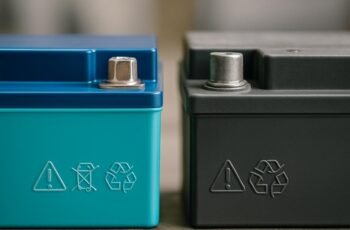
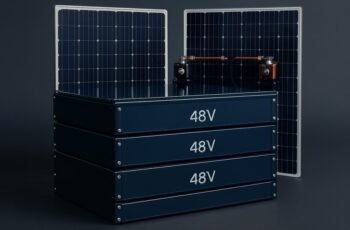
We see the spark of difference as two chemistries glow in parallel, each promising distinct strengths. We explore how Li-ion’s higher voltage and energy density contrast with LiFePO4’s safety and longevity, then weigh implications for safety, cost, and form factor. Our goal is precise, practical insight rather than hype. If you’re deciding for a project, the answer hinges on how you value energy, cadence, and resilience under abuse—and that balance isn’t the same for everyone.
Key Takeaways
- Li-ion offers higher energy density and voltage; LiFePO4 trades some energy for greater thermal stability and safety under abuse.
- Li-ion typically uses layered transition-metal oxide cathodes and graphite anodes; LiFePO4 uses olivine LiFePO4 cathodes with phosphate hosts.
- LiFePO4 shows steadier capacity retention and longer cycle life in many duty cycles, with lower risk of thermal runaway.
- Safety and thermal management priorities differ: LiFePO4 has higher thermal stability; Li-ion can exhibit sharper exotherms under abuse.
- Form factor, weight, and integration impact: Li-ion packs are lighter per energy, while LiFePO4 allows larger, safer packs with simpler cooling requirements.
Li-Ion vs LiFePO4: What’s the Difference at a Glance
Lithium-ion (Li-ion) and LiFePO4 (lithium iron phosphate) batteries share the same overall chemistry family, but they differ notably in voltage, energy density, safety, and cycle life. We’re comparing figures that matter for end-use decisions, not attributing value judgments. In voltage, Li-ion typically offers higher nominal ranges, while LiFePO4 provides steadier, safer behavior under abuse. Energy density favors Li-ion, translating to lighter packs for the same capacity. Safety profiles diverge in thermal stability and degradation pathways, influencing maintenance and enclosure requirements. Cycle life also trends longer for LiFePO4 in many applications, affecting total cost of ownership. Across markets, decisions hinge on ethics debate considerations and pricing trends, plus practical constraints like form factor and charging infrastructure. We present a precise, data-driven snapshot for readers evaluating suitability.
Core Chemistry: How Li-Ion and LiFePO4 Work
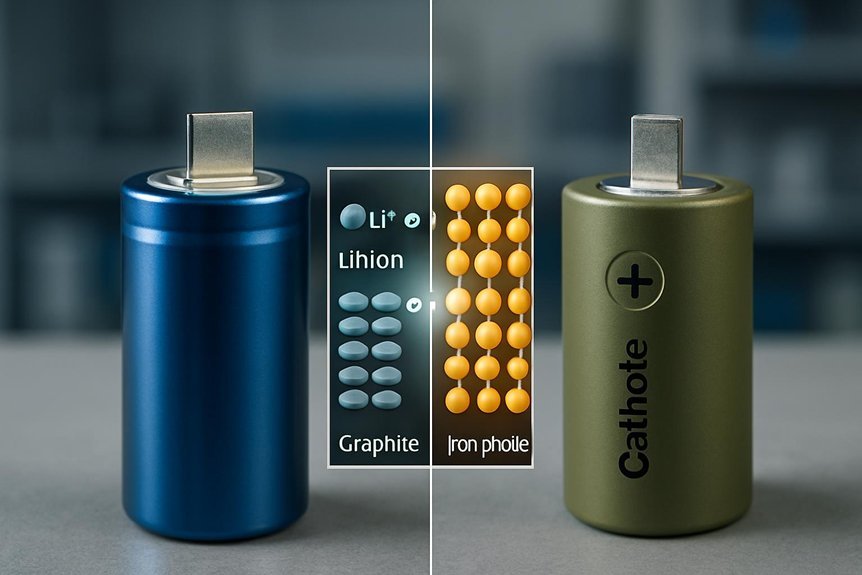
We compare the electrochemical mechanisms, contrast cathode materials profiles, and examine the roles of anodes and electrolytes to map how Li-ion and LiFePO4 chemistries differ in operation. By aligning these elements, we can assess performance implications, safety considerations, and longevity under real-world usage. This framing sets up a precise discussion of the core chemistry across the specified points.
Electrochemical Mechanisms Compared
Here’s how the two chemistries differ at the core: Li-ion cells use intercalation reactions with a graphite anode and a metal oxide cathode, while LiFePO4 cells employ olivine-structured LiFePO4 as the cathode and also rely on intercalation. Both systems shuttle Li+ ions between electrodes during charge and discharge, but their reaction potentials, diffusion kinetics, and structural tolerances diverge. In Li-ion, the layered oxide cathode enables higher energy density but can couple with complex side reactions at high voltage. LiFePO4 offers robust thermal stability and slower, more uniform diffusion, reducing overpotential under load. Bandgap and electronic conductivity differences require respective electrolyte and separator optimizations. Irrelevant topic, random exploration, aside from performance implications, we emphasize mechanism-driven design choices that influence efficiency and longevity.
Cathode Materials Profiles
What distinguishes the cathodes in Li-ion and LiFePO4 cells starts with structure and chemistry: layered transition-metal oxides for Li-ion versus olivine LiFePO4 for the LiFePO4 system. We, however, focus on material profiles rather than cell-level performance. In Li-ion cathodes, transition-metal layers enable high specific capacity and voltage, with ion diffusion in planes and phase transitions that influence stability and cycle life. LiFePO4 delivers lower voltage but remarkable structural stability due to the olivine framework, reducing lattice strain during (de)lithiation. Cathode material differences drive kinetics, energy density, and thermal behavior, affecting safety margins. Safety mechanism contrasts arise from oxygen release tendencies and redox stability, with LiFePO4 generally safer under abuse. Together, these profiles define operating envelopes and failure modes for each chemistry.
Anode and Electrolyte Roles
How do anode materials and electrolytes together shape ion transport and cell stability in Li-ion versus LiFePO4 systems? We, as analysts, compare how choice of anode materials and electrolyte roles governs kinetics, safety, and cycle life in each chemistry. In Li-ion, graphite anodes enable low potential and high capacity, while electrolyte salts and solvents promote fast Li+ transport but demand SEI stability. In LiFePO4, high-rate phosphate hosts stabilize structure but limit anode capacity; electrolyte roles shift toward robust SEI and thermal tolerance. The interplay determines impedance growth, diffusion paths, and thermal behavior across temperatures.
1) Anode materials influence voltage hysteresis, SEI formation, and compatibility with solvents.
2) Electrolyte roles center on ionic conductivity, chemical stability, and SEI composition.
3) Interfacial chemistry governs long-term cyclability.
4) System safety hinges on stable ion transport and minimal dendrite formation.
Safety Profiles: Thermal Stability and Risks
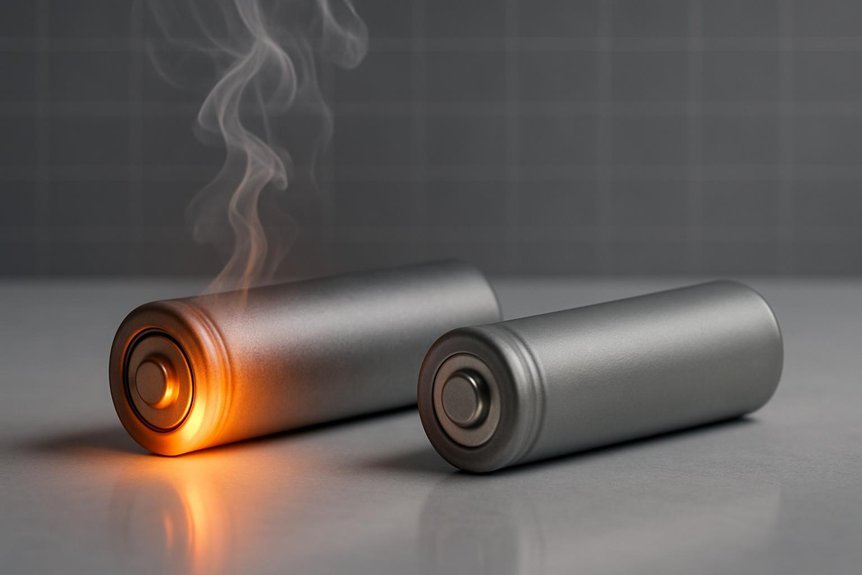
Thermal stability is a core differentiator between lithium-ion (Li-ion) and LiFePO4 batteries, affecting how each chemistry behaves under abuse, charging, and aging. We assess safety profiles by comparing intrinsic thermal properties, reaction pathways, and failure modes. Li-ion cells typically exhibit sharper exothermic responses under overcharge or mechanical damage, increasing risk of thermal runaway if cooling or protections fail. LiFePO4 chemistry offers higher thermal stability and lower peak temperatures, reducing runaway probability but not eliminating risks. Our analysis emphasizes mitigations: robust cell design, reliable BMS protections, appropriate charging, and effective thermal management. We quantify risk via temperature-rise thresholds and venting behavior, guiding safe operating envelopes. Understanding these dynamics enables informed choices for safety-critical applications without overestimating benefits or hazards.
Real-World Durability: Cycle Life and Longevity
Real-world durability for Li-ion and LiFePO4 batteries hinges on cycle life and longevity under practical usage patterns. We examine how these chemistries withstand repeated charge-discharge cycles and calendar aging, informing durability comparisons and reliability expectations.
- Cycle fatigue manifests differently: LiFePO4 typically shows steadier capacity retention over many cycles, while Li-ion can exhibit more pronounced degradation under high-stress profiles.
- Temperature and depth of discharge drive longevity, with moderate DOD and cooler operation favoring longer life for both chemistries.
- Calendar aging contributes beyond cycles, emphasizing stable chemistry and electrolyte integrity as durability determinants.
- Real-world performance combines aging mechanisms, calendar and cycle effects, and usage patterns into overall longevity projections.
Density, Weight, and Form Factor: What It Means for Your Device
We evaluate how density impacts capacity, noting that higher energy density often enables more usable energy in the same volume. We also assess weight, recognizing that lighter packs improve portability and reduce device strain without sacrificing performance. Finally, we consider form factor compatibility, ensuring the battery fits and interfaces correctly within the device’s enclosure and thermal design.
Density Impacts Capacity
Density determines how much energy a cell can store per unit weight or volume, so heavier or denser chemistries don’t always deliver longer runtimes in the same form factor. We assess how density translates to practical capacity, noting that higher energy density can improve runtime without changing size, yet may alter thermal and cycle performance. Our goal is to quantify how chemistry choice reshapes usable capacity under real-world constraints.
- Density dynamics: higher gravimetric energy can enable longer runtimes, but effects depend on thermal management and voltage windows.
- Volume density: volumetric energy affects pack footprint, influencing device enclosure and cooling needs.
- Capacity tradeoffs: higher density often accompanies reduced cycle life or higher price.
- System-level impact: overall energy delivery hinges on pack design, BMS, and operating temps.
Weight Affects Portability
Weight directly shapes how portable a device feels and how it’s carried in daily use. We compare Li-ion and LiFePO4 on mass, energy density, and overall form factor to quantify portability tradeoffs. In practical terms, lighter packs reduce user fatigue and enable slimmer enclosures, but often at the expense of energy capacity or thermal margins. LiFePO4’s lower energy density can be offset by larger cells or higher cell counts, altering weight impact relative to runtime. Conversely, Li-ion chemistries offer higher gravimetric density, enabling lighter batteries for the same energy target, yet may require enhanced cooling and structural support. Our assessment isolates mass as a design constraint, highlighting how component placement, housing rigidity, and connector mass influence handheld balance and device weight budgets.
Form Factor Compatibility
Could size and mass really determine battery compatibility across devices? We approach form factor compatibility with a precise lens, comparing density, weight, and physical envelope. We consider how form factor gaps influence integration, thermal paths, and connector alignment, reducing interchangeability between chemistries. Our analysis debunks charging myths tied to size alone, focusing on how module dimensions interact with device enclosures and cooling.
- Density differences affect energy per volume and thus pack fitting without resizing hardware
- Weight impacts mechanical loading, mounting schemes, and user-feel perceptions
- Form factor tolerances govern bay fit, venting, and electrical clearances
- System-level constraints, including thermal management and connector geometry, drive compatibility decisions
Total Cost of Ownership: Upfront vs Long-Term Value
At a glance, the total cost of ownership (TCO) for lithium-ion and LiFePO4 systems hinges on the balance between upfront expenditures and long-term value delivered through cycle life, reliability, and maintenance. We evaluate upfront costs, capital depreciation, and replacement frequency against long term savings from higher cycle counts, reduced service intervals, and lower thermal management demands. LiFePO4 typically offers longer cycle life and greater stability under abuse, lowering replacement and maintenance costs, while lithium-ion variants may incur higher degradation-related expenses in demanding duty cycles. Our assessment emphasizes lifespan-adjusted expenses, warranty terms, and system integration costs. By comparing total spend over equivalent service horizons, we identify scenarios where upfront investments yield superior long-term savings, clarifying the cost-benefit landscape for informed technology selection.
Charging Practices by Chemistry: How to Charge Li-Ion and LiFePO4
Charging practices differ meaningfully between Li-ion and LiFePO4 chemistries, and understanding these nuances helps optimize safety, efficiency, and lifecycle costs. We outline practical charging patterns, focusing on chemistry-specific constraints, measurement accuracy, and failure modes, not marketing claims. We address common charging myths and safety myths with precise guidance.
- Li-ion: use charger that delivers constant-current until a set voltage, then taper to cutoff; monitor temperature to prevent thermal runaway.
- LiFePO4: tolerate higher C-rates modestly but prefer gentler charging to extend cycle life; avoid overvoltage and high-temperature conditions.
- Temperature matters: colder cells require longer CC phase; hot packs demand cooldown periods before high-rate charging.
- Verification: balance rarely needed for LiFePO4, while Li-ion packs benefit from periodic cell balancing to prevent capacity loss.
Best Use Cases: When to Pick Li-Ion or LiFePO4
When choosing between Li-Ion and LiFePO4, the dominant criterion is how you value energy density versus cycle life, safety margins, and total cost of ownership. We guide readers toward practical use cases by weighing performance metrics, operating temperature tolerance, and installation footprint. Li-Ion suits high-energy needs with compact packaging, while LiFePO4 offers robust safety margins and longer cycle life in stationary storage and harsh environments. In fleet and grid-adjacent applications, we weigh battery economics and total cost of ownership, not just upfront price. Manufacturing scale influences availability and price stability for both chemistries. The table below summarizes recommended contexts by use case, emphasizing lifecycle cost, safety margins, and system integration considerations.
| Use Case | Recommended Chemistry |
|---|---|
| Portable devices | Li-Ion |
| Renewable energy storage | LiFePO4 |
| Electric buses | LiFePO4 |
| UPS backup | LiFePO4 |
| High-energy drones | Li-Ion |
How to Decide: A Simple Framework for Your Project
We’ve compared Li-Ion and LiFePO4 across metrics like energy density, cycle life, safety margins, and total cost of ownership; now we apply a simple framework to decide which chemistry fits your project. We present a four-step decision model that emphasizes measurable constraints, risk factors, and lifecycle economics, avoiding an unrelated comparison that confuses objectives. Our framework accounts for manufacturing quirks and supply chain realities, ensuring alignment with production capabilities and quality targets.
1) Define critical requirements: energy density, power, and safety thresholds.
2) Quantify lifecycle costs: replacements, maintenance, and end-of-life handling.
3) Assess manufacturing constraints: processes, tooling, and scrap rates.
4) Make a decision tied to risk-adjusted total cost of ownership, with a documented rationale.
Frequently Asked Questions
How Do Li-Ion and Lifepo4 Differ in Voltage Profiles?
We differ in voltage profiles: Li-ion cells show higher nominal voltage and flatter regions, while LiFePO4 offers steadier voltage but lower peak; volatility varies with state, affecting voltage stability and thermal sensitivity under load and temperature changes.
Which Chemistry Handles Deep Discharge Better and Why?
Answering: LiFePO4 handles deep discharge better due to its chemistry and voltage plateau, preserving cycle life; Li-ion fares worse under deep discharge, but offers higher energy. We, however, prefer LiFePO4 for thermal stability and durability.
What Are Charging Efficiency Differences Between Chemistries?
We see charging efficiency differs: Li-ion typically delivers slightly higher efficiency at moderate rates, while LiFePO4 shows steadier efficiency with lower voltage swing; voltage profiles matter, impacting losses and overall system cooling, charging losses, and cycle optimization for each chemistry.
How Do Temperature Effects Vary Between Li-Ion and Lifepo4?
Beneath the surface, temperature sensitivity differs: Li-ion shows sharper performance shifts with heat, LiFePO4 remains steadier. We note safety considerations rise with temperature, while lower temps degrade both; we optimize ranges to maintain reliability and longevity.
Which Chemistry Has a Longer Calendar Life?
LiFePO4 cells have the longer calendar life longevity, offering superior storage stability. We observe slower capacity fade over years, enhancing reliability for long-term storage and calendar aging comparisons, whereas Li-ion often degrades more quickly under similar conditions.
Conclusion
We conclude, continuing clear contrasts: Li-Ion offers higher energy, hasty heat, and compact charisma, while LiFePO4 favors fierce safety, steady stamina, and longer life. For finer fault tolerance, we favor LiFePO4; for familiarly fierce performance, we favor Li-Ion. We weigh watt-hours, weight, and cost, then tailor tolerance to temperature, charging, and use-case. In short, select cycles, safety, and scenario first, then select chemistry with confidence and clarity.