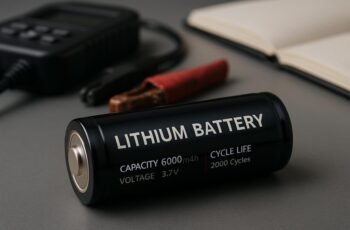
We understand high-capacity lithium batteries promise more energy per kilogram, but real-world performance depends on cooling, charging profiles, ambient conditions, and duty cycles. We’ll compare capacity, energy density, and weight implications alongside cycle life, impedance growth, and calendar aging. Safety, chemistry choices, and form factor matter as much as raw specs. We’ll outline how to evaluate tests, cost of ownership, and warranties, then pose the concrete questions you should push on manufacturers before you commit.
Key Takeaways
- Real-world performance depends on thermal management, charging profiles, ambient temperature, and usage patterns, not just raw capacity.
- Assess cycle life by full-depth-of-discharge cycles at specified temps and currents, separating calendar loss from wear.
- Total cost of ownership combines upfront price, cost per kWh, and expected pack life, with independent testing preferred.
- Higher capacity boosts usable energy but requires efficient packaging, cooling, and safety margins to maximize range.
- Choose chemistry and form factor to match duty cycle and infrastructure, balancing safety, cost, and longevity.
What High-Capacity Batteries Deliver in Real Use
High-capacity lithium batteries deliver more energy per unit mass, but real-world performance depends on several interacting factors. We observe higher specific energy yet similar cycle life constraints compared with standard cells, so our expectations translate into usage patterns rather than theoretical limits. In practice, you’ll see gains when drives, cycles, or duty cycles align with the cell’s heat tolerance and charging profile. Real world durability hinges on thermal management, charge/discharge rates, and ambient conditions, not just nominal capacity. Manufacturing variability introduces small yet measurable differences between units, affecting voltage behavior, impedance growth, and cycle-to-cycle reliability. We quantify performance through controlled tests and field data, emphasizing repeatable results, consistent safety margins, and predictable degradation trajectories across a representative sample.
Capacity, Energy Density, and Weight: How They Shape Performance
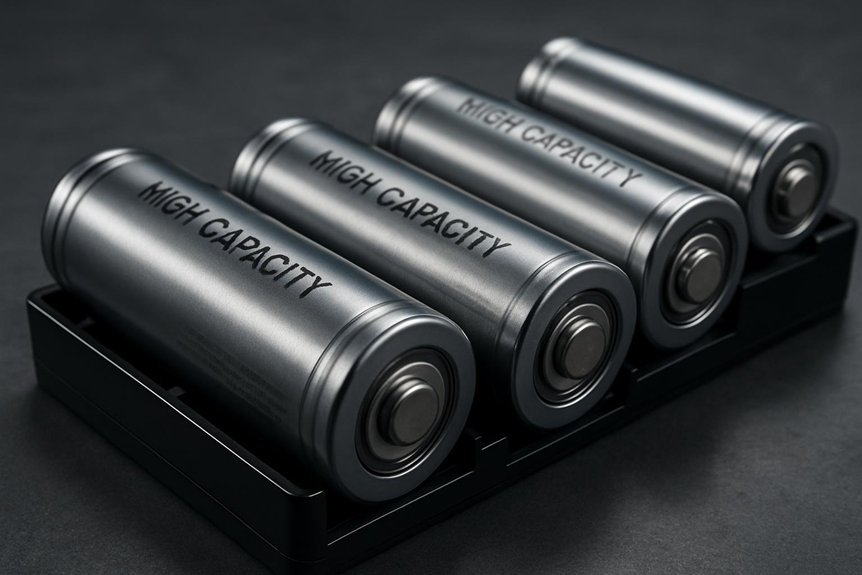
We’ll start by tying capacity to range, so you can see how more kilowatt-hours translate into more usable distance. Energy density directly affects how much energy a cell or pack holds per mass or volume, shaping efficiency and packaging choices. Weight and its tradeoffs influence vehicle dynamics and cost, guiding us to balance performance goals with practical constraints.
Capacity Impacts Range
What exactly determines an EV’s range if capacity, energy density, and weight change from cell to pack? We respond that range hinges on usable capacity, pack efficiency, and ancillary losses. Higher capacity increases available energy, but energy density and weight influence energy per kilometer and traction losses. Energy density boosts energy storage per mass, aiding efficiency, yet real-world pack design, thermal management, and safety margins modulate gains. Weight adds inertial demand, affecting acceleration and drag-related losses. To visualize, consider the table below.
| Cell/Module | Impact on Range |
|---|---|
| Capacity (Ah) | Direct energy reservoir |
| Weight (kg) | Influences efficiency |
| Energy density (Wh/kg) | Affects usable energy per mass |
Key terms: battery safety, thermal management.
Energy Density Consequences
Energy density sits at the core of performance because it ties energy storage to vehicle efficiency. We quantify energy density as the energy per unit mass or volume, linking capacity to range and acceleration. Higher energy density improves miles per charge, but it also shifts thermal management needs and safety considerations. We compare cells, modules, and packs to reveal how energy density directly affects usable capacity after losses and parasitic loads. Weight implications become a primary design constraint: heavier packs demand more structural support, impact suspension tuning, and alter rolling resistance. Our data show that incremental increases in energy density yield diminishing returns if cooling, packaging, or safety systems scale proportionally. We emphasize evaluating energy density alongside thermal performance and real-world drive cycles for accurate range projections.
Weight and Performance Tradeoffs
How do capacity, energy density, and weight together shape performance? We quantify tradeoffs by pairing capacities with specific energy and mass, then assessing system-level impact on range, cycle life, and form factor. Higher capacity often raises energy density, yet adds weight that diminishes acceleration and efficiency. In practice, we trade energy density for usable capacity to meet mission profiles, balancing peak power, voltage stability, and thermal margins. Charging efficiency tends to improve with optimized cell chemistry but can incur higher heat generation at high load, stressing thermal management. We measure tradeoffs through metrics like energy per kilogram, specific power, and cycle durability under representative duty cycles. Selecting a battery requires aligning weight-sensitive performance goals with acceptable heat generation and charging efficiency to optimize total system performance.
Safety First: Thermal Management and Protection Features
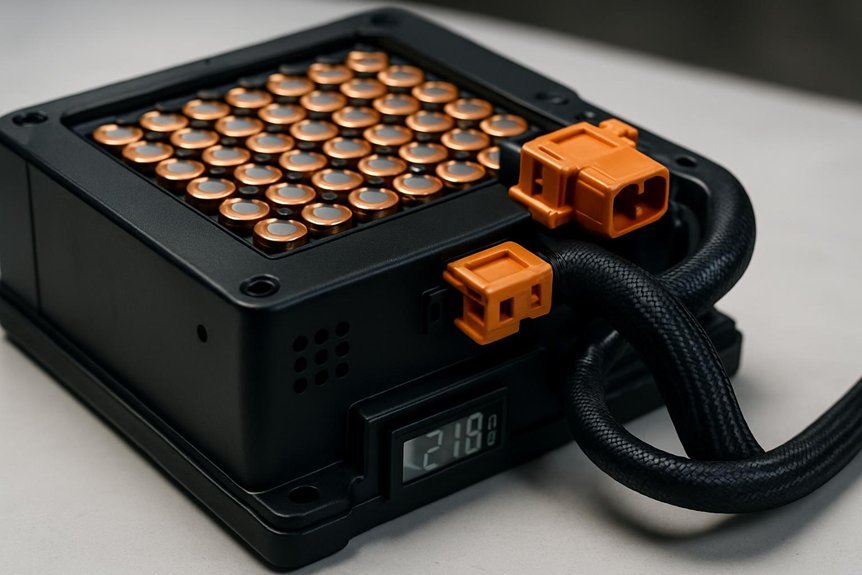
We start by outlining Thermal Management Essentials and Protective Features Overview to set the framework for safe high-capacity cells. We’ll present the core data on heat generation, dissipation paths, and thermal thresholds, and show how protection features respond in real-world scenarios. This is a precision-driven view that connects thermal design to safety outcomes and system reliability.
Thermal Management Essentials
Thermal management is critical for safety and longevity in high-capacity lithium batteries; without proper control, heat generation can exceed what the pack can safely dissipate, triggering thermal runaway or accelerated degradation. We rely on data-driven strategies to quantify heat: active cooling, passive conduction, and phase-change materials. Thermal modeling guides design choices, predicting hotspots and informing cooling capacity. We also address materials aging, where corrosion prevention reduces impedance growth and graft failure risks under temperature cycling. Our approach balances performance, safety margins, and lifecycle costs, using measurable targets for temperature uniformity and rate limits. Implemented controls must respond rapidly to sensor feedback, preventing runaway scenarios and sustaining uniform aging.
- Clear temperature targets and rapid-response cooling
- Accurate thermal modeling to preempt failures
- Proactive corrosion prevention with monitored aging
Protective Features Overview
Protective features complement our thermal strategy by combining sensors, controls, and design safeguards that detect anomalies, limit risk, and preserve pack health. We implement active thermal protection to trigger shutdowns or derating when temperatures exceed thresholds, backed by data from embedded thermistors and on-pack monitoring. Our systems use current and voltage telemetry to flag overcharge, overdischarge, or short-circuit conditions, then execute rapid isolation or cooling as needed. Battery packs incorporate pressure vents and PTC devices to mitigate gas buildup and thermal runaway risk. Redundant safety logic, watchdog timers, and secure fault logging ensure traceability and rapid diagnostics. In practice, these protective features minimize heat exposure, extend cycle life, and support safe, predictable performance under diverse operating conditions.
Choosing Chemistry for Your Application: LFP, NMC/NCA, and Beyond
Choosing the right chemistry hinges on how you balance energy density, safety, cost, and lifecycle. We guide you through LFP, NMC/NCA, and beyond to match your application, from consumer lithium devices to grid-scale storage. We weigh specific energy, thermal risk, supplier stability, and end-of-life costs to define practical tradeoffs. LFP offers safety and longevity with lower energy density; NMC/NCA delivers higher energy per kilogram for extended range or throughput. Emerging chemistries promise improved cycle life and lighter packs, but bring supply and validation considerations. Our approach aligns performance targets with real-world operating conditions, not just lab labels. Priorities differ by usage profile, duty cycle, and infrastructure readiness, shaping the best battery chemistry for your needs.
- Emphasized reliability and lifecycle economics
- Targeted energy density vs. thermal management
- Clear alignment with consumer lithium expectations
How to Compare Cells: Capacity, Cycle Life, Degradation, and Cost
To compare cells effectively, we start from the metrics that matter for real-world use: capacity, cycle life, degradation, and cost. We frame capacity comparison by usable energy per cell at the operating voltage window, then normalize for pack configuration. Cycle life is evaluated through the number of full-depth-of-discharge cycles under specified temperature and current, not just nominal counts. Degradation tracks capacity fade and impedance growth over time, isolating calendar loss from usage-driven wear. Cost assessment combines up-front price, cost per kilowatt-hour, and total cost of ownership across the expected life. We prefer transparent test methods and independent data when possible, avoiding optimistic vendor claims. Together, these factors guide selections aligned with durability, efficiency, and budget, emphasizing realistic performance over peak specs, with emphasis on practical capacity comparison and sustained cycle life.
Charging Habits and Cycling for Longevity
How should you charge and cycle batteries to maximize longevity? We examine how charging habits and cycling impact life, using data-driven benchmarks for high-capacity cells. We focus on charge cycles, depth of discharge, and temperature effects, optimizing for minimal degradation. Operating within manufacturer-recommended voltages and avoiding sustained high current reduces parasitic reactions and capacity fade. Ambient temperature directly influences impedance rise and coulombic efficiency, so we favor moderate environments and avoid charging at extremes. Our approach balances accessibility with durability, tracking cycle counts and remaining capacity to predict end-of-life timelines.
- We prioritize stable ambient temperature and gentle charging profiles to protect long-term health.
- We monitor charge cycles and recommend staying away from shallow or deeply excessive discharges.
- We document consistent usage patterns to sustain predictable performance and longevity.
Picking Form Factor and Protections for EVs vs. Gadgets
When sizing the form factor and protections, we match battery chemistry and expected duty cycles to the device’s use case, drawing on our prior findings about longevity under constrained temperatures and charging profiles. For EVs, we prioritize robust protection mechanisms and scalable form factors that tolerate high current draw, thermal rise, and vibration. Gadgets demand compact form factors and lightweight protection schemes, focusing on ultrafast charging resilience and lower energy loss. Tradeoffs appear in pack density, cooling needs, and safety margins, quantified by C-rates, thermal impedance, and cycle life projections. Below is a compact comparison.
| Parameter | EV-focused | Gadget-focused | Notes |
|---|---|---|---|
| Form factor | Large, modular | Small, integrated | Tradeoffs in density |
| Protection mechanisms | Active BMS, fault isolation | Simplified BMS, fuse-based | Safety vs. size |
| Cooling method | Liquid/air, elaborate | Passive/compact | Thermal management |
| Target life | >8–10 years | 3–5 years | Lifecycle expectations |
A Practical Decision Framework: Questions to Ask Manufacturers and Retailers
Before engaging suppliers, we must agree on a concise decision framework that surfaces critical data, tests assumptions, and flags risk early. We guide buyers to ask focused questions that reveal cost tradeoffs, reliability, and provenance, then map findings to the supply chain implications. We evaluate batch consistency, safety certifications, warranties, and service levels, prioritizing verifiable metrics over assurances. Price alone tells only part of the story; we quantify total cost of ownership, potential recalls, and upgrade paths. We seek transparent data on manufacturing controls, facility scalability, and backlog management. We also validate logistics, lead times, and after-sales support to minimize disruption.
- Clear cost tradeoffs documented with data and scenarios
- Transparent supply chain visibility and contingency plans
- Quantified risk signals and response playbooks
Frequently Asked Questions
How Do Manufacturing Provenance and Supply Chains Affect Battery Reliability?
We believe manufacturing provenance and supply chain reliability directly affect battery reliability, revealing material quality and process consistency. We monitor provenance data and diversify sources to reduce disruptions, ensuring traceability, performing rigorous QC, and sustaining performance across batches.
What Are Real-World Degradation Differences Between New vs. Refurbished Packs?
We’ve seen newpack reliability far surpass refurbished risk, but real-world data show only modest gaps: initial capacity loss is similar, while cycle life differs 10–25%. We consistently test, compare, and optimize for our readers.
How Do Environmental Conditions Impact High-Capacity Battery Performance Long-Term?
We observe that environmental exposure and thermal cycling accelerate aging; long-term performance declines correlate with repeated temperature swings and moisture ingress, reducing capacity retention and increasing internal resistance. We quantify effects via controlled tests and duty-cycle modeling for reliability.
Can Warranties Cover Fast-Charging-Induced Capacity Loss or Swelling?
Yes—we’ve seen warranties often exclude fast-charging degradation, but some cover it under warranty scope if defined limits are exceeded. We’ll quantify charging induced degradation risk and reference cycle-count data to clarify coverage for swelling.
What Impact Do BMS Features Have on Usable Capacity in Practice?
BMS features reduce usable capacity in practice by balancing cells, limiting voltage windows, and preventing over-discharge; we observe 5–15% typical loss, depending on chemistry and usage, so usable capacity declines despite nominal pack ratings.
Conclusion
We’ve seen that high-capacity cells promise more energy, but real-world performance rides on thermal management, charging regimes, and aging behavior. As you weigh capacity against cycle life, impedance drift, and total ownership costs, the stakes rise with every use case. Ask for transparent test data, insist on appropriate cooling, and demand clear warranties. The choice isn’t just specs—it’s reliability under your duty cycle. Choose with rigor, and your next decision will feel inevitable, not uncertain.