When comparing LiFePO4 and lithium-ion batteries, it’s crucial to understand their fundamental differences in chemistry, safety, and performance. These distinctions influence their suitability for various applications, from energy storage to portable devices. As we examine their characteristics, you’ll see that selecting the right type involves evaluating multiple factors, each impacting long-term efficiency and safety. Exploring these nuances can help clarify which battery aligns best with your specific needs.
Key Takeaways
- LiFePO4 batteries have higher thermal stability and safety, reducing fire risks compared to lithium-ion batteries.
- Lithium-ion batteries offer higher energy density, making them suitable for portable electronics and high-capacity applications.
- LiFePO4 features a longer cycle life and better thermal management, ideal for renewable energy storage and electric vehicles.
- Manufacturing processes differ, with LiFePO4 emphasizing safety and durability, while lithium-ion focuses on maximizing energy density.
- LiFePO4 has a smaller environmental footprint and is easier to recycle due to its stable, non-toxic chemistry.
What Are LiFePO4 and Lithium-Ion Batteries? An Overview
LiFePO4 (Lithium Iron Phosphate) and lithium-ion batteries are two prevalent types of rechargeable batteries used in various applications, from electric vehicles to stationary energy storage. Their distinct battery aesthetic results from differing manufacturing processes, which influence cell design and internal structure. LiFePO4 batteries typically feature a more robust, thermally stable chemistry, leading to a different visual and structural appearance compared to lithium-ion variants, which often prioritize higher energy density. Manufacturing processes for each involve precise electrode fabrication and electrolyte integration, but LiFePO4’s cathode material demands specific handling to optimize safety and longevity. These manufacturing differences impact not only performance but also the overall aesthetic and durability of the batteries, making them suitable for different use cases based on structural and visual considerations.
How Do LiFePO4 and Lithium-Ion Batteries Differ in Chemistry and Design
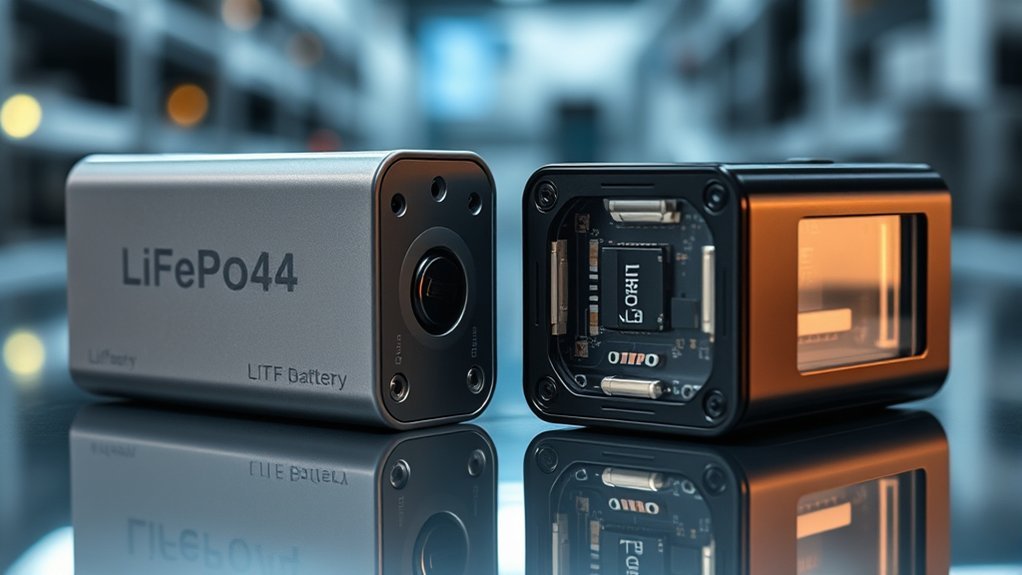
While both battery types are rechargeable, their underlying chemistries and cell designs differ considerably, impacting performance, safety, and longevity. Lithium Iron Phosphate (LiFePO4) batteries utilize a cathode composed of lithium iron phosphate, offering a stable chemical structure that enhances thermal stability and cycle life. In contrast, lithium-ion batteries typically employ layered transition metal oxides, which allow higher energy density but pose greater safety risks. These fundamental differences influence battery manufacturing processes, with LiFePO4 requiring specific electrode materials and manufacturing controls to guarantee safety and longevity. Market availability also varies; LiFePO4 cells are produced with a focus on durability and safety, making them prevalent in industrial and renewable energy applications, whereas lithium-ion batteries dominate portable electronics due to their higher energy density.
Comparing Safety: Which Battery Is Safer for Your Application?
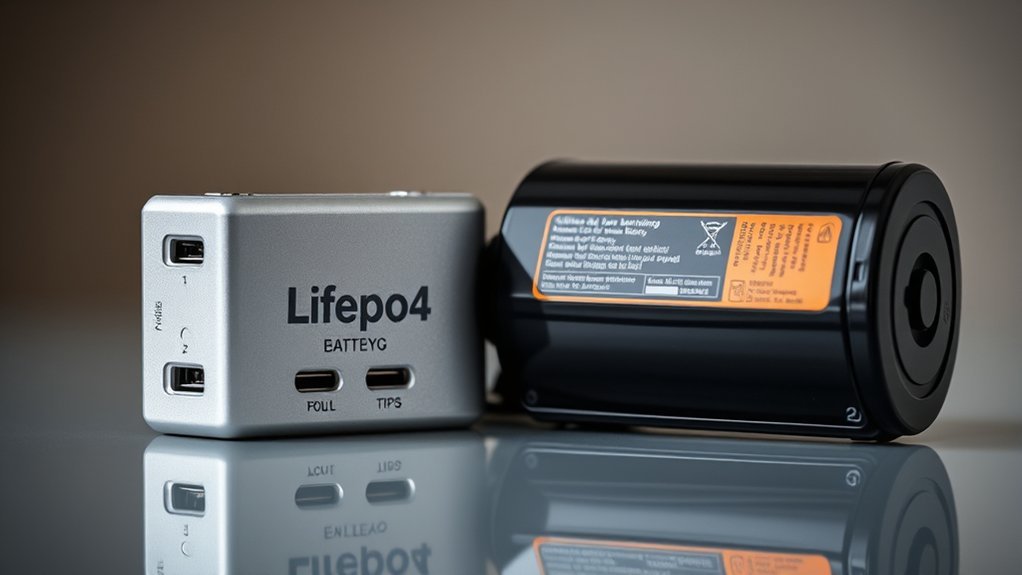
When evaluating safety, we consider thermal stability, which directly impacts the risk of fire or thermal runaway in each battery type. LiFePO4 batteries generally exhibit higher thermal stability, reducing safety concerns during operation and handling. Understanding these differences helps determine the appropriate choice based on application-specific safety requirements and handling precautions.
Thermal Stability Differences
Because thermal stability directly impacts safety, understanding the differences between LiFePO4 and lithium-ion batteries is essential for selecting the right power source. LiFePO4 batteries exhibit superior thermal stability due to their chemical composition, which results in lower thermal conductivity and reduced heat generation during operation. This translates into more efficient heat dissipation and less risk of thermal runaway. Lithium-ion batteries, conversely, have higher thermal conductivity, making them more prone to temperature fluctuations under stress, especially during rapid charging or heavy loads. Their relatively lower heat dissipation capacity increases the potential for localized overheating. Overall, LiFePO4’s enhanced thermal stability makes it a safer choice in applications requiring consistent heat management and minimized thermal risks.
Risk of Fire
The risk of fire is a critical safety consideration when choosing between LiFePO4 and lithium-ion batteries, as their chemical compositions and thermal properties markedly influence their propensity for thermal runaway. LiFePO4 batteries inherently possess greater thermal stability due to their stable cathode chemistry, reducing the likelihood of catastrophic failure. Conversely, lithium-ion batteries with cobalt or nickel-based chemistries are more susceptible to thermal runaway, increasing fire risk. Battery manufacturing quality and supply chain integrity substantially impact safety, as consistent production controls minimize defects that could trigger thermal events. A robust supply chain ensures reliable sourcing of high-quality components, further reducing fire hazards. Overall, LiFePO4 batteries present a safer profile for applications demanding higher safety margins, especially when supply chain reliability is maintained.
Handling Precautions
Handling precautions are essential in evaluating the overall safety of LiFePO4 and lithium-ion batteries, as proper management minimizes risks associated with misuse or accidental damage. From a technical perspective, these precautions depend heavily on battery manufacturing quality and adherence to safety standards. As market trends evolve, manufacturers emphasize robust insulation, secure connections, and thermal management systems.
- Avoid physical impacts or punctures that can compromise cell integrity, especially in lithium-ion batteries.
- Use appropriate chargers and follow manufacturer-recommended charging protocols.
- Store batteries in cool, dry environments to prevent thermal runaway.
- Regularly inspect for damage or deformation, highlighting the importance of quality control in battery manufacturing processes.
These practices are critical for ensuring safe handling and maximizing battery lifespan across applications.
Assessing Performance: Capacity, Lifespan, and Charging Characteristics
When evaluating performance, understanding capacity retention over time is vital, as it directly impacts long-term usability. We also examine charging efficiency and cycle life, since these determine how effectively a battery sustains performance through repeated use. Analyzing these factors helps identify which battery type offers the most reliable and efficient operation for specific applications.
Capacity Retention Over Time
Although both LiFePO4 and lithium-ion batteries demonstrate high initial capacities, their ability to retain that capacity over time varies considerably. LiFePO4 batteries excel in battery durability, maintaining over 80% of capacity after 2000 cycles, thanks to their stable chemistry. Conversely, lithium-ion batteries typically experience a gradual decline, retaining around 70-80% after 500-1000 cycles, influenced by their higher energy density which accelerates capacity fade. Key distinctions include:
- Cycle Life: LiFePO4 outperforms lithium-ion in long-term capacity retention.
- Capacity Fade Rate: Lithium-ion batteries exhibit a faster decline due to thermal and chemical stresses.
- Temperature Stability: LiFePO4 maintains consistent performance over temperature variations.
- Impact on Battery Durability: These differences markedly affect overall lifespan and reliability in application.
Charging Efficiency and Cycles
Charging efficiency and cycle performance are critical factors in evaluating lithium-based batteries, as they directly influence overall lifespan and operational stability. Lithium Iron Phosphate (LiFePO4) batteries generally demonstrate higher charge retention efficiency due to their stable chemistry, which minimizes energy loss during charging cycles. Conversely, traditional lithium-ion batteries may experience greater energy fade over time, impacting cycle life. Battery manufacturing processes heavily influence these characteristics, with advanced techniques enhancing cycle durability and reducing degradation. Market trends reflect a growing preference for LiFePO4 in applications demanding longevity and safety, while lithium-ion batteries remain prevalent in consumer electronics. Understanding these differences enables better assessment of each battery type’s performance, capacity retention, and suitability for specific applications, emphasizing the importance of optimized manufacturing for improved charging efficiency and extended cycle life.
Cost and Value: Which Battery Type Offers Better Long-Term Investment?
Evaluating the long-term investment potential of Lifepo4 versus lithium-ion batteries requires a careful analysis of initial costs, lifespan, and overall value. From a technical standpoint, Lifepo4 batteries often have higher upfront costs due to advanced battery manufacturing and safety features. However, they tend to offer a longer lifecycle, reducing replacement frequency and total cost of ownership. Market trends indicate increasing adoption of Lifepo4 in utility-scale applications, which could influence pricing and availability. Conversely, lithium-ion batteries benefit from economies of scale, lowering initial costs but generally exhibit shorter cycle life. Consider these factors:
- Initial cost differences driven by battery manufacturing complexity
- Lifespan disparities impacting long-term savings
- Market trends favoring Lifepo4 for safety and durability
- Overall value considering replacement and performance metrics
Best Uses for LiFePO4 Batteries Versus Lithium-Ion Batteries
LiFePO4 batteries and lithium-ion batteries each serve distinct applications based on their technical attributes and performance profiles. LiFePO4’s stability, longer cycle life, and safety make them ideal for energy storage in renewable energy systems, electric vehicles, and grid storage. In contrast, lithium-ion batteries excel in portable electronics and consumer gadgets requiring high energy density. From a manufacturing perspective, LiFePO4 batteries involve simpler manufacturing processes with less thermal management, which enhances sustainability through easier battery recycling. Lithium-ion batteries, however, often contain materials like cobalt that complicate recycling and raise environmental concerns. These differences influence their best use cases, with LiFePO4 favored where longevity and safety are paramount, and lithium-ion preferred for high energy density and compact applications.
How Do Charging and Maintenance Requirements Vary?
While both LiFePO4 and lithium-ion batteries require proper charging and maintenance protocols, their specific needs differ considerably due to their chemical and structural characteristics. LiFePO4 batteries exhibit greater thermal stability, reducing the risk of overcharging and enabling more flexible charging parameters. In contrast, lithium-ion batteries demand strict voltage control during charging to prevent capacity fade. Key differences include:
- LiFePO4 batteries tolerate deeper discharges with less impact on lifespan, influencing maintenance routines.
- Charging voltages are higher for lithium-ion batteries, necessitating precise chargers aligned with battery manufacturing standards.
- Market trends show increasing adoption of LiFePO4 for stationary storage, emphasizing durability and lower maintenance.
- Lithium-ion batteries require regular monitoring of electrolyte health, while LiFePO4’s chemical stability simplifies upkeep.
Understanding these distinctions is crucial for optimizing performance and aligning with evolving market demands.
Environmental Impact and Recycling Considerations for Both Batteries
Despite their technological advantages, both LiFePO4 and lithium-ion batteries present environmental challenges that must be addressed through responsible management and recycling practices. Recycling challenges stem from the complex chemistry and variety of materials used, complicating efficient recovery of valuable components. LiFePO4 batteries tend to have a smaller ecological footprint due to their non-toxic, stable chemistry and reduced reliance on cobalt and nickel. Conversely, lithium-ion batteries with high cobalt content pose greater environmental risks if improperly disposed of, contributing to soil and water contamination. Effective recycling strategies are essential to mitigate these impacts, reduce waste, and reclaim critical materials. Addressing these challenges not only minimizes ecological footprints but also promotes sustainable battery use in the growing energy storage landscape.
Which Battery Is Right for Your Needs? Factors to Consider
Choosing the right battery depends on evaluating specific performance requirements, environmental considerations, and cost factors. Key considerations include:
- Battery packaging — Lifepo4 batteries typically feature sturdy, thermally stable casing, suitable for demanding environments, while lithium-ion batteries often have more compact, lightweight packaging optimized for space.
- Manufacturing processes — Lifepo4’s manufacturing involves stable, scalable processes resulting in longer cycle life; lithium-ion production emphasizes higher energy density but can be more complex.
- Performance needs — High power output and fast charging favor lithium-ion, whereas Lifepo4 excels in longevity and safety.
- Cost implications — Manufacturing efficiencies influence initial costs, with Lifepo4 often being more economical over time due to durability, despite higher initial investment.
Frequently Asked Questions
How Do Temperature Ranges Affect Lifepo4 and Lithium-Ion Battery Performance?
Temperature ranges critically impact battery performance; Lifepo4 offers superior thermal stability within broader operating limits, reducing risk of thermal runaway, unlike lithium-ion batteries, which require strict temperature control for ideal performance and safety.
Are There Notable Differences in Weight and Size Between These Batteries?
Battery capacity and charging speed influence size and weight; Lifepo4 batteries are typically 20% heavier but more compact, affecting performance. These differences impact design choices, emphasizing the importance of optimizing size for specific applications.
Which Battery Type Is More Resistant to Overcharging and Deep Discharges?
We find that Lifepo4 batteries excel in overcharge resilience and deep discharge tolerance, making them more reliable under extreme conditions. Lithium-ion batteries are less resistant, risking damage or safety issues with overcharging or deep discharges.
How Do Warranty Periods Typically Compare for Lifepo4 and Lithium-Ion Batteries?
Like a marathon runner, warranty periods for Lifepo4 batteries generally last longer than lithium-ion, often 8-10 years, compared to 2-5 years. This impacts overall cost comparison, as longer battery lifespan reduces replacement frequency and expenses.
What Are the Differences in Recycling Processes for These Battery Types?
We find that LiFePO4 batteries present fewer recycling challenges due to their stable chemistry, extending battery lifespan and facilitating safer, more environmentally friendly recycling processes, whereas lithium-ion batteries involve complex procedures due to hazardous materials and varied chemistries.
Conclusion
By understanding the nuances between LiFePO4 and lithium-ion batteries, we can make informed choices akin to selecting the right tool for a complex task. Just as a seasoned engineer weighs safety, capacity, and cost, we must consider our specific needs—whether for durability or portability. Ultimately, choosing the best battery mirrors steering through a labyrinth; knowledge guides us to the exit, ensuring safety, efficiency, and long-term value.