We’ll absolutely maximize your system’s resilience, planning for 12 months of energy, a 20–30% weather or outage buffer, and 90–95% DoD to balance usable capacity with longevity. We’ll size inverters for peak load plus headroom, favor higher voltage buses, and ensure solid protection, monitoring, and BMS compatibility. If you’re aiming for a mixed grid-tied, off-grid, or hybrid setup, we’ll map thorough load profiles and temperature-aware charging to keep ROI strong while guarding reliability—so let’s push forward together.
Key Takeaways
- Size capacity based on 12-month average daily use plus 20–30% buffer and target 10–15 kWh daily cycling, 20–30 kWh multi-day resilience.
- Choose 90–95% DOD to maximize usable energy while preserving cycle life; ensure scalable modules and warranty/monitoring alignment.
- Size inverters to peak load plus 20% headroom, favor high-voltage bus, assess efficiency and protection features; verify surge/backfeed specs.
- Favor NMC or LFP chemistries for safety and reliability; balance energy density, cycle life, and upfront cost for home vs business use.
- Monitor cycle efficiency, self-discharge, and degradation; maintain 20–35°C storage when idle, log temps, currents, and voltages for aging assessment.
Lithium Battery Storage: Size Your System for Home or Business
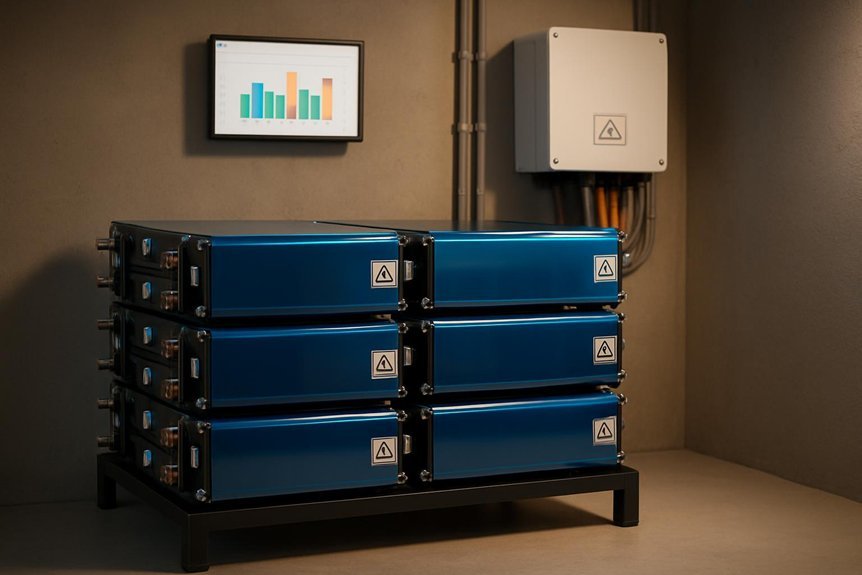
How big should your lithium battery storage be? We’ll guide you through practical home sizing for reliable power. We base size on daily energy use, peak load, and desired autonomy. Start with your 12-month average daily energy, then add a 20–30% buffer for weather or outages. For a typical home, target 10–15 kWh of usable capacity for daily cycling, or 20–30 kWh if you need several days of off grid resilience. Choose a lithium storage system with at least 90–95% DoD to maximize usable energy while preserving cycle life. Consider inverter efficiency, charging rates, and warranty terms that cover depth of discharge and cycle counts. Document your load profile and budget, then compare home sizing options against warranty terms and system monitoring capabilities. Ensure scalable modules for future growth.
How to Choose Inverters and Power Electronics
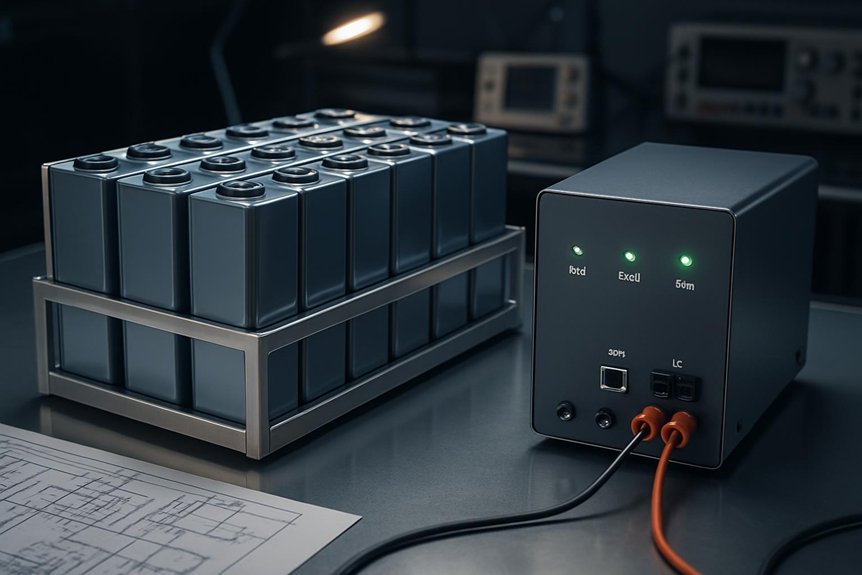
We start by sizing inverters to meet your peak load plus 20% headroom, and we’ll match this to battery voltage and efficiency targets to minimize losses. We’ll compare inverter efficiency curves, transformer vs. switch-mode options, and the impact of surge and backfeed ratings on system reliability. Finally, we’ll select power electronics with appropriate protections, monitoring, and compatibility with our battery chemistry and system controller.
Inverter Sizing Tips
What size inverter do you actually need, and how do you verify it? We’ll confirm inverter sizing by matching peak load plus margin to sustain cycle efficiency, then validate with load profiles and battery you’ll actually run.
- Picture a chart showing simultaneous appliances, peaks, and a 20% headroom buffer.
- Imagine a rating stick that only uses proven continuous and surge specs, not marketing labels.
- See our calculator translating watts and volt-amps into a real, usable DC-AC path with efficiency targets.
- Visualize testing during a typical day to ensure device duty cycles stay within cycle efficiency limits and avoid derates.
We’ll avoid overbuilding and keep results practical, predictable, and verifiable.
Power Electronics Selection
Power electronics selection hinges on matching inverter topology and components to your load profile and battery chemistry, with a focus on efficiency, protection, and reliability. We evaluate topology options (grid-t-tie, off-grid, hybrid) by peak load, surge, and DC-AC efficiency. We align switching frequency, dead-time, and MOSFET/IGBT ratings to lithium chemistries, targeting <5% round-trip losses and robust fault handling. We specify input impedance, DC bus voltage, and protection schemes (BMS signaling, isolation, anti-islanding). We quantify compatibility via power electronics synergy: higher voltage buses reduce current, cooler operation, and longer life. Table illustrates typical ranges.
| Parameter | Target Range | Notes |
|---|---|---|
| DC bus voltage | 400–800 V | Match battery stack |
| Inverter efficiency | >95% | At 50–80% load |
| Protection features | OC/SC, ZIP | Essential for safety |
Cycle Life, Depth of Discharge, and Longevity Explained

How do cycle life, depth of discharge (DOD), and longevity shape your battery’s performance and total cost? We quantify effects to guide decisions. Cycle life defines usable charge-discharge cycles before capacity falls below a threshold. Depth of discharge directly limits usable capacity per cycle; deeper DOD yields fewer practical cycles and earlier capacity fade. Longevity combines calendar life and cycle aging, influencing warranty, replacement intervals, and total cost of ownership. We balance these factors by choosing operating windows, charging strategies, and state-of-charge targets that maximize cycles at a given DOD.
Cycle life, DOD, and longevity drive cost and performance, guiding optimal SOC and charging strategies.
- Higher DOD reduces cycles but increases immediate usable energy, affecting ROI.
- Shallower cycling preserves cycle life and reduces degradation rate.
- Temperature and charging rate shift both cycle life and longevity.
- Regular SOC targets stabilize performance and predictability.
Compare Lithium Chemistries for Home vs. Business Use
When sizing home vs business storage, the chemistry choice drives energy density, safety, lifespan, and total cost. We compare lithium chemistries by capacity per cell, cycle stability, and thermal margins to match load profiles. For homes, NMC or LFP offer reliable safety margins; for businesses, higher energy density and longer cycle life may justify higher upfront costs. Storage targets differ: residential short bursts, commercial longer discharge windows. We quantify tradeoffs with simple metrics: energy density (Wh/kg), cycle life (C/L), and thermal runaway resistance. The table below captures representative values to guide decisions without overclaiming performance in real systems.
| Chemistry | Energy Density (Wh/kg) | Typical Cycle Life (cycles) |
|---|---|---|
| NMC | 150–200 | 2,000–4,000 |
| LFP | 90–160 | 3,000–7,000 |
| NMC-533/811 | 180–210 | 2,500–4,500 |
Charging Regimes and Daily Operating Windows
We’ll outline daily charging windows and optimal charge durations to minimize degradation and maximize usable capacity. In practice, we target charging to 80–90% during peak rate periods and limit full cycles to 2–3 per week, with top-ups spaced to maintain a 20–80% operating band. This sets clear, quantitative guidelines for how long to charge and when to run the battery at its healthiest pace.
Daily Charging Windows
Daily charging windows define when we allow a lithium‑ion battery to accept current each day, balancing availability, efficiency, and battery health. We set predictable intervals, monitor real‑time temperature, and cap current to preserve long‑term capacity. Our charging profile prioritizes steady, controlled input, minimizing stress during peak and trough periods. We quantify via target state of charge ranges and time windows, not guesses. Temperature effects guide our start times and ramp rates, ensuring safe operation across environments. We document deviations, then recalibrate.
- We align window start with ambient and cell temperature rise.
- We limit peak current to reduce thermal peaks.
- We schedule mid‑window checks for SOC drift.
- We adjust windows based on forecasted load and temps.
Optimal Charge Durations
Optimal charge durations define how long we allow charging within each daily window to balance cycle life and readiness. We target a per-window charge of 30–60 minutes for standard 3.2–3.6 C-rate ranges, avoiding extended top-offs that waste time and elevate stress. For our calendar, we prefer a partial-fill strategy: charge to 80% during the peak window and cap at 90% if high demand persists. We monitor state-of-charge drift and temperature, adjusting durations by ±5 minutes as needed. If ambient temps rise, shorten the window by 5–10 minutes to protect chemistry; if they fall, extend by a similar margin to maintain readiness. Avoid irrelevant topic, unrelated concept discussions; focus on precise timers, SOC targets, and safe thermal envelopes. Document exact start and end times for reproducibility.
Safety, Warranties, and Real-World Reliability
How safe are lithium-ion battery systems in real use, and what guarantees stand behind them? We present a practical view grounded in real-world data, emphasizing measurable safety and reliability. We address safety guidelines and warranty nuances with concrete expectations, not myths, so you can plan confidently.
- We track temperature, venting, and fault incidence to stay below risk thresholds, enabling predictable performance.
- We quantify cycle life and degradation curves, so warranty duration aligns with realistic capacity retention.
- We require certified components and third‑party testing to reduce latent failure probabilities.
- We document response times, replacement rates, and field failure modes to set transparent expectations.
Our approach is data‑driven, conservative, and cost‑aware, prioritizing durable operation and clear guarantees.
Estimate Total Cost of Ownership and ROI
What’s the true financial payoff of lithium‑ion storage when you factor upfront capex, operating costs, and revenue streams? We break down total cost of ownership (TCO) into capex amortization, maintenance, degradation, and insurance, then compare against revenue from avoided energy, demand charge reductions, and ancillary services. Capital cost per kilowatt-hour, inverter lifetime, and cycle life dominate TCO; we quantify in dollars per kWh cycled and per day of availability. Operating costs are modest but real, including cooling, replacements, and monitoring. ROI hinges on return timing: early-year savings compound toward payback, with longer-term benefits from higher round‑trip efficiency. A clear cost comparison shows whether the project meets internal hurdles, while sensitivity analyses reveal how depreciation, incentives, and price volatility shift ROI.
Backup Strategies: Grid-Tied vs. Off-Grid Resilience
Do you weigh grid-tied resilience against off-grid autonomy when reliability is non-negotiable? We compare options with clarity, focusing on backup viability and grid independence. Grid-tied systems maximize return by sharing excess power with the grid, reducing storage needs, and lowering upfront costs per kWh. Off-grid setups prioritize uninterrupted loads during failures, demanding larger storage buffers and robust inverters. Our guidance emphasizes quantitative metrics: discharge depth, state of charge targets, and cycle life under typical temperatures. Use hybrid configurations to balance both goals, optimizing both cost and resilience.
- Grid-tied: lightweight storage, high utilization, rapid recovery after outages.
- Off-grid: generous battery bank, autonomous operation, guaranteed loads.
- Hybrid: staged SOC targets, modular expansion, transparent metrics.
- Verification: simulate outages, track backup viability and grid independence over seasons.
Operating Thresholds: Temperature, Maintenance, Aging
Operating thresholds keep performance predictable: we set explicit temperature bands, maintenance cycles, and aging targets to protect capacity and extend cycle life. We define temperature thresholds for safe operation, typically 0–35°C, with charge limits above 30°C and storage at 20°C when idle. We target cyclic aging reductions by restricting depth of discharge and enforcing rest periods after high-rate events. Maintenance schedules specify battery checks, electrolyte or cell impedance tests, and connection inspections at fixed intervals, not ad hoc. We log voltages, currents, and temperatures in every cycle to verify stability against drift. We adjust thresholds if ambient conditions shift beyond design envelopes. Together, these controls keep performance predictable, minimize capacity fade, and maximize usable life while reducing unexpected failures.
Measuring Performance: Efficiency, Self-Discharge, Degradation Indicators
We’ll outline the key metrics for measuring performance: efficiency metrics, how self-discharge varies with temperature and state of charge, and the early signals of degradation. We’ll quantify targets (e.g., round-trip efficiency, monthly self-discharge rates, and capacity fading per cycle) and connect them to actionable tests. This starts our practical framework for interpreting performance data and guiding management decisions.
Efficiency Metrics Overview
In evaluating lithium-ion battery performance, we track three core metrics: efficiency, self-discharge, and degradation indicators. Our focus here is how we measure and apply cycle efficiency and the effects of thermal management on performance stability.
- Cycle efficiency is quantified as the ratio of discharge energy to charge energy over a defined cycle window, indicating energy retention per cycle.
- Self-discharge rate is monitored under controlled temperatures to separate parasitic losses from usable capacity.
- Degradation indicators include capacity fade, resistance rise, and impedance growth, informing end-of-life projections.
- Thermal management effectiveness directly influences all metrics by maintaining safe operating temperatures and minimizing efficiency losses.
Effective practices: baseline testing, repeatable conditioning, and data-driven adjustments to charging profiles.
Self-Discharge Influencers
How much do self-discharge drivers affect overall efficiency and degradation signals, and how do we measure them precisely? We quantify self discharge as a percentage of capacity loss per month at controlled temperature (25°C) and state of charge (SOC) targets, typically 0.05–0.3% per day for common Li-ion chemistries. We monitor offline gain or loss after short rest periods to isolate passive losses from load-induced effects. Influencers include electrolyte decomposition, SEI growth, and poor thermal management, each contributing distinct time constants observable in calendar aging tests. We express results as milliamps per cell or percent per month, normalizing to rated capacity. We standardize test durations, temperatures, and SOC windows to compare cells, formats, and manufacturers. Accurate reporting enables ranking, benchmarking, and informed system-level decisions.
Degradation Indicators Signals
What signals best indicate degradation—efficiency loss, self-discharge, and other degradation indicators—so we can diagnose and act early? We measure clear performance shifts, quantify capacity fade, and monitor energy efficiency versus baseline. We track self discharge influences by comparing overnight losses and calendar aging, then normalize to temperature and state of charge. Our focus is on actionable metrics, not guesswork.
- Capacity retention drop rate per cycle and per year
- Round-trip efficiency decline under controlled test conditions
- Self-discharge rate during rest periods relative to temperature
- Rate of impedance growth and internal resistance increase
Frequently Asked Questions
How Do Battery Recycling Programs Affect Long-Term Costs?
Recycling programs cut long-term costs by lowering disposal costs and improving recycling economics; we expect resale and material recovery to offset upfront processing, reducing total lifecycle expenses even as volumes grow.
What Are Hidden Maintenance Costs Not Covered Elsewhere?
We note hidden maintenance can add 5–15% of upfront costs, plus scheduled checks flagging hidden fees, annual calibration, and electrolyte loss. We estimate maintenance costs at $0.05–0.15 per watt-hour lifetime, translating to predictable, quantified budgeting.
Can Batteries Affect Home Electrical Insurance Requirements?
Batteries can affect home insurance requirements, and yes, we see tighter coverage when batteries are installed, tested quarterly, and vented properly. Our batteries insurance expectations quantify risk reductions, while home requirements demand compliant labeling, proper clearance, and documented maintenance intervals.
How Do Microgrid Reliability Standards Influence Sizing?
We start with a truth: microgrid reliability shapes sizing implications. We, as planners, quantify reserve margins, load, and duration, then size storage and generation to meet targets. We discuss numbers, constraints, and practical optimization with you.
What Are the Environmental Impacts of End-Of-Life Disposal?
We must address environmental impacts: end of life disposal releases toxic metals and greenhouse gases unless recycled; recycling reduces waste by up to 90%, recovers critical materials, and lowers overall environmental impacts through proper handling and processing.
Conclusion
We’ve lined up a practical, scalable path: prioritize high-DoD, 12-month planning, and a 20–30% weather/shutdown buffer, targeting 90–95% DoD for longevity. Size inverters for peak loads with headroom, favor higher voltage buses, and fuse in robust protection and BMS compatibility. Use mixed grid/off-grid/hybrid strategies, document loads, and keep charging temperature-aware (80–90% target, 20–80% band). Track cycle efficiency, self-discharge, and aging to maximize ROI and resilience—coincidence often reveals the best operating window.