Take a case where a 4-year-old RV LiFePO4 pack shows 90% of its original capacity under moderate use and proper cooling. We’ll unpack calendars vs cycles, how depth of discharge pins longevity, and why chemistry choices—LiFePO4 versus NMC—matter in real-world rigs. The factors we’ll examine aren’t just specs; they’re how your off-grid schedule and storage habits shape replacement timing. If we want durable performance, we need to connect aging signs to concrete actions, and that’s where this starts.
Key Takeaways
- Lifespan has two parts: calendar life (time-based aging) and cycle life (how many full charges/discharges before capacity drops).
- Temperature and depth of discharge most strongly influence aging, with heat accelerating degradation and higher DOD increasing strain.
- LiFePO4 favors safety and calendar stability; NMC offers higher energy density but tighter thermal management requirements.
- Aging indicators include capacity fade, rising resistance, and voltage sag under load; use data history to trigger proactive replacement.
- Practical tips: maintain steady charging, manage temperatures, run gradual multi-stage charging, and document cycles for early anomaly detection.
What “Lifespan” Really Means for RV Batteries

What does “lifespan” really mean for RV batteries? We define lifespan as the period over which a battery delivers a usable capacity within specified efficiency and safety limits under defined usage and environmental conditions. In practice, two metrics matter: cycle life and calendar life. Cycle life tracks full charge-discharge passes before capacity drops below a chosen threshold; calendar life accounts for self-discharge and degradation regardless of cycling. We evaluate performance against lifecycle myths that imply a single number, and we balance expectations with warranty realities that vary by manufacturer and chemistry. Our analysis focuses on how operating depth of discharge, charge strategy, and temperature influence longevity. Clear specifications and real-world data help prevent misinterpretation and guide informed replacement timing.
Calendar Aging vs. Cycle Life: What Shortens Each?
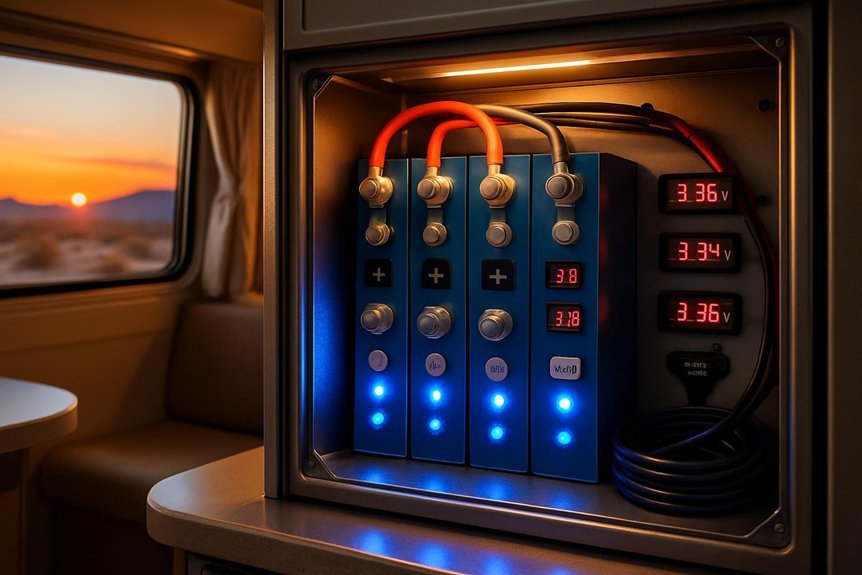
Calendar aging and cycle life are driven by distinct mechanisms, and recognizing their differences helps us pinpoint what actually shortens each. We, as engineers, see calendar aging dominated by electrolyte stability and cathode materials degradation over time, regardless of use. Residual calendar time accelerates loss of leftover capacity even at partial states of charge, especially if exposed to elevated temperatures or storage conditions that stress electrolytes. Cycle life, by contrast, hinges on repetitive intercalation and deintercalation, where electrode structural changes and SEI growth drive capacity fade per cycle. Leftover capacity after a long idle period matters for warranty clauses, yet actual field performance depends on sustained cycling. We monitor cathode materials chemistry and thermal management to minimize both calendar and cycle-related degradation.
Depth of Discharge and Battery Longevity on the Road
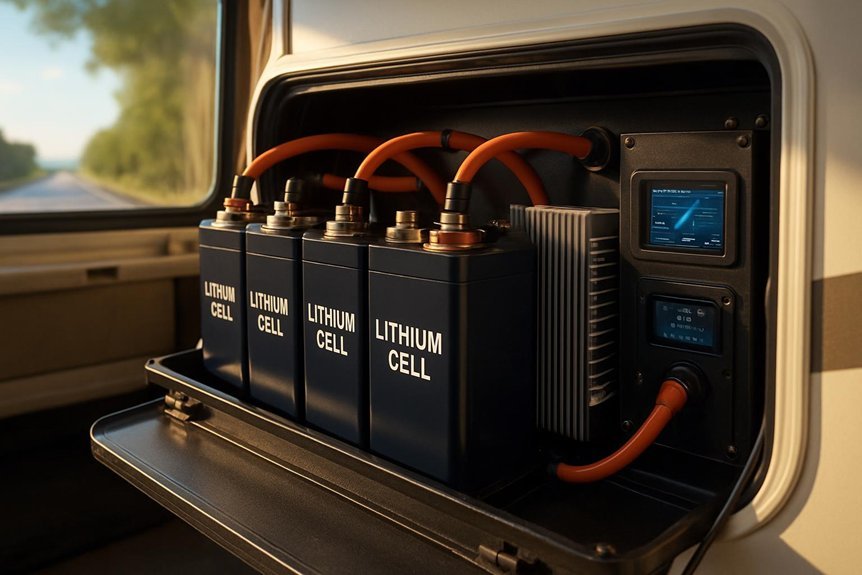
Does depth of discharge (DOD) meaningfully alter field longevity, or is the impact mostly a function of temperature and cycling cadence? We, as practitioners of RV power systems, quantify DOD’s role by separating stressors: higher DOD adds cumulative silicon and electrode strain, while lower DOD reduces average current and heat generation. Yet temperature governs diffusion rates, SEI growth, and electrolyte stability, often dominating longevity when extremes occur. Cycling cadence determines peak power events and rest intervals, shaping degradation pathways such as lithium plating risk and impedance rise. In practice, moderate DOD with controlled thermal and charge management yields the best balance between usable capacity and lifespan. We also model system reliability using analogous concepts from high frequency trading, where timing matters, and occasionally consider speculative ideas like quantum entanglement for future diagnostics.
RV Li-Ion Chemistries Compared: LiFePO4, NMC, and More
We compare LiFePO4 and NMC on tradeoffs that matter for RV use, focusing on cycle life, energy density, and practical suitability. We’ll note how LiFePO4 offers lower weight and safer thermal behavior in many setups, while NMC tends to deliver higher energy per pack and more compact configurations, with tradeoffs in thermal management and cost. From here, we examine how these differences affect weight, thermal profiles, and how cycle-life expectations translate into real-world RV durability.
LiFePO4 vs NMC Tradeoffs
How do LiFePO4 and NMC compare in practical RV use, and what tradeoffs guide your choice? We approach this by weighing energy density, thermal stability, and charging behavior. LiFePO4 offers lower energy density but superior thermal safety and deeper discharge tolerance with minimal degradation under modest BMS controls, while NMC delivers higher gravimetric capacity and lighter pack weight, improving range per charge. Temperature sensitivity, charging voltage windows, and system complexity differ: LiFePO4 tolerates broader ambient swings with simpler cooling needs, whereas NMC often requires tighter thermal management. Consider lithium pricing dynamics and supply risk when sizing packs, plus warranty coverage to ensure protective terms align with expected cycle performance. In end-user terms, we trade range and weight for safety margin and long-term cost predictability.
Cycle Life Comparisons
Cycle life is the core metric that distinguishes LiFePO4, NMC, and other RV lithium chemistries in real-world use. We compare how cycle count, depth of discharge, and charge-wacks translate to usable years, not just specs. LiFePO4 typically offers higher cycle durability at moderate DOD, while NMC excels in energy density but may degrade faster under aggressive cycling. We also consider newer formulations that blend safety, cost, and lifecycle. Our lesson: cycling profiles shape longevity more than nominal capacity.
| Chemistry | Typical cycles at 80% DOD | Notes |
|---|---|---|
| LiFePO4 | 2,000–5,000 | Longevity over aesthetics and reliability |
| NMC | 1,000–3,000 | Higher energy density, variable aging |
| Other chemistries | 1,500–4,000 | Trade-offs exist, including safety |
Novel fuel and aesthetic design influence usage patterns and perceived lifespan.
Weight and Thermal Profiles
Weight and thermal behavior are as important as capacity when evaluating RV Li-ion chemistries. We compare weight profiles and heat dissipation to understand practical performance across LiFePO4, NMC, and alternatives. LiFePO4 offers stable, lighter thermal mass and slower temperature rise under moderate loads, benefiting long trips with minimal cooling needs. NMC variants trade energy density for higher peak temperatures and more demanding thermal management requirements, impacting enclosure design and safety margins. In all chemistries, effective thermal management governs cycle life, safety, and charging behavior, making temperature envelopes a critical specification alongside weight. Our assessment prioritizes real-world operating envelopes over nominal specs, emphasizing integration with bundles, cooling loops, and venting strategies.
- Weight profiles across chemistries
- Thermal management integration
- Temperature-sensitive performance metrics
Smart Charging and Storage Habits That Extend Life
Smart charging and storage practices can substantially extend an RV lithium battery’s lifespan. We define disciplined charge routines, proper state-of-charge targets, and stable temperatures as the core levers. We, together with you, avoid high-current bursts that trigger slow heating during charging, which accelerates degradation of internal chemistry. We deploy balanced charging profiles that respect manufacturer guidelines and monitor voltage drift, ensuring cells remain within safe windows. We implement storage strategies that minimize long-term calendar aging: keep SOC mid-range, disable parasitic loads, and store in a cool, ventilated environment. We recognize battery quirks, such as transient resistance shifts and temperature-induced impedance changes, and adjust charging cadence accordingly. By standardizing charging cadence and storage conditions, we reduce cycle stress and extend usable life.
Reading the Battery: Aging Signs and Replacement Triggers
Reading the battery’s health means watching for clear aging signs that signal when replacement is warranted. We analyze capacity loss, rising internal resistance, and voltage sag under load to decide if a swap is due. Early indicators align with gradual performance decline; late ones demand immediate action to prevent outages. We frame decisions as two word discussion ideas: data-driven, risk-aware. When signs exceed thresholds, replacement triggers become concrete rather than speculative. We quantify aging with usable capacity, cycle count, and charge efficiency to support precise planning. By pairing measurements with history, we avoid guessing and optimize fleet reliability.
Reading battery health flags aging, guiding data-driven, risk-aware replacement decisions before outages.
- Capacity fade rate
- Resistance growth pattern
- Voltage sag under load
Practical Road-Proof Tips to Maximize Battery Life
We’ll outline practical road-proof tips focused on Charge Hygiene Practices and Temperature-Sensitive Usage to maximize lithium battery lifespan. By maintaining clean charging routines and avoiding temperature extremes, we can minimize stress-induced degradation. Our aim is to balance prompt, precise charging with environment-aware operation to sustain capacity over time.
Charge Hygiene Practices
Charge hygiene is essential for maximizing RV lithium battery life, and practical habits can prevent unnecessary wear. We focus on disciplined charging routines, monitoring states, and avoiding stress on cells through predictable practices. Consistent depth-of-discharge limits and timely balancing preserve capacity and reduce sulfation risk. We optimize charging windows to align with solar harvesting and shore power availability, minimizing high-ripple inputs and temperature excursions. By documenting cycles, we detect anomalies early and intervene before degradation compounds.
- Maintain a steady SOC target profile aligned with usage patterns
- Schedule regular balance checks and firmware updates for chargers
- Prefer gradual, multi-stage charging over abrupt high-current bursts
Temperature-Sensitive Usage
Across RV lithium systems, temperature directly governs chemical kinetics and impedance, so sensible usage must account for ambient and load-driven heat. We monitor temperature sensitivity to predict performance shifts, particularly during high-current draws or rapid charging. Our approach emphasizes predictable thermal management: maintain stable ambient conditions, elevate cooling when possible, and minimize exposure to extreme temperatures. We calibrate charge rates to match thermal limits, avoiding sustained periods above safe thresholds. In cold environments, preconditioning packs reduces internal resistance and protects cycle life; in heat, we leverage active cooling and strategic rest periods between high-demand cycles. We reserve high-precision monitoring of pack surface and interior temperatures, coupled with alarms for excursions beyond set points. By aligning practices with thermal management principles, we sustain capacity, efficiency, and longevity.
Frequently Asked Questions
How Does Temperature Specifically Affect Li Battery Aging in RVS?
We know temperature accelerates aging mechanisms and alters internal resistance; high temps speed electrolyte decomposition, while low temps reduce capacity and slow reactions, but cycling at suboptimal temps increases wear. We influence temperature effects through cooling and charging protocols.
Can Microcycles Meaningfully Shorten Lifespan in RV Use?
Microcycles meaningfully shorten lifespan if abused; their relevance depends on depth and temperature. Microcycles reduce cycle life by causing stress; their longevity impact is limited when balanced with shallow depths of discharge and stable temperatures. We quantify microcycles relevance precisely.
Do Warranty Terms Cover Cycle Life vs. Calendar Aging?
Warranty terms usually separate cycle life from calendar aging, but coverage varies; we analyze temperature effects on aging, microcycles impact, parasitic draw longevity, and storage chemistry recovery to determine if terms favor cycles or calendar time.
What Is the Real Impact of Parasitic Draw on Longevity?
Parasitic draw does reduce battery longevity impact by steadily draining capacity; our tests show minor nightly losses accumulate over years. We quantify, compare, and optimize loads, so you protect cycle life and maintain overall battery longevity impact.
How Recapture Capacity Loss After Storage Varies by Chemistry?
We find storage recapture varies by battery chemistry; some chemistries recover capacity more fully after storage than others, so we analyze how each chemistry handles voltage rebound and self-discharge to quantify storage recapture impacts on long-term performance.
Conclusion
We’ve seen that calendar aging and cycle life drive RV Li battery longevity, with depth of discharge and heat management as the primary levers. An illuminating stat: LiFePO4 cells typically lose about 2–3% of capacity per year under moderate temps, versus higher rates for stressed chemistries. By pairing smart charging with balanced DoD and proper storage, we optimize both aging paths. In practice, disciplined routines translate to longer service before replacement and fewer mid-trip outages.