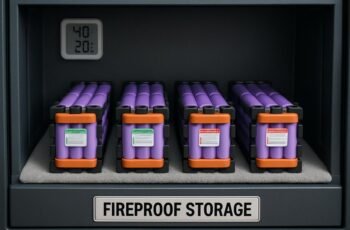
Like a compass amid shifting currents, we frame how marine lithium batteries transform onboard power. We’ll explore energy density, charging resilience, and real-time BMS safety that together support longer voyages with tighter space and lower upkeep. We’ll outline practical sizing, integration with electronics, and cost-per-cycle benefits, all through a systems lens that weights sustainability. Stay with us as we connect performance, safety, and lifecycle economics to common marine setups without signaling a finish line.
Key Takeaways
- Higher usable energy and deeper cycling with predictable performance for longer trips and reliable power.
- Safer, real-time battery management with temperature-aware charging and fault detection to prevent failures.
- Space-efficient, modular design enables compact packaging and scalable capacity without adding ballast.
- Lower maintenance and longer lifespan reduce replacement frequency and lifecycle costs.
- Resilience in harsh marine environments with salt-water sealing, corrosion resistance, and robust diagnostics.
Why Marine Lithium Batteries Change Power On Board
Marine lithium batteries redefine on-board power by delivering higher usable energy, faster charging, and deeper cycling with predictable performance. We, as a system, examine how this shift reshapes vessel operations, maintenance, and safety margins. Our focus is on reliability, thermal management, and lifecycle transparency, ensuring predictable outcomes under varying loads and environmental conditions. We consider offshore ethics, recognizing the responsibility to minimize ecological footprints from production to end-of-life. We also examine supply chains, identifying where material sourcing, manufacturing, and logistics influence cost, risk, and continuity of power. By aligning battery chemistry, power electronics, and energy management strategies, we enable smarter decision-making for peak shaving, routine charging, and redundancy. Our collaborative approach keeps sustainability central while delivering practical, measurable performance gains for marine applications.
Energy Density: Sizing Smaller Boats Without Sacrificing Power
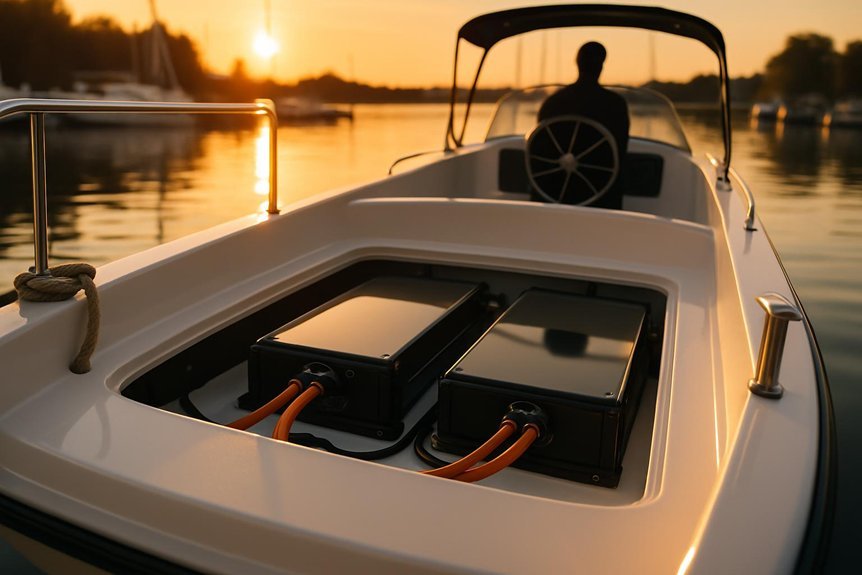
We optimize energy density to size smaller boats without sacrificing power, balancing compact energy storage with predictable performance. By prioritizing power-to-weight and efficient space planning, we guarantee robust capabilities without excess bulk. This systems-focused approach supports sustainability by reducing hull weight and resource use while maintaining operational reliability.
Compact Energy Density
Isn’t it impressive how lithium batteries deliver compact energy density, enabling smaller boats to pack the same power without sacrificing range? We aim for a precise, systems-oriented view: compact energy translates to tighter packaging, reduced hull space consumption, and simpler integration with existing powertrain layouts. Our approach prioritizes modularity, scalable chemistries, and thermal management that keeps performance consistent under variable loads. By focusing on energy density per volume and per mass, we minimize ballast impacts and simplify mounting schemes, contributing to weight optimization across the vessel. This efficiency supports longer trips with fewer batteries, lower lifecycle emissions, and easier retirement or repowering. In practice, we validate performance through calibrated simulations and on-water tests, ensuring reliable power delivery without compromising safety or sustainability targets.
Power-To-Weight Balance
Power-to-weight balance hinges on delivering authoritative energy density without adding ballast that undermines performance. We align sizing with mission profiles, ensuring lithium systems provide sustained power without excess mass. By comparing energy density to hull dynamics, we optimize propulsion margins while preserving handling and stability. Our approach prioritizes marine durability, selecting cells and packs designed for cyclic loads, corrosion resistance, and thermal management that keep performance consistent at sea. We quantify tradeoffs between capacity, weight, and range, enabling smarter fleet decisions and smaller-battery configurations that still meet peak power demands. Charging convenience features—fast-but-safe top-offs, smart BMS alerts, and shore-side interoperability—minimize downtime without compromising safety. The result is predictable performance, reduced structural ballast, and resilient operation across environments.
Efficient Space Planning
Efficient space planning hinges on maximizing energy density without expanding the hull’s footprint, so smaller boats can sustain full-power operation when needed. We apply rigorous space optimization to locate cells, management hardware, and thermal interfaces within tight envelopes, preserving usable deck and cargo areas. By integrating high-energy-density lithium packs, we reduce ballast and free volume for ballast-aware systems, enabling cleaner weight distributions at critical trim points. Our approach emphasizes modular pack layouts that balance parasitic losses with thermal management, preserving performance margins under varying loads. We analyze load profiles, peak-current paths, and charging dynamics to prevent bottlenecks during acceleration and maneuvers. This systems view aligns with sustainability goals, minimizing material mass while maintaining reliability, safety, and service life through deliberate weight distribution and efficient space planning.
How Long It Lasts: Runtime Gains Without Frequent Replacements
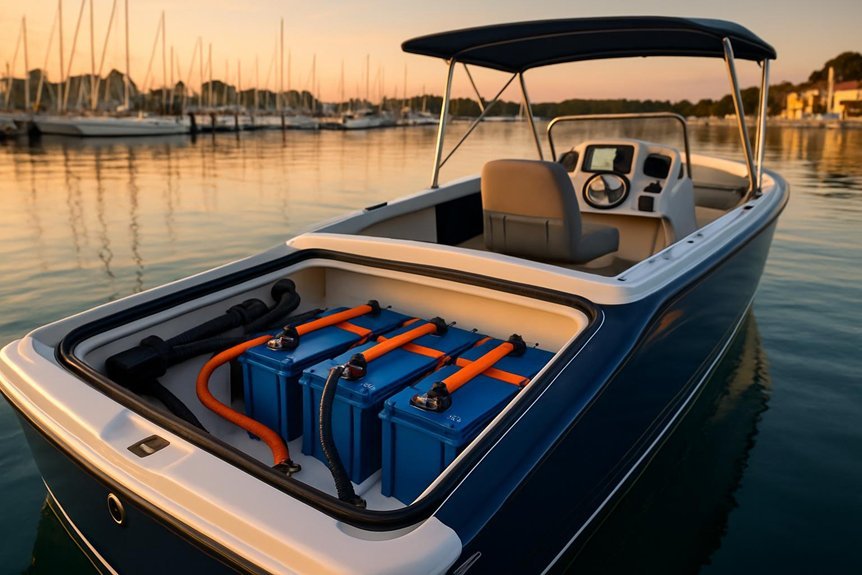
We see longer lifespan and steady runtime as core advantages, delivering sustained power over longer intervals and reducing the frequency of system maintenance. With fewer replacements, overall lifecycle costs drop and operational reliability increases, especially in demanding marine environments. Our focus is on consistent power delivery, where stable voltage and depth-of-discharge management support predictable performance and sustainability.
Longer Lifespan Runtime Gains
Do lithium batteries really extend on-water runtimes? Yes, by delivering sustained energy with tighter tolerances across cycles. We structure performance around a true long lifespan: minimal capacity fade, predictable discharge curves, and consistent temperature management that preserves chemistry. Runtime gains come from high energy density and low parasitic losses, reducing system weight and auxiliary load. We optimize for endurance across cycles, using battery management that mitigates depth-of-discharge stress and balances charge acceptance in variable conditions. Our design prioritizes modularity, scalable capacity, and thermal stability, so you gain reproducible runtimes under real-world sailing, trolling, and cruising. This approach yields measurable, repeatable improvements in endurance, aligning with sustainability goals while maintaining safety, reliability, and efficiency.
Fewer Replacements Needed
With fewer replacements needed, lithium systems deliver longer intervals between maintenance cycles by combining high cycle life, robust thermal management, and stable chemistry. We optimize battery longevity by reducing invasive replacements and extending operational windows, while preserving performance across charge cycles. Our approach minimizes total ownership costs and environmental impact through durable materials and efficient management. In practice, you’ll observe steadier capacity retention, fewer outages, and predictable schedules that support safer, continuous cruising. This consistency reinforces sustainable operations and asset longevity across vessel fleets.
| Column A | Column B |
|---|---|
| Battery longevity | Charge cycle |
| Reduced maintenance | Lifecycle prediction |
| Thermal safety margins | System diagnostics |
| Durable chemistry | Preventive action |
| Long-term cost savings | Operational resilience |
Consistent Power Delivery
Consistent power delivery hinges on energy density, charge stability, and thermal management that keep performance steady across cycles. We, as designers and operators, value predictable runtime and minimal drift under load, so lithium systems deliver consistent current when engine room demand shifts. Our focus is on battery chemistry and pack topology that resist voltage sag during high-current draws, while thermal controls prevent hotspots that erode capacity. We also consider aging patterns to refine the maintenance cadence, ensuring cells remain balanced and capable across seasons. By improving cycle life and state-of-health monitoring, we reduce surprises during voyages. This systemic approach supports sustainable ballast management, safer charging practices, and smarter energy budgeting, translating into reliable overnight runs and optimized maintenance investments.
Fast Charging: Get Back on the Water Sooner
Fast charging is a key enabler for marine lithium systems, reducing downtime and keeping boats on the water rather than tethered to shore power. We design charging profiles with efficiency, thermal management, and lifecycle impact in mind, so every amp-hour is purposeful. Our approach blends fast-fill capability with balance maintenance, minimizing stress on cells and connectors while preserving pack longevity. By coordinating battery management, solar input, and shore power, we reduce idle time and emissions. This is systems thinking in action: predictable energy availability, optimized dockside routines, and sustainable operation. Irrelevant topic and off topic discussion should not distract from functional gains.
- Precise ramp rates that protect chemistry
- Real-time temp-aware charging
- Load-aware dockside integration
- Predictable rest and cycling schedules
- Minimal idle energy losses
Key Safety Features for Salt Air and Wet Environments
We prioritize salt air resilience and robust wet-environment safety to keep lithium systems reliable at sea. Our approach combines corrosion protection, enclosure sealing, and moisture management to maintain performance under harsh marine conditions. By designing with sustainable materials and fault-tolerant layouts, we minimize risk while maximizing long-term safety for crews and ecosystems.
Salt Air Resilience
Salt air and marine exposure pose corrosion and moisture challenges that demand robust resilience. We design lithium systems to tolerate salt exposure, prevent cascading failures, and sustain reliable operation under harsh coastal conditions.
– Comprehensive sealing against salt fog and splash
-Cathodic protection-compatible housings to minimize corrosion risk
- Moisture ingress locks and desiccant-enabled enclosures
- Corrosion-resistant materials chosen for long-term stability
- Real-time health monitoring for early fault detection and maintenance
Our approach integrates thermal, electrical, and structural safeguards to reduce maintenance velocity and extend service life. By aligning with sustainability goals, we minimize replacement cycles and maximize recycled content. This salt air resilience supports safer, high-performance marine systems while reducing environmental impact. Trust in a design that prioritizes resilience, predictability, and responsible stewardship on every voyage.
Wet Environment Safety
How do we guarantee safety in wet, saline environments without compromising performance? We implement rigorous insulation and enclosure strategies that resist immersion and splashes while preserving system accessibility for maintenance. Our approach centers on robust waterproof coatings and sealed junctions to minimize moisture ingress, paired with modular battery packs that isolate sections if exposure occurs. We continuously monitor temperature, voltage, and current with diagnostics that flag anomalies before failures emerge. Material selection targets corrosion resistance, reducing long-term degradation, and supports sustainable lifecycle performance. We assess corrosion risk across all interfaces, optimizing fasteners and gaskets to deter galvanic reactions. Maintenance cycles emphasize cleaning, surface protection, and corroborating coating integrity. This systems view aligns safety, reliability, and environmental responsibility in demanding wet environments.
Understanding Marine BMS: What It Does for You
A Marine Battery Management System (BMS) monitors cell health, balances charge, and protects the pack from overcharge, overdischarge, short circuits, and thermal runaway, ensuring safe, reliable operation at sea. Our marine BMS aligns chemistry, thermals, and load profiles to maximize longevity, reliability, and performance. Through real-time battery monitoring, we gain visibility into state of health, state of charge, and temperature margins, enabling proactive decisions and safer voyages.
- Alerts we trust for critical thresholds
- Optimized charging profiles that protect cells
- Early fault detection to prevent failures
- Transparent data for maintenance planning
- Reduced risk through integrated safety safeguards
Lower Maintenance, Lower Ownership Costs
Why do maintenance and ownership costs drop when you choose lithium marine batteries? We view lifecycle costs through a systems lens, balancing upfront investments against long-term performance and reliability. Our approach centers on durable cell chemistry, robust BMS integration, and fewer moving parts, translating to reduced service intervals and less crew time spent on upkeep. You gain consistent charge cycles, lower parasitic losses, and fewer replacement events, which shore up marina-compatible cost profiles. Marine efficiency improves as fewer auxiliary loads creep in and energy density enables smaller, lighter packs with simpler mounting. Corrosion resistance of enclosure hardware and connectors minimizes maintenance over salt exposure, while diagnostic tooling accelerates fault isolation. Together, these factors lower total cost of ownership and boost predictable boating economics.
Temperature Resilience and Saltwater Exposure Practicalities
Temperature resilience and saltwater exposure demand a systems approach: we design lithium marine packs to operate reliably across a wide temperature band and withstand corrosive marine environments.
Temperature resilience and saltwater exposure demand a systems approach for reliable lithium marine packs.
- Temperature isolation strategies maintain performance across coastal and tropical ranges
- Salt tolerance achieved through corrosion-resistant housings and seals
- Battery management aligns chemistry, cooling, and insulation for stability
- Material selection prioritizes longevity under splash, spray, and immersion
- Preventive maintenance reduces failure risk and preserves residual value
Our approach integrates thermal modeling, seal integrity, and lifecycle sustainability to minimize environmental impact while maximizing reliability. We emphasize modular packs, fault tolerance, and predictable second-life potential. By foreseeing dew, humidity, and salinity effects, we protect cells and electronics. This precision mindset supports consistent charge, discharge, and safety margins, enabling confidence in blue-water and salt-influenced operations.
Sizing and Integrating Marine Lithium With Your Electronics
How do we size and integrate marine lithium systems with your onboard electronics to assure reliability and efficiency? We approach sizing with a systems view, balancing load profiles, peak currents, and reserve capacity against boat usage patterns. We align cell chemistry, BMS capabilities, and charging sources to maintain voltage stability and cycle life, while minimizing weight and space demands. Our sizing guidelines emphasize margin for startup surges, temperature effects, and future expansion, ensuring safe, consistent performance under salt spray and vibration. Integration focuses on harness routing, fuse protection, and ground schemes to avoid ground loops and EMI. We identify integration pitfalls early—inadequate thermal management, mismatched chargers, and improper battery-to-accessory acceptance. Together, we promote robust, sustainable electronics ecosystems that endure marinas, tides, and long voyages.
Real-World Scenarios: Trolling Motors, House Systems, and More
Trolling motors, house systems, and other onboard loads spell distinct demands for reliability and efficiency, so we examine real-world usage patterns to tailor lithium solutions precisely. We translate field data into scalable architectures, balancing energy density, cycle life, and charging cadence to minimize downtime and weight. Our approach emphasizes prognosis, fault isolation, and modular upgrades that sustain performance across seasons. By modeling load profiles, we optimize inverter compatibility, BMS integration, and heat management for marine environments. We prioritize sustainability by selecting materials with lower environmental impact and enabling long service life. This systems view ensures predictable performance, reducing risk and maintenance needs for skippers and crews alike.
- Consistent trolling motor runtime under variable seas
- Seamless house system power during storm events
- Precise state-of-charge tracking for critical loads
- Quick, safe charging with marine-grade adapters
- Modular upgrades that extend system life
Frequently Asked Questions
Are Marine Lithium Batteries Ship-Safe and Compliant With Regulations?
Yes, marine lithium batteries are ship-safe when properly installed and used; they meet regulatory compliance with proper certification, battery management systems, and safety procedures. We emphasize marine safety, regulatory compliance, system integrity, and sustainability in our approach.
How Do Lithium Batteries Handle Extreme Heat and Sun Exposure?
“Slow and steady wins the race.” We handle extreme heat and sun exposure with robust thermal management, cell balancing, and venting. We monitor temps, protect packs, and optimize cycle life, sustainability, and safety in harsh marine conditions.
Can Lithium Be Recycled or Repurposed After Boating Use?
We can recycle or repurpose lithium batteries after boating use. We explore recycling options and repurposing potential, applying technical precision and systems thinking to maximize sustainability, safety, and lifecycle efficiency for marine applications.
Do Lithium Packs Require Specialized Marine Installers or Diy-Friendly Setup?
We do not require specialized marine installers for basic setups, but for complex systems we recommend trained technicians; DIY-friendly setup exists with clear guidelines. We prioritize Specialized installation nuances and ensure sustainability through precise, safe, integrated configurations.
What Warranty and Service Support Come With Marine Lithium Systems?
We provide robust warranty coverage, backed by a nationwide service network, ensuring prompt compliance with safety regulations; our support emphasizes sustainability, diagnostics, and proactive maintenance so you can trust marine lithium systems long-term.
Conclusion
We’re not chasing hype; we’re engineering reliability. Lithium batteries compress power into compact, modular packs that scale with our boats, yet they demand smart BMS and thoughtful integration. Juxtapose their energy density with the salt air’s corrosion and our need for safety, and a clearer picture emerges: higher performance with lower maintenance, but only when systems thinking guides charging, thermal management, and sizing. In this balance, sustainable, on-water resilience becomes our standard operation.