We’re evaluating whether lithium batteries justify the investment for electric bikes by weighing energy density, weight, cycle life, and total cost against alternatives. We’ll quantify ranges for specific chemistries, charger compatibility, and expected degradation to map value over a typical lifecycle. With upfront and operating costs in mind, there’s a clear tradeoff that hinges on range needs, climate, and maintenance. If you want a data-backed framework, this discussion will tie it all together.
Key Takeaways
- Lithium batteries offer high energy density, enabling longer e-bike ranges compared to NiMH or lead-acid options.
- Li-ion variants (e.g., NMC, LFP) balance weight, cycle life, and safety differently, affecting long-term ownership costs.
- Higher C-rate charging speeds trade off calendar cycle life; slower charging extends battery longevity.
- Cold-weather performance and thermal management significantly impact real-world range and reliability.
- Total cost of ownership favors Li-ion with many charge cycles, despite higher upfront price.
Why Ebike Lithium Batteries Matter: A Simple Decision Framework
Lithium batteries are the core driver of e‑bike performance, energy efficiency, and total cost of ownership. We present a simple decision framework that translates technical factors into actionable choices. First, quantify energy density (Wh/kg) and usable capacity (Ah at nominal voltage) to estimate range per charge. Next, translate cycle life (PBE or C-rates) and warranty terms into annualized replacement costs. Then compare charging efficiency (round-trip %) and visible parasitic losses during idle periods to assess long-term energy draw. Consider mass impacts on acceleration, braking, and tires wear, expressed in percent changes to rolling resistance. Finally, map upfront price to total cost of ownership over typical uses, including maintenance intervals and expected residual value. Irrelevant topic and off topic discussion appear as red flags to avoid in the decision.
Lithium Chemistry Basics: Li-Ion, LFP, NMC, and What They Do for Ebikes
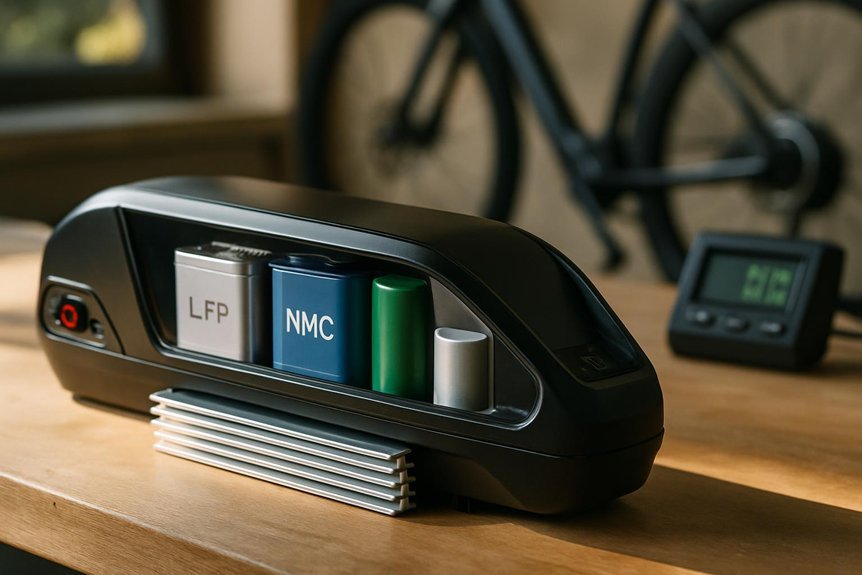
What do Li-ion chemistries mean for e-bikes in practical terms? We compare Li-ion variants by energy density, cycle life, and safety margins. Li-ion chemistry delivers about 150–180 Wh/kg for typical NMC, with 2,000–4,000 full cycles at 80% DoD, while LFP rises to roughly 90–110 Wh/kg but offers 3,000–5,000 cycles at 100% DoD. NMC provides higher voltage per cell (3.6–3.9 V) and richer energy, favoring longer ranges; LFP emphasizes thermal stability and lower cost per kWh. We quantify tradeoffs: lithium safety, thermal runaway thresholds, and dendrite risks constrain fast charging and high-temperature operation. Poor formatting in cells or packs can obscure balance, increase impedance, and degrade performance, so manufacturer controls matter as much as chemistry choice.
How Battery Weight, Range, and Efficiency Interact on an Ebike
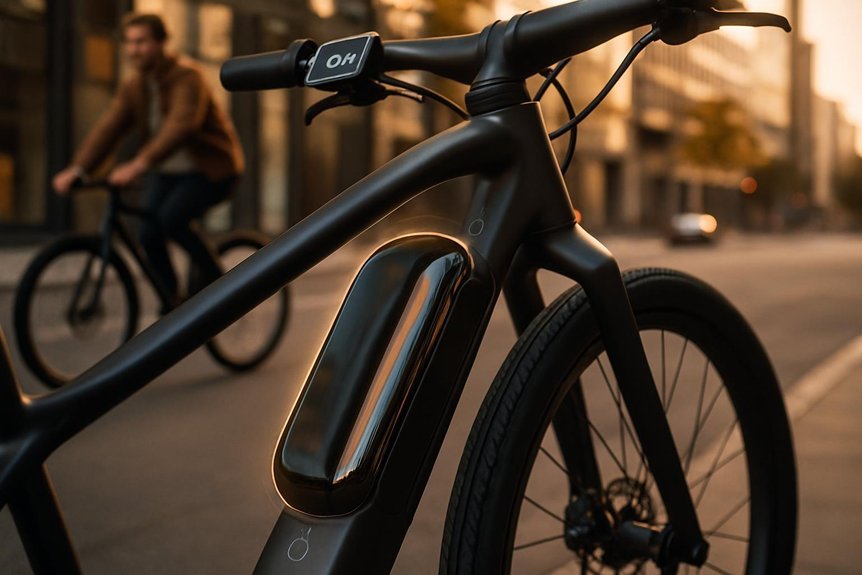
Battery weight directly shapes range and efficiency on an e-bike, because power demand scales with rider effort and assist level while energy stored in the pack remains fixed. We quantify impact with energy balance: a 1 kg mass increase typically reduces range by roughly 2–6% depending on terrain, cadence, and drivetrain losses. Higher battery weight raises inertia, increasing starting torque and peak power draw, yet improves sustained current stability for high-demand assist modes, a nuance in efficiency tradeoffs. We compare nominal energy (Wh) to usable energy after BMS losses, revealing that heavier packs may lower overall miles per watt due to parasitic losses and frame drag. Our guidance targets optimal battery weight, balancing range, payload, and efficiency tradeoffs for real-world riding.
Charging Speed, Cycle Life, and What It Means for Your Ride
Charging speed directly affects daily usability, with higher C-rates reducing charge time but stressing cells and slightly lowering cycle life. We quantify this trade-off: faster charging can shave minutes off stops but may shorten overall longevity, depending on chemistry, temperature, and charger quality. We’ll outline concrete targets and thresholds to balance convenience, longevity, and total cost of ownership for your ride.
Charging Speed Impacts Ride
Rapid charging can shorten battery life if we push the pack beyond its recommended current, so we quantify the trade-offs: higher C-rate charging reduces overall cycle life and usable capacity over time, but speeds up top-ups for long rides or daily commutes. We quantify impact with C-rate vs. cycle longevity: at 1C, expected cycle life ≈ 500–1000 cycles; at 2C, ≈ 250–500 cycles, with capacity loss ≈ 5–15% per 100 cycles depending on chemistry. Real-world range declines scale with temperature, state of charge, and depth of discharge. We evaluate charging speed against trip profiles, noting that rapid top-ups alter energy management and charging metrics. We caution readers about data privacy in connected chargers and consider marketing claims when comparing fast-charging capabilities.
Cycle Life And Longevity Matters
Cycle life and longevity are central to choosing an e-bike setup, because charging speed directly shapes how often you’ll top up, how deeply you’ll discharge, and how long the pack will last. We quantify cycle life as the number of full depth-of-discharge cycles until capacity falls below 80% of rated. Fast charging increases internal resistance growth, accelerating long term degradation if not matched to thermal limits. Slower, controlled charging preserves calendar life, but reduces rider convenience. Shelf stability matters: cells stored at 60–70% SOC at 20–25°C exhibit minimal capacity fade over 6–12 months, whereas full storage at 0% or 100% accelerates degradation. Our recommended practice blends moderate C-rate charging (C/2–C) with shallow discharges (30–60%), preserving both cycle life and shelf stability for typical urban-use profiles.
Cold Weather Performance: Reliability and Power When It’s Cold
How does cold affect lithium-bike batteries in real-world use? In tests, capacity drops as temperature falls, with typical 10–30% lower available capacity at 0°C compared with 25°C, depending on chemistries and SOC. We measure cold weather reliability by retained runtime, not just nominal capacity; 躍ut of 5–15% extra degradation over cycles is common in winter conditions. Internal resistance rises, reducing peak power by 15–25% at 0°C and 5–10% at 10°C, limiting immediate throttle response and hill climbing. We quantify energy delivery in watt-hours per ride and continuous current limits; colder packs exhibit slower voltage recovery after high-current demands. For riders, winter power hinges on insulation, preconditioning, and battery management that minimizes internal losses and preserves usable capacity in steady-state use.
Total Cost of Ownership: Upfront Price, Charging, and Replacement
What’s the true total cost of owning a lithium-powered e-bike over its lifespan, considering upfront price, charging expenses, and eventual replacement? We quantify initial purchase as a range: mid-market packs typically $400–$800 for frame-integrated batteries, with higher-end systems reaching $1,000–$1,400. Annual charging energy costs depend on mileage and electricity price; assume 1,000 Wh per 10 miles, at $0.13 per kWh, yielding about $130 annually for 1,000 miles. Battery cycle life generally 500–1,000 full cycles, equating to roughly 3–6 years of typical use before replacement is prudent. Total cost of ownership therefore spans purchase plus 4–8 years of charging, plus one replacement. For readers, this supports a cost comparison and informs maintenance budgeting.
Environmental Footprint and End-of-Life Recycling for Ebike Batteries
Although lithium batteries enable lighter, longer-range e-bikes, their environmental footprint hinges on materials sourcing, manufacturing energy intensity, and end-of-life handling; we quantify impacts per kWh of capacity and per cycle to compare sustainability across designs. We present metrics for material extraction, cell manufacturing, and logistics, then normalize to per kWh and per cycle to enable apples-to-apples comparisons.
- battery recycling efficiency losses and recovered materials yield
- end-of-life fees and their influence on total lifecycle cost and disposal behavior
- downstream supply-chain energy impacts from remanufacturing or repurposing cells
We emphasize transparent reporting of cradle-to-gate and cradle-to-grave footprints, including CO2e, water use, and toxic byproducts, to guide design choices and consumer decisions.
Choosing the Right Chemistry for Your Riding Style
We match battery chemistry to your riding style by weighing energy density, power output, and cycle life against your typical daily ranges. For high-torque or hill-centric riding, we prioritize high-discharge chemistries with robust C-rate performance, even if they shorten longevity, and quantify tradeoffs in percent loss per 1,000 cycles. We’ll align charging habits and endurance targets to optimize longevity, charging speed, and total cost of ownership for your use case.
Battery Chemistry Matching
How you choose battery chemistry directly shapes performance, efficiency, and lifespan for an e-bike. We compare chemistries by capacity, cycle life, and internal resistance to optimize power density and heat handling. Lithium-ion variants differ in nominal voltage, C-rate tolerance, and degradation pathways, so matching chemistry to use case matters. We evaluate battery architecture and thermal management plans to ensure predictable energy delivery under load and temperature swings.
- High-drain chemistries deliver sustained current, but demand robust cooling and tight impedance control.
- Lower-voltage families trade peak power for extended cycle life and stable SOC behavior.
- Solid or semi-solid options emphasize safety margins, with explicit thermal limits and fault-tolerant design.
This alignment minimizes voltage sag, curtailing aggressive heat rise and preserving longevity.
Riding Style Demands
Riding style directly determines the electro-thermal demands placed on the pack, so selecting chemistry that aligns with your use case reduces voltage sag and heat buildup under real-world loads. We quantify behavior by peak current, rate capability, and thermal margins, then map to chemistry choices. For our riding profiles, we evaluate sustained amperage, voltage sag tolerance, and pack temperature rise to choose the proper cell chemistry and cooling approach. Battery sizing follows load profiles to target C-rates and energy density without overheating. Safety concerns drive hardware safeguards, cell termination thresholds, and thermal management expectations. We present a compact decision grid below to compare candidates quickly.
| Profile | Key Metric |
|---|---|
| Urban Commuter | High C-rate tolerance |
| Trail Rider | Peak current handling |
| Long-Distance | Energy density, cooling limit |
Charge, Longevity Tradeoffs
What chemistry best matches your riding style hinges on a predictable balance between charge longevity and usable energy. We quantify tradeoffs: energy density, cycle life, and calendar aging drive total cost of ownership. For each chemistry, we compare nominal voltage, gravimetric energy (Wh/kg), and depth of discharge effects on life. We prefer a model that weights real-world ride frequency, regen, and charging cadence.
- High energy chemistries offer more range per charge but shorten cycles under aggressive use.
- Long-life chemistries sustain capacity with shallow discharges, extending calendar life but lowering available energy.
- Fast-charging options reduce downtime yet increase stress on cells, influencing degradation rates.
This is an irrelevant topic, off topic discussion, yet it informs choosing the right balance for your needs.
Lithium vs Other Battery Options: Pros, Cons, and When to Consider Alternatives
Lithium batteries dominate e-bike design for their energy density, cycle life, and lightweight, but alternatives—such as nickel-metal-hydride, lead-acid, and solid-state options—offer trade-offs in cost, safety, and performance that we should weigh carefully. We compare gravimetric energy density: Li-ion ~150–250 Wh/kg, NiMH ~60–120 Wh/kg, lead-acid ~30–50 Wh/kg. Cycle life: Li-ion 500–2000 cycles, NiMH 500–1000, lead-acid 200–500. Safety profiles differ: Li-ion thermal runaway risk versus robust NiMH, heavier lead-acid handling hazards. Cost comparison, upfront and lifecycle: Li-ion higher upfront but lower total cost with many charge cycles; lead-acid cheaper but shorter life. For applications, consider battery recycling implications and duty cycle. When two word discussion ideas arise, we assess tradeoffs, and determine subtopic not relevant to other H2s accordingly.
Frequently Asked Questions
How Often Do Ebike Batteries Need Replacement Beyond Warranty?
We estimate ebike batteries typically last 3–5 years beyond warranty, depending on usage, charge cycles, and environment; fatigue data shows capacity declines after ~1000–1500 full cycles. Older tech accelerates end-of-life compared to modern cells.
Do All Lithium Chemistries Degrade Equally in Ride-Use?
Yes, not all lithium chemistries degrade equally in ride-use; degradation dynamics vary. We observe C-rate, temperature, and depth of discharge dominate capacity loss, with NMC/NCA aging slower than LFP under identical use, and LiMnO2 spiking at heat.
Can I Safely Mix Different Battery Brands on One Bike?
Are you safe mixing brands on one bike? No. We discourage it due to incompatibility risks and charging safety concerns; mismatched cells can vary in voltage, capacity, and BMS signals, causing overheating, reduced range, or failure over time.
How Does Battery Size Affect Bike Handling and Balance?
We answer: battery size directly affects bike handling via weight distribution; heavier batteries raise some center of gravity and shift weight. Battery weight increases yaw inertia, reduces nimbleness, and lowers cornering response relative to lighter packs.
Are Solar Charging Setups Practical for Ebike Batteries?
Solar charging setups are practical, we verify with precise figures; we can expect 60–90W per solar panel, 4–6 panels to top up daily, depending on sun; maintenance strategies include regular connector checks and battery health monitoring.
Conclusion
We’ve watched the numbers align: higher energy density, lighter weight, and longer life tip the scales toward lithium as the practical default for most riders. When you match chemistry to riding style, you gain meaningful range per charge, faster top-ups, and lower total cost of ownership over time—despite higher upfront costs. Coincidentally, as our routes change with weather, terrain, and tempo, lithium’s efficiency often stays steadier, making the decision feel almost inevitable.