Some worry battery banks are too complex to size accurately, but we can anchor design in daily kWh, reserve days, and realistic inverter efficiency. We’ll compare LiFePO4, NMC, and LTO for safety, longevity, and cost, and translate those choices into usable capacity, depth of discharge, and system deratings. With a stepwise method from load to panel generation, we establish a practical, scalable plan that invites you to proceed with concrete calculations and a solid budget.
Key Takeaways
- Define daily load as total essential energy (Wh/kWh) and separate fixed vs. adjustable loads to size inverter and battery capacity accurately.
- Use Usable Capacity = nominal energy × DoD × inverter derating; target 60–80% DoD for longevity and 5–15% aging margin.
- Prioritize LiFePO4 for grid-backed systems due to safety and longevity, noting 2,000–5,000 cycles at 80% DoD; compare with NMC/LTO tradeoffs.
- Size for 2–4 days of autonomy for critical loads and plan reserves to meet peak vs. average demand with 15-minute load granularity.
- Budget with staged expansion, 15–25% capex, 10–15% contingency, and 5–10% future-proofing; verify with capacity, discharge window, and protection coordination.
What a Solar Lithium Bank Is and When You Need One
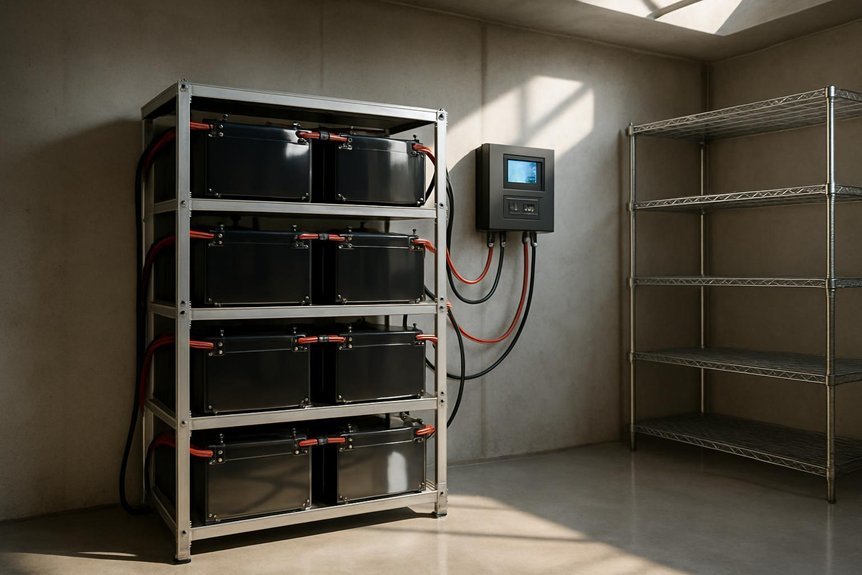
A solar lithium battery bank is a centralized energy storage system made of lithium-based modules that store solar-generated electricity for later use. We define it by capacity, voltage, and discharge rating, ensuring compatibility with our PV array, inverter, and charge controller. We quantify need with daily kWh delivery,autonomy hours, and depth of discharge targets per standards, then map to modules in series and parallel to meet required voltage and capacity. We assess battery chemistry to optimize cycle life, efficiency, and thermal management, selecting a chemistry that aligns with temperature range and cycling profile. Solar economics drives initial cost, round-trip efficiency, and O&M. We document safety margins, protection schemes, and verification tests, so installations meet performance criteria, reliability benchmarks, and professional guidelines.
Define Your Daily Load to Size Accurately
We define our daily load by totaling Daily Energy Intake from all essential circuits and devices, then compare it to Peak vs Average Demand to ensure our bank sizing aligns with real usage. We’ll quantify energy in watt-hours per day and compare it to our inverter and battery discharge limits to prevent chronic over- or under-sizing. This discussion grounds sizing in measurable, standards-driven metrics so you can validate assumptions with a clear, data‑driven plan.
Daily Energy Intake
How much energy do we actually need each day? We start by quantifying daily energy in watt-hours (Wh) or kilowatt-hours (kWh) from verifiable loads, excluding未来. We document all sockets, appliances, and circuits, totaling a defined daily energy target with a tolerance of ±5%. We separate fixed loads from adjustable ones and benchmark against manufacturer efficiency curves at 230 V or 120 V as appropriate. We compute peak demand, noting the highest simultaneous draw, and translate that into instantaneous power (kW) to inform inverter sizing. Our methodology emphasizes repeatable steps, documented usage profiles, and conservative margins. The result is a defensible daily energy budget that aligns with code standards and enables accurate battery bank sizing for predictable performance.
Peak vs Average Demand
Do we size for peak or average demand? We answer by defining our daily load with explicit metrics. We compare peak demand, the single highest 15- or 60-minute interval, versus average demand, the mean over a 24-hour cycle. We size lithium banks to meet the 97.5th percentile of daily usage or the duty cycle described in applicable standards, then apply derating for temperature and aging. We quantify ambient temperature effects on inverter and panel efficiency, dc bus losses, and battery capacity via a temperature correction factor. We document hourly load profiles, identify the duration of peak events, and ensure the bank sustains critical loads with acceptable state-of-charge windows. This approach yields a robust, code-aligned, performance-driven design that minimizes both wasted capacity and risk.
Compare Lithium Chemistries for Safety, Longevity, and Cost
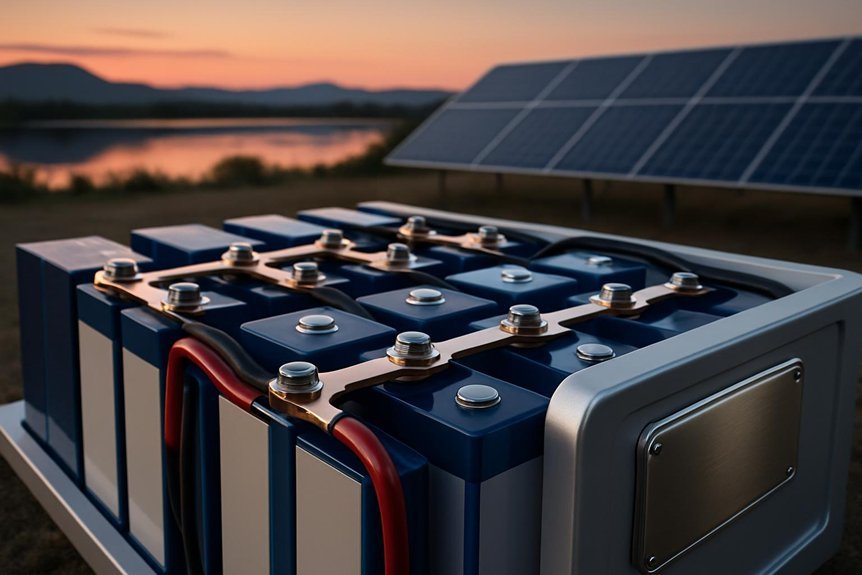
Which lithium chemistry offers the best balance of safety, longevity, and cost for a solar battery bank? We compare LiFePO4, NMC, and LTO on three quantified axes: safety, lifecycle, and cost per usable kWh. LiFePO4 shows the lowest thermal risk and robust stability, with cycle lives commonly 2,000–5,000 at 80% DoD, and a Level 1 safety rating under standard tests. NMC offers higher energy density, 150–200 Wh/kg, but shorter chemistry longevity under high-temperature cycling, typically 1,500–2,500 cycles at 80% DoD. LTO delivers exceptional cycle life, 8,000–20,000 cycles at 80% DoD, with excellent tolerance but higher upfront cost. For grid-backed solar, we prioritize safety and longevity, yielding lower long-term cost with LiFePO4.
How Usable Capacity, Depth of Discharge, and Inverter Efficiency Drive Size
Determining usable capacity starts with a clear handle on depth of discharge, inverter efficiency, and the system’s required runtime. We quantify usable capacity as the product of nominal pack energy, applicable DoD, and derating for inverter efficiency. For lithium chemistry, we select a target DoD that preserves cycle life; common ranges are 80% for high-cycle fleets or 60–70% for extended longevity under mixed loads. Inverter efficiency directly scales usable energy, with spec sheets typically listing 95% to 98% at nominal load, reducing available energy at higher or lower power levels. We size capacity by meeting peak and average loads over the desired runtime, then apply a conservative margin (5–15%) for aging. This disciplined approach ensures predictable performance and aligns with standards-driven design practices.
Step-By-Step Real‑World Sizing: From Load to Panel Generation
From the usable capacity framework we established, we translate loads and runtimes into concrete panel and inverter requirements. We quantify daily energy needs in watt-hours, then apply the design margin from bank sizing to accommodate variability. We map each circuit load to a corresponding inverter size, ensuring continuous operation at peak during worst‑case daily profiles. We convert energy into required solar array output by designing for expected sun hours and system losses, targeting a bank that maintains 80% DoD under typical cycles. We specify panel generation by meeting daytimeWh production plus buffer, using standard efficiency factors and temperature derating. We validate with a stepwise check: capacity, discharge window, inverter duty, and protection coordination. This is solar lithium, bank sizing done with measurement, not guesswork.
Budget, Scalability, and Common Sizing Pitfalls to Avoid
We set Budget Boundaries by design to align capex with expected ROI and system resilience, targeting a defined cost per watt-hour and a clear payback horizon. We’ll discuss scalable sizing pitfalls, including over- or under-sizing due to changing loads, growth assumptions, and battery derating, with concrete thresholds and revision points. By the end, you’ll have a framework to prevent common pitfalls and plan a scalable, cost-efficient battery bank.
Budget Boundaries By Design
Where should you set your budget boundaries to ensure a scalable solar lithium battery bank without overcommitting resources? We begin with a defined budget envelope: cap upfront capital at 15–25% of total system cost for the first build, then reserve 10–15% for contingency, and allocate 5–10% for future expansion. Establish a monthly operating budget targeting 0.5–1.0% of asset value for maintenance, diagnostics, and safety checks. Use standardized efficiency assumptions: 95% round-trip energy, 0.1–0.3C charge rates for longevity, and a 10-year design life. Document constraints in a single, auditable spreadsheet that links capacity, depth of discharge, and system health. Prioritize solar budgeting discipline and lithium safety through conservative state-of-charge windows and certified components. This framework supports scalable growth without compromising reliability.
Scalable Sizing Pitfalls
Could misjudging scale push you into expensive rework? In scalable sizing, we quantify every step, defining a target energy capacity, charge/discharge rates, and module counts with tolerance bands. We map system voltage, C-rate, and DoD to a single baseline, then scale rationally using linear or modular growth, not ad hoc additions. Pitfall avoidance means validating capacity headroom, converter sizing, and wiring losses at each stage, and anchoring decisions to standards-driven metrics like round-trip efficiency, thermal margins, and SOC windows. We present scalable sizing as a staged, data-backed process: initial baseline, growth factor, and final trim. By documenting assumptions and constraints, we prevent cascading rework and ensure cost-effective expandability, reliability, and maintainability.
Put It All Together: a Practical 7-Step Sizing Checklist
Are you ready to translate theory into action? We’ll walk through a practical 7-step checklist that translates sizing math into a deployable plan. Step 1: define your load profile with 15-minute granularity and a 99% reliability target. Step 2: set energy reserves to 2–4 days of autonomy for critical loads, using 4000–6000 Wh per day as a baseline. Step 3: select a usable capacity and depth of discharge aligned with lithium chemistry, targeting 80% DoD. Step 4: verify inverter compatibility with peak and surge demands, and ensure voltage, current, and frequency ratings meet standards. Step 5: confirm temperature derating and battery thermal management. Step 6: plan for solar battery maintenance intervals. Step 7: document commissioning tests for safety, efficiency, and long-term performance.
Frequently Asked Questions
How Do Seasonal Variations Affect Long-Term Battery Sizing Accuracy?
Seasonal variability reduces long-term sizing accuracy, causing up to 10–20% drift in usable capacity. We monitor degradation monthly, adjust assumptions quarterly, and reproject five-year cycles to maintain standards-driven, precise design margins despite seasonal and environmental fluctuations.
What Are Hidden Costs Beyond Initial Battery Price?
Sure: Hidden costs include maintenance, replacements, shipping, and inverter upgrades, plus warranty gaps. We’ll quantify risks with 5–10% annualized overruns, cite standards, and note hidden fees as persistent 0.5–2% of project costs, addressing durability expectations. Also, beware.
How Many Cycles Define a Battery’s Useful Life for Sizing?
We define a battery’s useful life by its cycle life, typically 300–1,500 cycles depending on battery chemistry; higher-rate discharge reduces cycles. For sizing, we expect 80% DoD, tracking cycle life and battery chemistry impacts precisely.
Can Microgrid or Backup Needs Change Size Requirements Post-Installation?
Can our microgrid post installation or backup needs change size requirements? Yes—we adjust based on load profiles, contingency assumptions, and state-of-charge targets. We quantify changes, document standards, and revalidate capacity against new backup needs and reliability metrics.
How Does Battery Aging Impact Usable Capacity Over Time?
We’ll explain that battery aging reduces usable capacity over time, with seasonal effects altering performance; expect derating curves showing capacity loss annually, plus temperature and cycling factors quantified per standards to forecast remaining capacity and reserve margins precisely.
Conclusion
We’ve sized, checked, and budgeted until the batteries practically beg for retirement. In truth, it’s all a numbers game: daily kWh, DoD, and inverter efficiency drive pack counts, while sun hours and derates cap panel area. Lithium picks safety and longevity without sacrificing cost, and 7-step checklists keep us honest. So, reader, here’s your spoiler: respect derating, include contingency, plan for expansion, then power on. If not, you’ll be composing a resignation letter to your inverter.