We could not be more precise about testing a lithium battery than we are right now. We’ll establish a baseline with controlled discharges, track capacity and end-points, and run impedance checks to surface aging. We’ll log voltage, current, SOC, and temperature continuously, watch for abnormal heating, and compare full- versus partial-depth cycles while accounting for rest periods. If safety flags appear or data diverges from specs, we’ll decide on replacement or service—and we’ll explain exactly why to move forward.
Key Takeaways
- Establish a baseline: record capacity, internal resistance, and temperature at a defined state of charge using controlled discharge and a repeatable profile.
- Perform impedance checks periodically to detect aging trends and surface any rising resistance before failures.
- Use controlled C-rate discharges with clear end-criteria, and log voltage, current, SOC, and temperature for traceability.
- Compare full-depth and partial-depth cycles to assess real-world performance and energy delivery under typical duty cycles.
- Flag safety indicators (swelling, leakage, heat) and follow manufacturer guidance for replacement or servicing with documented actions.
What a Modern Li‑Ion Battery Is (Key Terms and Why Health Matters)
What is a modern Li‑ion battery, and why should we care about its health? We define it as an energy store using layered transition metal oxides or alternative chemistries, with graphite or silicon anodes, and electrolyte salts enabling ion transport. We care because performance and safety hinge on state of health, not just capacity. We quantify health through metrics like capacity, internal resistance, and cycle life, all influenced by operating temperature, depth of discharge, and aging mechanisms. Our focus is on robust data, not hype. In practice, modern chemistries offer higher energy density and improved safety profiles, yet they still experience battery degradation over time, reducing usable capacity and accelerating resistance rise. Understanding these dynamics lets us predict performance and plan maintenance, replacements, and usage limits with confidence.
Step‑By‑Step Capacity Check: Methods, Tools, and Readouts

How do we reliably gauge a battery’s capacity in the field and in the lab? We approach it with structured, repeatable steps that emphasize data and traceability. Our focus is on capacity testing, using controlled discharge with defined C-rates and end-of-discharge criteria, and recording real-time metrics for comparison. We complement this with impedance checks to surface aging or degradation trends before performance drops, and discharge profiling to capture capacity under representative duty cycles. Thermal behavior is tracked to flag abnormal heating that skews results.
- Establish baseline, select test profile, and log initial conditions
- Execute controlled discharge, capture voltage, current, and end-point data
- Analyze curves, compare to specs, and document deviations for trend analysis
How to Measure Internal Resistance and What It Means
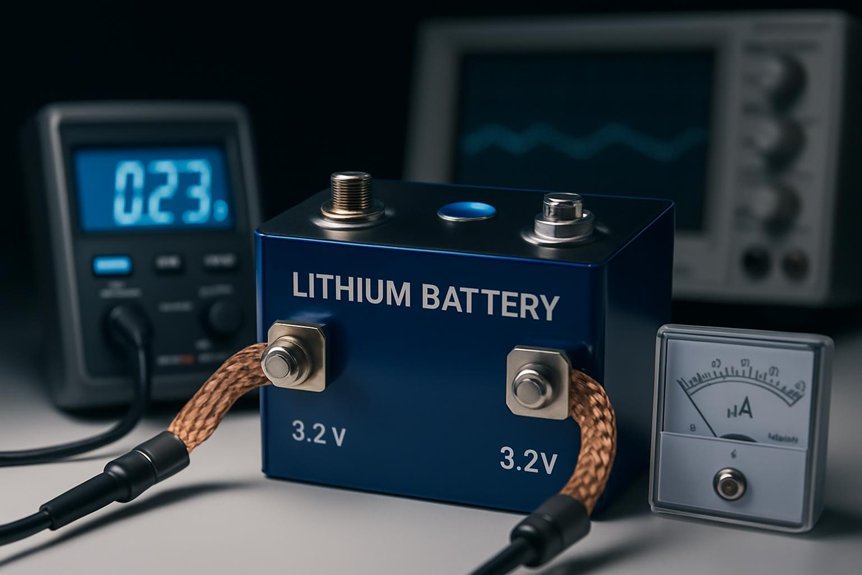
Internal resistance is a diagnostic lens we use to quantify a cell’s health and predict performance under load. We measure it with controlled current pulses and small-signal impedance tests, recording rise time, voltage drop, and temperature correction. Our measurement techniques focus on repeatability, loading conditions, and calibration to ensure comparability across cells and tests.
| Variable | Description |
|---|---|
| Temperature | Impacts resistance; adjust to standard test conditions |
| Current amplitude | Affects voltage response and measurement precision |
| Time base | Defines resolution of transient behavior |
Accurate internal resistance data reveal aging, electrolyte depletion, and contact losses. We interpret rising values as progressive degradation and use trends over cycles to forecast remaining life, guiding maintenance or replacement decisions.
Evaluating Charge/Discharge Cycles for Real‑World Performance
Evaluating charge and discharge cycles under real-world conditions builds directly on our resistance measurements by translating static health indicators into dynamic performance. We approach this with disciplined protocols that reflect actual usage, ensuring repeatable conclusions about capacity, efficiency, and aging.
- Establish calibration intervals and synchronize them with every cycle to minimize drift and maintain measurement integrity.
- Implement continuous data logging for voltage, current, temperature, and state of charge to capture transient effects and recoveries.
- Analyze cycle life trends by comparing full-depth versus partial-depth cycles, correcting for temperature and resting periods to isolate true degradation.
This methodical framework yields actionable metrics, enabling accurate projections of real-world range, power delivery, and reliability.
Safety, Red Flags, and Clear Next Steps for Replacement or Service
Safety considerations are non-negotiable when evaluating lithium battery health, as early warning signs can prevent costly failures and safety incidents. We outline safety protocols, identify risk indicators, and specify concrete actions for replacement or service. When anomalies appear, we prioritize rapid assessment, documented thresholds, and traceable decisions. If a cell or pack shows swelling, heat, leakage, or sudden voltage drops, treat as critical. We recommend isolating the unit, consulting qualified technicians, and following manufacturer instructions. Posture, PPE, and proper venting are essential. Below is a concise decision matrix to aid next steps.
| Action | Outcome |
|---|---|
| Inspect/measure anomalies | Decide on service vs. replacement |
Frequently Asked Questions
How Often Should I Test a Li-Ion Battery for Health?
We should test every 3–6 months for a Li-ion battery’s health, adjusting with usage and aging. Our testing frequency remains data-driven; we monitor capacity fade and impedance. This assure battery aging is tracked rigorously, not guessed.
What Ambient Conditions Affect Accuracy of Tests?
Like a clockwork compass, ambient conditions steer testing accuracy. We, readers, must control temperature, humidity, and airflow, quantify variations, and document data to ensure ambient conditions don’t skew testing accuracy. We insist on rigorous, data-driven procedures.
Can Testing Harm the Battery or Void Warranties?
We can test without harming the battery or voiding warranties if we follow manufacturer guidance and safe procedures; improper testing risks damage. We assess testing warranties and battery safety data, documenting steps to guarantee non-destructive, compliant evaluations.
Which Brands or Models Are Best for Home Testing?
Are you wondering which brands or models are best for home testing? We recommend brands to test and models for home testing that offer reliable data, documented specs, and user-friendly interfaces, supported by rigorous, data-driven testing protocols.
How Should I Interpret Test Results Without Technical Jargon?
We interpret results by keeping it simple: look for clear trends, not every decimal. Interpretation tips guide us through non technical phrasing, showing how numbers reflect health and performance in a straightforward, data-driven, methodical way.
Conclusion
We test Li‑ion health with rigor, precision, and repeatable steps. We baseline capacity, then stress with controlled discharges, logging voltage, current, SOC, and temperature. We measure impedance, perform small-signal tests, and compare full-depth versus partial-depth cycles. We watch for safety flags—swelling, leaks, rapid voltage changes—and document deviations. We analyze rest periods, temperature effects, and aging indicators, then decide on replacement or service per guidelines. We rely on data, repeatability, and clear thresholds. We act on findings, and we communicate them.