We weigh what powers more than volume or price: the chemistry inside the cell, where tiny changes in cathode, anode, and electrolyte shift safety, cost, and performance. We’ll map how nickel, cobalt, and manganese alter capacity and stability, why LFP’s sturdiness comes at a density trade-off, and how solid-state ambitions clash with interfaces. Together, we’ll assess temperature, aging, and pack design to answer—which chemistry fits your use case best, and at what cost?
Key Takeaways
- Cathode chemistry sets voltage, energy density, thermal stability, and cost; higher Ni increases energy density but can reduce safety margins.
- Anode choices trade capacity for stability: graphite is balanced, silicon boosts capacity with volume changes, lithium metal raises density with safety concerns.
- Electrolyte and SEI govern long-term cycling, calendar aging, and interfacial degradation; SEI formation and growth are pivotal.
- Energy density and cycle life depend on cell format and packaging; high-Ni/NMC/NCA offer high energy but require advanced thermal management.
- Supply chain and material availability (Co, Ni, Li) drive adoption, costs, and design choices across chemistries.
What Are Lithium Battery Chemistries and Why They Differ
So, what makes lithium battery chemistries differ? We see that cathode chemistry defines voltage, energy density, thermal stability, and cost, while transition-metal composition shifts redox potential and capacity per mass. Higher Ni boosts energy density but can reduce thermal stability, and crystal structure governs lithium diffusion and cycling degradation, with olivine (LFP) offering superior stability. Elemental scarcity, especially cobalt and nickel, drives adoption and per-kWh costs, and synthesis and coating techniques—doping, surface coatings—alter cycle life, rate capability, and safety margins. Anode choices trade capacity for stability: graphite balances cost and efficiency; silicon raises capacity but expands volume; lithium metal raises energy density yet raises safety concerns. Solid-state options promise safety gains but face interfacial and manufacturability hurdles, shaping temperature aging and supply sustainability decisions. New sentence added here with a main factual point: The electrolyte formulation also governs SEI formation, impacting long-term cycling and safety. [New sentence concludes with the main factual point bracketed: SEI formation
Key Performance Metrics You Should Care About
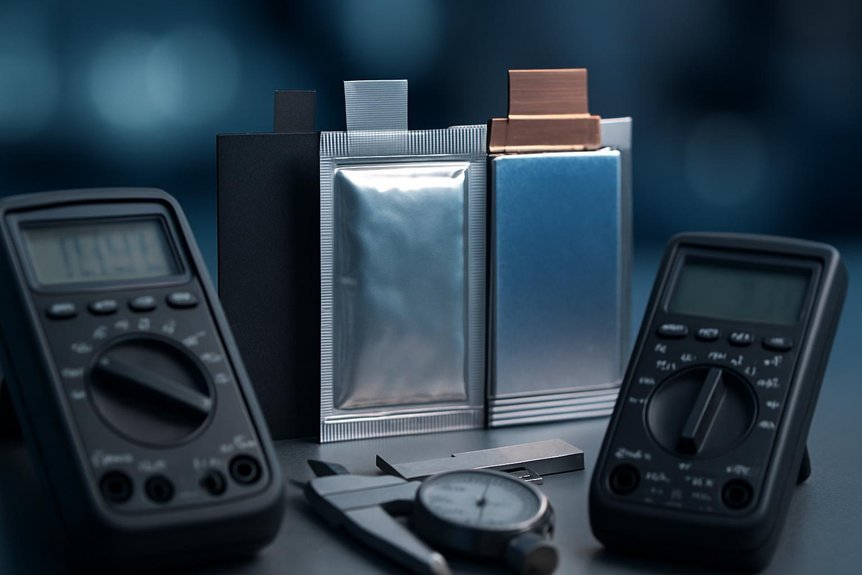
We examine how energy density and cycle life trade off across chemistries, because higher Wh/kg often comes at the cost of shorter lifetime or tougher thermal management. We’ll compare nominal capacity, DoD impact, and real-world energy throughput to show what matters for end-to-end performance. Our goal is to ground choices in measurable metrics, not marketing claims.
Longer-lasting lithium batteries provide more usable energy per dollar over time, especially with proper BMS, which reinforces the idea that measured cycle life and degradation rate matter as much as nominal capacity. Longer-lasting lithium batteries provide more usable energy per dollar over time, especially with proper BMS, which reinforces the idea that measured cycle life and degradation rate matter as much as nominal capacity.
Energy Density Range
How much energy can a lithium battery store, and how does that vary across chemistries and formats? We quantify energy density by gravimetric and volumetric metrics, with typical commercial gravimetric ranges at 100–300 Wh/kg and volumetric 250–700 Wh/L. High-Ni NMC and NCA cells push toward 180–270 Wh/kg and 600–700 Wh/L in optimized formats, while LiFePO4 sits around 90–160 Wh/kg and 250–350 Wh/L. Lab-scale Li-metal and advanced cells target >400 Wh/kg, though not mass-market. Pack-level realities reduce cell values by ~10–30% for mobility, BMS, cooling, and safety margins. Across formats, pouch and prismatic formats maximize Wh/L; cylindrical formats often lag. Abstract benchmarking and redox coupling clarify tradeoffs between density, safety, and longevity in practical designs.
Cycle Life Tradeoffs
Are cycle life and DoD intertwined in predictable ways, or do clever management tricks offer only marginal gains? We examine tradeoffs through cycle life, DoD, and calendar aging to reveal practical limits. LFP offers 3,000–10,000 full cycles to 80% SOH, while automotive NMC ranges 1,000–4,000; premium variants push toward 4,000. DoD nonlinearity means deeper discharges hasten fade, yet 50–80% DoD often yields the best energy-life balance. Equivalent full cycles help normalize partial discharges, essential for accurate forecasts. Temperature effects dominate degradation: every 10°C raise roughly doubles reaction rates and SEI growth, with LFP showing greater thermal robustness than NMC. Active thermal management, maintaining ~20–30°C, meaningfully extends cycle life; high SOC at elevated temperature accelerates calendar fade, underscoring calendar-cycle coupling. LFP’s safer and more stable chemistry further supports longer calendar lifetimes in exposed environments.
LCO, NMC, and NCA: How the Mainstream Chemistries Compare
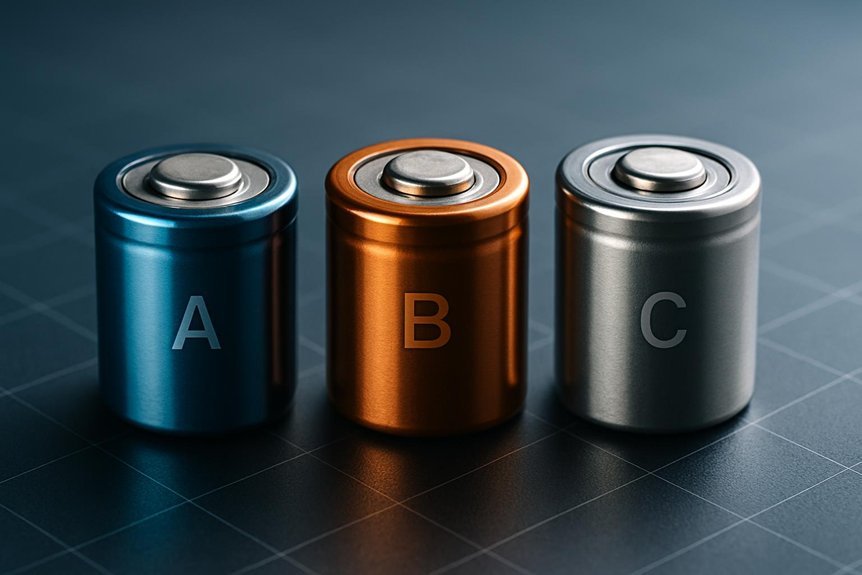
We compare LCO, NMC, and NCA through the lens of energy density tradeoffs and safety implications, focusing on how nickel content, cobalt stability, and aluminum reinforcement shape capacity and stability. We observe that higher nickel boosts gravimetric energy density but challenges high-rate performance and thermal management, while cobalt and aluminum mitigate lattice distortion and improve cycle life. This framing invites a concrete discussion on how chemistry choices leverage space, weight, and safety constraints across applications.
Energy Density Tradeoffs
What are the practical energy densities we can expect from the mainstream lithium chemistries, and how do LCO, NMC, and NCA trade gravimetric versus volumetric performance, cycle life, and rate capability in real devices? We summarize, with cell-level ranges: LCO 150–250 Wh/kg (labs up to ~300), NMC 180–260 Wh/kg, NCA 200–260 Wh/kg. Pack-level reductions of 5–20% apply. LCO offers high gravimetric density but limited cycle life; NMC provides balanced gravimetric and volumetric performance with adaptable formulations; NCA favors gravimetric efficiency and strong high-energy potential in production EVs. Rate capability scales with engineering choices; higher power often lowers usable energy. Tradeoffs also hinge on battery recycling and raw material sourcing to sustain density gains.
Safety and Stability Factors
Safety and stability in mainstream layered oxides hinge on how composition and structure respond to abuse, with LCO, NMC, and NCA each presenting distinct risk profiles. We examine how thermal runaway and mechanical abuse unfold differently across chemistries, guided by known degradation pathways and heat generation. Ni-rich formulations elevate heat and accelerate failure, while Al in NCA adds rigidity but cannot fully suppress oxygen evolution. Layered oxides exhibit lattice destabilization under deep delithiation, increasing fracture risk and surface reactivity after mechanical abuse. Oxygen release sustains exotherms, feeding rapid runaway, and SOC amplifies initiation hazards.
- Thermal runaway risks rise with higher Ni content and SOC
- Mechanical abuse promotes particle damage and local short circuits
- Abuses demand stricter protective controls for layered chemistries
LFP and LMO: Safety, Cost, and Where They Shine
LFP and LMO differ markedly in safety, cost, and ideal applications, with LFP offering superior thermal stability and a simpler safety envelope at the pack level while LMO provides moderate safety and distinct performance traits that suit certain design goals. We present a concise comparison: LFP’s high thermal runaway threshold and reduced heat generation enable simpler thermal management for stationary packs, while LMO’s spinel lattice yields 3D Li+ diffusion that can favor certain high-rate layouts. Cost and material availability favor LFP due to iron and phosphate abundance; LMO relies on manganese with competitive costs but variable performance. In research terms, model training and academic debates focus on balancing cycle life, abuse tolerance, and system-level integration to identify where each chemistry shines.
LTO and Fast Charging: Where They Fit and Where They Don’t
How do LTO’s fast-charge traits translate into real-world design, and where do they collide with practical constraints? We examine LTO tradeoffs through a battery-physics lens: high-rate capability clashes with energy density, cell voltage, and system-level constraints. While Li4Ti5O12 enables rapid charging with reduced plating risk, the elevated anode potential lowers pack energy and requires larger volumes to meet range targets. Practical performance hinges on cathode kinetics, electrolyte conductivity, and thermal paths, not just the anode.
- LTO tradeoffs: high cycle life and safety vs. lower gravimetric energy density
- Fast charging tradeoffs: rapid current flow balanced against thermal and parasitic losses
- System design: architecture, cooling, and packaging determine achievable charge rates
How Temperature and Aging Affect Different Chemistries
Temperature and aging play out differently across chemistries, so we can’t assume one-size-fits-all behavior after examining fast-charging tradeoffs. We assess how temperature and aging interact with each chemistry’s structure and degradation pathways. NMC/NCA suffer rapid performance loss above ~40°C due to electrolyte oxidation and transition‑metal dissolution; calendar aging accelerates with high SOC and heat. LFP shows better high‑temperature resilience but still ages faster above ~45°C, with SEI and electrolyte effects chronic at extreme temperatures. LCO is highly temperature sensitive, risking rapid electrolyte decomposition and instability. LTO demonstrates broad tolerance, yet energy density and self‑heating differ from graphite. Solid‑state and high‑Ni variants shift temperature windows and interfacial stresses. We note low temperature drafting and high temperature mitigation as practical framing for design and testing.
How to Choose the Right Chemistry for Your Use Case
Which chemistry best fits your use case depends on balancing energy, power, longevity, and safety requirements against size, cost, and operating conditions. We analyze tradeoffs to align with prospective markets and material availability, not just specs. LFP offers safety and long calendar life, suitable for stationary storage and high-DoD apps where volume is acceptable. LTO excels in rapid charge and high cycle life, ideal for heavy-duty transport and grid services with robust thermal systems. For compact, high-energy needs, NMC/NCA/LCO dominate, but demand tighter BMS, cooling, and supply discipline. Weigh energy density against safety margins and supply risk, then match packaging and thermal strategy to the target market.
- Prospective markets alignment
- Material availability
- System complexity and cost
Supply Chain, Cost, and Sustainability Considerations
Where do supply chains, costs, and sustainability intersect most critically for battery chemistries? We map dependencies from feedstock to finished packs, noting how geopolitical risk concentrates cobalt and nickel in a few regions, how China dominates refining and electrode capacity, and how processing bottlenecks cap scale. Costs swing with nickel, cobalt, and lithium prices, while policy incentives—like domestic manufacturing credits—reshape regional parity and investment. Recycling economics vary by chemistry: high-value NMC/NCA metals yield better recovery, whereas LFP and sodium-ion rely on volume and credits to close the loop. Alternative chemistries lower material scarcity but require different recycling economics and scale. Long-duration options promise lower $/kWh, yet trade efficiency for tail-end sustainability.
Frequently Asked Questions
How Do Chemistries Differ in Thermal Stability and Safety Risks?
Chemistries differ in thermal stability: LFP’s higher onset temps and lower gas/oxygen release yield safer profiles, while NMC/NCA/LCO show lower thresholds and greater heat release. Chemistry tradeoffs affect safety considerations, with containment and cooling-driven risk management critical for all.
What Governs Cycle Life Across Chemistries Under Real-World Use?
Cycle life is governed by DoD, SoC windows, temperature, and rate, with calendar aging looming alongside cycle aging; we observe cell-to-cell variability, thermal nonuniformity, and BMS controls shaping real-world degradation across chemistries.
Which Chemistries Excel in High-Drain Power Applications?
We excel in high-drain focus, delivering superior power density metrics when configured for high-rate use. We find LFP, LMO, and high-nickel chemistries offer rugged, sustained power, while NMC/NCA variants push peak currents with trade-offs.
How Do Charging Speed and Calendar Life Trade-Offs Vary?
We find that fast charging and calendar life trade-offs hinge on chemistry: high energy density chemistries suffer more from temperature and voltage stress, while lower energy ones tolerate fast charging better; we balance cycle longevity with calendar degradation.
What Are Practical Heuristics for End-User Battery Selection?
We investigate truthfully enough to imagine the scene: practical heuristics illuminate end user selection, guiding you and us toward safer, longer-lasting choices, balancing cost, safety, and fit for purpose with clear, analytical criteria.
Conclusion
We’ve walked through how cathode and anode choices shape voltage, energy density, safety, and cost, and how temperature, aging, and pack design alter real-world performance. In short, no single chemistry dominates; it’s about matching needs to trade-offs. Think of it like tuning an instrument: each string adds a distinct note to the harmony of performance, safety, and economics. By understanding your use case, you can craft the optimal, balanced battery solution.