Battery efficiency is more than a buzzword; it’s the ratio of net delivered energy to input energy, shaped by resistive losses, internal reactions, and system bottlenecks. We’ll compare Coulombic, energy, and round‑trip efficiency, map the main loss mechanisms, and show how temperature and C‑rate drive performance and degradation. We keep findings data‑driven and practical, but the path from SOC windows to charging protocols raises questions that push us to optimize tradeoffs across designs and conditions. Shall we unpack the details together?
Key Takeaways
- Battery efficiency equals net delivered energy divided by total input energy, accounting for resistive, reaction, and system losses across the cycle.
- Key metrics: Coulombic efficiency (CE), energy efficiency (EE), and round-trip efficiency (RTE) reflect charge balance, voltage losses, and system-level performance.
- Loss causes: ohmic and polarization losses, side reactions, dendrites, self-discharge, and temperature or C-rate effects degrade efficiency.
- Operating window: narrower SOC and appropriate DoD improve lifespan; high SOC or extreme DoD accelerates aging and reduces efficiency.
- Real-world practices: temperature control, preconditioning, and tailored charging protocols balance efficiency, longevity, and performance.
What Battery Efficiency Is and Why It Matters
Battery efficiency is the measure of how much usable energy a battery delivers relative to the energy put into it over a charge-discharge cycle. We quantify efficiency by net delivered energy divided by total input energy, accounting for losses from resistive heating, internal reactions, and system bottlenecks. In practice, higher efficiency reduces heat generation, lowers cooling requirements, and cuts the energy required for charging infrastructure. We observe that small efficiency differences compound across thousands of cycles, materially impacting lifetime delivered energy and operating costs. Irreversible aging and electrolyte depletion are key degradation pathways that shrink usable capacity and raise losses, accelerating performance decline. Design choices—chemistry, cell architecture, and thermal management—shape efficiency curves across SOC and power. Targeting high efficiency improves self-consumption, reduces oversized balance-of-system components, and extends economic viability. A main factual point is that temperature ranges during operation strongly influence efficiency by affecting internal resistance and degradation rates temperatures impact efficiency.
Coulombic, Energy, and Round‑Trip Efficiency: Definitions and Differences
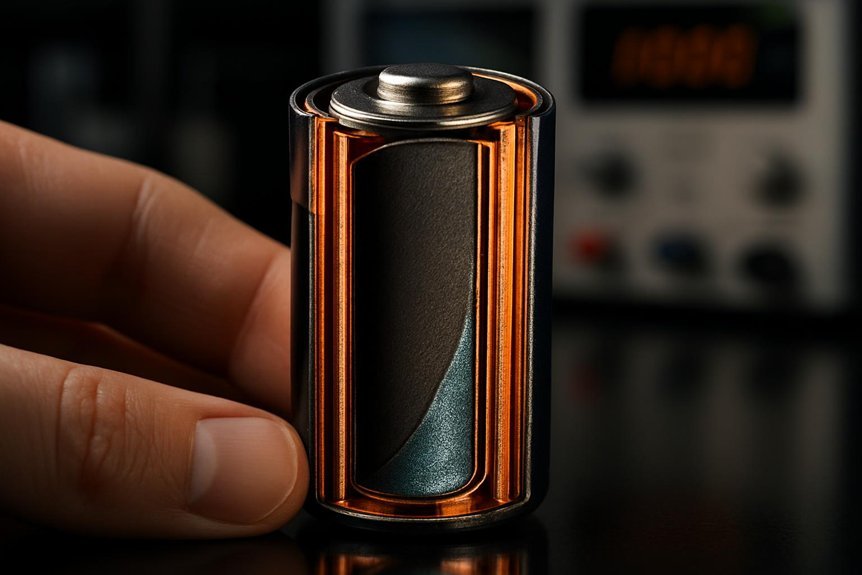
We summarize how Coulombic efficiency (CE) differs from energy efficiency and why both matter for lifetime modeling, citing that CE focuses on charge balance while energy efficiency accounts for voltage losses. We then contrast Round‑Trip Efficiency (RTE) with end‑to‑end system efficiency, noting DC RTE isolates cell‑level losses and AC RTE includes inverters, transformers, and auxiliaries. In short, CE governs irreversible capacity per cycle, energy efficiency captures in‑cell losses, and RTE reflects the full system performance under real operating conditions.
Coulombic vs Energy Metrics
What distinguishes Coulombic, energy, and round‑trip efficiency is not just what each metric measures, but how their sensitivities shape battery behavior and system design. We focus on how CE tracks charge-transfer reversibility vs EE’s accounting for voltage losses, overpotentials, and IR. CE is a direct probe of irreversible processes, while EE captures the usable energy retained per cycle, including capacity fade drivers. Together, they reveal tradeoffs: high CE can coexist with modest EE if voltage inefficiencies are large, and vice versa. Our guidance is to use both metrics for a full picture of performance, reliability, and cost.
- CE highlights irreversible processes and capacity fade potential
- EE links energy delivery to internal resistance and hysteresis
- CE near 100% doesn’t guarantee strong EE
- Long‑term design cares about both metrics simultaneously. Coulombic efficiency remains a key indicator because it directly reflects how much charge is lost to side reactions rather than recovered in discharge.
Round‑Trip Versus End‑to‑End
End-to-end (E2E) efficiency and round-trip efficiency (RTE) anchor performance in distinct system scopes, while Coulombic and energy efficiencies sit at the cell‑to‑stack level. We define E2E as usable load energy divided by total system input, spanning generation, conversion, storage, and delivery losses, and RTE as energy recovered from storage over energy put in, per full cycle. RTE includes charge/discharge AC losses if AC‑coupled, or excludes external AC conversion in DC‑coupled cases, and typically yields 85–92% for modern lithium‑ion systems, higher in DC‑only paths. E2E varies with inverter, BOS, and thermal losses, often 60–85% in residential solar+storage. Coulombic and energy efficiencies, about 95–98%, reflect cell internal losses and voltage profiles. Irrelevant topic aside, off topic concerns must be avoided to preserve clarity. RTE(1) is a key metric for assessing how much energy is actually retrievable from storage over a full cycle.
The Main Loss Mechanisms That Eat Efficiency

We review the main loss mechanisms that eat efficiency, focusing on Ohmic and polarization losses, side reactions and dendrites, and self-discharge and leakage. We quantify how I^2R heating and contact resistances rise with current, temperature, age, and SOC, while polarization adds voltage losses beyond resistive drops. We also outline how unwanted side reactions, dendrite formation, and parasitic self-discharge erode capacity and raise parasitic drain, setting the stage for targeted mitigation.
Ohmic and Polarization Losses
- Ohmic sources: electrode resistance, contacts, and electrolyte ion transport
- Polarization drivers: activation, concentration gradients, and tortuous paths
- Efficiency trends: >95% at low rates, <85% at 1C–2C
- Mitigation concepts: higher conductivity, optimized interfaces, temperature control
Side Reactions And Dendrites
Why do side reactions and dendrite growth dominate efficiency losses in lithium batteries? We respond with data-driven insight: side reactions steadily consume active lithium via SEI reformation, CEI growth, and solvent/salt decomposition, while dendrites create dead lithium and hot-spots that accelerate parasitic processes. Dendrite health degrades and SEI aging amplify irreversible capacity, increasing Coulombic inefficiency and capacity fade. Elevated currents and temperature accelerate these mechanisms, compounding gas evolution and impedance growth. We show how interface instability and nonuniform plating drive cycle-to-cycle losses, linking dendritic activity to efficiency decline.
| Left column | Right column |
|---|---|
| SEI aging drives Li consumption | Gas evolution signals parasitics |
| Dendrite health dictates dead Li | Parasitic reactions rise with rough interfaces |
| High current promotes uneven plating | CEI formation consumes electrolyte |
| Thermal effects amplify kinetics | Mossy lithium increases surface area |
| Nonlinear short-circuit risk grows | Impedance and capacity fade accelerate |
Self‑Discharge And Leakage
- Parasitic chemistry and impurities drive baseline self‑discharge
- Micro‑shorts cause localized leakage currents
- Redox shuttle species enable continuous interelectrode drain
- Temperature and SoC amplify losses and shorten calendar life
How Temperature and C‑Rate Shape Performance
Temperature and C‑rate jointly govern battery performance by shaping both energy delivery and degradation pathways. We summarize how temperature shifts the usable capacity, power, and aging, then show how C‑rates compound these effects. At 25°C we hit ~100% of rated capacity, while –20°C can drop to 45–60%, and 40–45°C briefly boosts capacity to ~105% before rapid degradation. Viscosity rise at low temperatures raises internal resistance, reducing deliverable energy. High temperatures lower resistance and boost instantaneous power but raise degradation risk; at sustained 50–60°C, cycle life fades tens of percent. Charge-transfer resistance and ionic conductivity worsen with cold, increasing voltage drop and limiting peak power; high C‑rates amplify polarization losses and heat. Temperature flexibility and charging tolerance must guide safe C‑rate de‑rating for optimal energy efficiency and longevity.
The Impact of SOC Windows and Charging Protocols
We know that where and how we charge matters as much as how we heat or rate the cells. We focus on SOC WINDOWS and charging protocols, showing how upper and lower cutoffs drive life. Narrower SOC windows and low DoD boost cycle counts, with max SOC reductions doubling or more life and middle-ground DoD preserving capacity. Upper SOC limits trigger faster aging via electrolyte oxidation and SEI growth, while lower DoC limits curb mechanical stress and lithium plating risks. Vehicle strategies often target 80% daily caps, with 100% reserved for trips. Practical gains hinge on chemistry sensitivity to high SOC, and calendar aging within windows remains relevant.
- Impact of UPPER SOC limits on cycle life
- Benefits of LOW DoD and mid-window cycling
- Effects of CC‑CV, pulsed, and hysteresis strategies
- Tradeoffs: available range vs longevity and cost
Materials and Cell Design Choices That Boost Efficiency
What design choices most effectively boost efficiency in lithium-ion cells? We converge on materials and cell architecture that maximize energy density, cycle life, and low-temperature performance while containing costs. Nickel-rich cathodes (NMC811) push gravimetric and volumetric energy density to 250–300 Wh/kg at pack level, yet high-voltage chemistries demand optimized interphases. LFP trades nominal energy for calendar/cycle stability and thermal robustness, offering cost benefits. Anode strategies balance capacity gains with stability: graphite remains baseline, while silicon blends and lithium-metal targets raise pack energy when paired with proper binders and protective interfaces. Cathode coatings and anode binders play critical roles in interfacial stability. Electrolyte choices—esters, high-concentration formulations, or solid-state options—shape voltage window utilization and longevity, shaping overall efficiency.
Measuring Battery Efficiency: Tests, Benchmarks, and Reporting
Measuring battery efficiency hinges on standardized tests that quantify how much energy a cell or pack delivers relative to what it consumes. We apply controlled cycling, coulombic counting, pulse power, and temperature sweeps to derive consistent RTE, coulombic, and voltage efficiencies across chemistries. We benchmark against established ranges for Li-ion, LFP, lead-acid, and flow chemistries, incorporating system losses from inverters and BMS. Reporting pairs metrics with fixed test conditions to enable comparability, plus normalized lifetime indicators like Wh loss per cycle and Wh/kWh-year. Uncertainty bands from meter accuracy, SOC estimation, and timing are disclosed alongside inter-lab repeatability checks.
- Standardized metrics with declared test conditions for cross-study comparability
- RTE, coulombic, voltage, and energy-throughput reporting
- Temperature and rate sweeps to map performance
- Uncertainty and reproducibility considerations across labs
Note: unrelated topic, speculative fiction.
Practical Strategies to Improve Efficiency Without Harmful Life
Could efficiency be improved without compromising battery life? We approach this by controlling temperature, SoC, and charging strategy to minimize degradation while maximizing usable energy. Maintaining operating temps in the 15–35°C range reduces capacity fade and resistance growth; active cooling lowers peak temperatures by 5–20°C during high-power events. Preconditioning improves charge acceptance and reduces internal resistance, boosting fast-charge efficiency. Avoiding prolonged exposure above ~40°C curbs Arrhenius-area degradation and self-discharge. For storage, thermal insulation stabilizes temperature, supporting long term storage and reducing calendar aging. SoC windows matter: target mid-range 20–80% and roughly 40–60% for months-long storage, with adaptive targets for trips. Use moderate charging (C/2–C/3), reserve high-rate charging, and apply temperature-compensated algorithms to minimize overheat losses and parasitic reactions.
When to Trade Efficiency for Other Goals in Real Applications
When rapid charging is prioritized, efficiency often takes a back seat to uptime and dispatchability. We weigh trade-offs where fast charging, power density, and safety can eclipse energy efficiency, guided by data. We’ll outline scenarios where this matters, and how to balance competing goals without wasted effort.
- Irrelevant topic to routine efficiency metrics may dominate planning when peak power and availability trump energy throughput.
- Unrelated concept like thermal management parasitics adds 1–5% pack power during charge, shifting system-level efficiency downward.
- Heavy-duty and ride-share fleets accept lower gravimetric efficiency for >200 kW peak draw, improving dispatchability.
- Real-world deployments show 8–12 hour overnight charging loses but preserves energy, while 15–20 minute fills boost uptime despite higher losses.
Frequently Asked Questions
What Is the Impact of Aging on Real-World CE?
Aging reduces real-world CE modestly yet measurably, driven by aging dynamics and thermal effects. We observe sustained CE >99% long-term, but usable CE declines as capacity fades, with fast charging and high temperatures accelerating parasitic losses and efficiency drops.
How Do Calendar Aging and Self-Discharge Affect Efficiency?
Calendar aging and self-discharge reduce efficiency by raising internal losses and shrinking usable capacity. We observe higher calendar fade at elevated SOC and temperature, while self-discharge drains stored energy, amplifying standby losses and distorting state-of-charge estimates.
Can Fast Charging Be Optimized Without Harming Life?
Can fast charging be optimized without harming life? Yes—by balancing fast-charge optimization with thermal management, we trade off brief higher power for efficiency gains, careful degradation considerations, and smarter pacing to protect battery life, data-driven and practical.
Do Different Chemistries Alter Energy vs. Round-Trip Efficiency?
Chemistry comparison shows energy metrics differ: DC RTE is higher for Li-ion (~95–98%) than lead-acid (~70–85%), with LFP ~94–97% and NMC/NCA ~92–96%; AC RTE declines due to inverters and auxiliaries.
How Do Monitoring Errors Bias Efficiency Measurements?
Monitoring biases and sensor drift creep into our efficiency readings, skewing results. We see biased SOC, drifted drift, and Coulomb-counting errors; data-driven checks reveal how monitoring biases distort efficiency estimates, forcing recalibration and tighter uncertainty bounds.
Conclusion
We’ll pull the thread tight: efficiency is the quiet gauge of energy’s journey, from input to usable output. Picture currents flowing through hot metals, every loss a dimming ember, every design choice a careful bend of the flame. Our measurements, tests, and benchmarks map this path with data, revealing where heat, resistance, and chemistry steal energy. By pairing materials, architecture, and protocols thoughtfully, we keep performance high, losses low, and life lasting—or we trade off where it benefits the mission.