We explain Depth of Discharge as the fraction of a battery’s usable energy drawn from its reference capacity, versus the energy left in reserve. We examine how DoD, state of charge, and cycling influence aging, efficiency, and reliability, and we map chemistry-specific limits to real-world operation. We’ll trace how BMS protections shape usable energy and how temperature and load affect performance, then show practical consequences for system design. The implications push us to contemplate tradeoffs we can’t ignore.
Key Takeaways
- DoD is the fraction of battery capacity used during discharge relative to reference capacity; it also acts as a design/operation limit to protect cells.
- Higher DoD reduces usable cycles and accelerates degradation through chemical and mechanical stress.
- Different chemistries tolerate DoD differently: Li-ion often 80–90% DoD; LiFePO4 supports 80–100% with longer life.
- Usable capacity equals nominal capacity multiplied by DoD, with round-trip efficiency affecting delivered energy.
- Real-world DoD targets adjust by use case, temperature, economics, and BMS strategies to balance durability and availability.
Foundations: DoD, SoC, and Lifecycle Basics
Depth of Discharge (DoD) and State of Charge (SoC) define how much battery energy we’ve used versus how much remains. We measure DoD as a percentage of full-charge capacity, and SoC as the instantaneous remaining fraction, both relative to the same reference. In practice, DoD has two meanings: current discharge fraction and a routine operational limit. BMSs enforce these bounds to protect cells and preserve warranties. We rely on Coulomb counting, OCV mapping, and model-based estimates to track SoC, but each method introduces calibration challenges and chemistry nuances that can drift over time. Periodic reconditioning or zero-offset resets mitigate Coulomb-counting drift. Reported usable capacity reflects factory DoD boundaries, temperature, and cycling protocols. Understanding these fundamentals clarifies lifecycle behavior and sets the stage for discussing how DoD interacts with longevity without venturing into the next topic. Main factual point: DoD and SoC are both tied to a common reference frame for a battery’s rated capacity, ensuring consistent interpretation across methods.
How DoD Impacts Battery Life and Reliability
How does DoD influence a battery’s life and reliability in practical terms? We quantify DoD effects with cycle life, aging, and system reliability. Higher DoD reduces guaranteed full-equivalent cycles and accelerates capacity fade per cycle due to nonlinear degradation, while partial cycles convert to equivalent cycles via rainflow counting. Internal stress rises with DoD, accelerating SEI growth, electrolyte oxidation, mechanical strain, and impedance, and increasing lithium plating risk under cold or high-rate charging. Calendar aging compounds cycle aging, so deeper cycling hastens capacity loss in the same calendar time. DoD policies shape redundancy, derating, and maintenance—higher DoD expands energy per cycle but lowers mean time to replacement. Unrelated topic and irrelevant focus are distractions that muddy risk assessment, not engineering realities. Depth of Discharge also governs how much energy is drawn per cycle, influencing both instantaneous strain and long-term durability.
DoD Limits by Battery Chemistry
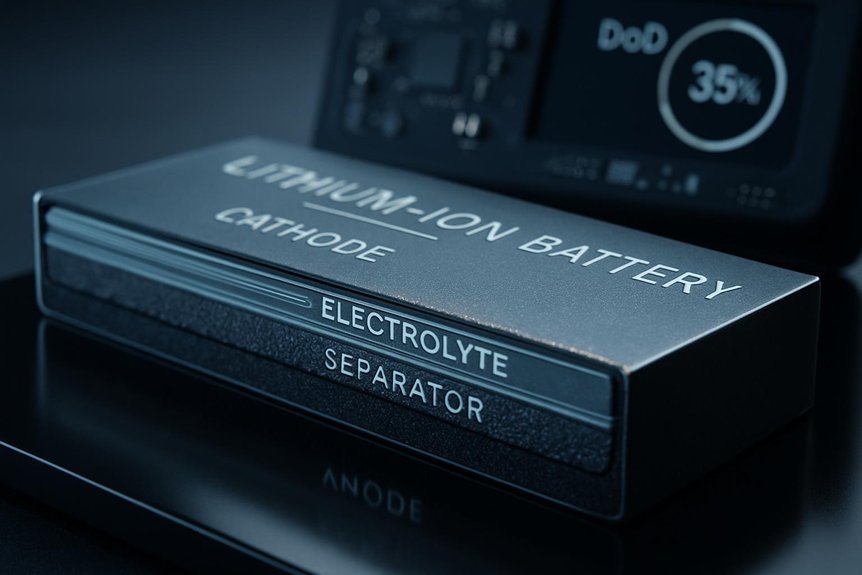
Depth of Discharge limits by chemistry vary markedly because each chemistry balances capacity retention, cycle life, and safety in distinct ways. We examine how battery aging and thermal risks shape practical DoD use across chemistries. Lead‑acid systems typically target ~50% usable DoD for longevity; deeper discharges accelerate sulfation or plate degradation, shortening cycles and demanding regular equalization. Lithium‑ion chemistries (NMC/NCA/LCO) enable broad DoD ranges, yet 80–90% cycling often yields the best life vs capacity trade‑off; full 0–100% cycling raises failure risk without careful thermal control. LiFePO4 offers higher tolerance to deep discharge, with 80–100% DoD common and extended cycle life, while maintaining safety through a wider voltage window. Nickel‑based chemistries limit DoD to 30–50% for cycle longevity, and exhibit higher self‑discharge. Emerging chemistries promise different DoD paradigms, shaped by thermal and aging dynamics. DoD limits by chemistry reflect how energy delivery and wear patterns interact under typical operating temperatures and usage profiles.
Translating DoD to Usable Capacity for Your System
To translate DoD into usable capacity, we start with the basic arithmetic: usable capacity equals nominal capacity times DoD, with energy expressed in Wh as nominal Wh times DoD. We then apply system architecture constraints: in series, usable Ah equals single-cell Ah times DoD; in parallel, usable capacity sums across strings. Round-trip efficiency reduces delivered energy: Delivered = Usable × efficiency. For sizing, required usable capacity is daily energy divided by system usable DoD and by efficiency, plus an autonomy buffer. Temperature and seasonality derate nominal capacity, and peak power needs may mandate larger nominal capacity despite DoD-derived energy. Usable capacity management hinges on BMS limits and a practical SoC window, with rate effects and aging shrinking usable capacity over time. LCOS and replacement timing tie to lifetime throughput and cost optimization. DoD is essential for aligning energy draw with available capacity, ensuring safe and reliable operation.
Optimizing DoD in Real-World Operations
We’ll apply the DoD optimization concepts from DoD-to-usable-capacity to real-world operations by tailoring depth targets to each use case and monitoring degradation signals to update those targets over time. We emphasize lifecycle-aware decisions across residential, commercial/industrial, EV, and grid services contexts, balancing degradation with revenue opportunities. Negative pricing signals and fleet demo experiences inform adaptive DoD setpoints, adjusting targets when TOU arbitrage or demand charges shift economics. We leverage hard/soft BMS limits, predictive SOC/SoH estimation, and fleet-level orchestration to equalize aging while maximizing availability. Calendar and temperature effects, C-rate stress, and partial-depth cycling benefits shape policy. Data logging feeds models that refine DoD policies, ensuring durable throughput and lower $/kWh over warranty.
Frequently Asked Questions
How Does Temperature Affect Dod Effectiveness and Battery Aging?
Temperature effects drive aging interactions: at cold temps DoD effectiveness shrinks due to slower kinetics, while heat boosts short-term DoD but accelerates irreversible loss. We observe non-linear, Arrhenius-like aging, especially under high DoD and elevated temperatures.
Can Dod Vary by Season Without Harming Warranty?
We can vary DoD seasonally within defined limits, but only under Seasonal warranty considerations and Temperature related policy nuances; we’ll document cycles, stay inside rated usable capacity, and maintain BMS-enforced protections to preserve coverage.
What’s the Fastest Way to Recalibrate Dod Readings?
We recalibrate fast by controlled, shallow cycles and precise logging, but beware calibration pitfalls and accuracy limits; we minimize depth, rest adequately, and verify with a short discharge and cross-check against OCV to confirm alignment.
How Do Dod Choices Impact PV Self-Consumption?
We avoid depth concerns and focus on doD impact battery aging, as higher DoD often boosts PV self-consumption by discharging more during peak, but accelerates aging, lowers cycle life, and reshapes LCOS with adaptive control.
Is Dod the Same Across All Battery Pack Modules?
Yes, not exactly. We acknowledge idle chatter and marketing jargon, because DoD varies module‑to‑module due to SOH, balancing, temperature, and BMS limits, so practical DoD isn’t uniform across a pack.
Conclusion
We’ll summarize the core takeaway: DoD is a controllable lever that trades usable energy for longevity and reliability. In practice, aiming for modest DoD often yields longer cycle life and lower impedance growth, especially in Li-ion chemistries. Consider this statistic: a typical high-energy pouch cell can gain up to 20–30% cycle life when DoD is limited from 100% to about 80%. Balancing DoD with efficiency and temperature is essential for predictable performance across applications.