We understand what powers our devices, yet we still wonder how something so small holds so much energy. We’ll walk you through lithium batteries, from ions moving inside to electrons flowing outside, and how this simple idea becomes a reliable power source. We’ll outline how charging and discharging reverse and restore ion positions, and why the battery management system matters. Stay with us as we connect chemistry, forms, and performance metrics to real-world behavior.
Key Takeaways
- Lithium batteries shuttle Li ions between anode and cathode during charging and discharging, powering devices via external electrons.
- Anodes are graphite/silicon; cathodes are metal oxides/phosphates; electrolytes enable Li-ion transport between electrodes.
- Types (NMC, NCA, LFP, LCO, LMO) and form factors (cylindrical, prismatic, pouch) affect energy density and safety.
- A Battery Management System (BMS) monitors voltages, temperatures, and SOC, balancing cells and protecting the pack.
- Performance depends on usable capacity (often 80–90% of rating), rate capability, aging indicators, and safety considerations.
Lithium Batteries at a Glance: What They Are and How They Work
Lithium batteries are rechargeable cells that shuttle lithium ions between electrodes during operation, enabling energy storage and release. We describe Li-ion chemistries like NMC, NCA, LFP, LCO, and LMO, and note that form factors—cylindrical, prismatic, and pouch—shape energy density and thermal behavior. We distinguish cells, modules, and packs coordinated by BMS. Nominal cell voltages range ~3.2–3.7 V, charging up to ~4.0–4.3 V, with end-of-discharge near 2.5–3.0 V, depending on chemistry. Anodes commonly use graphite or silicon composites; cathodes use metal oxides or phosphates; electrolytes combine lithium salts with carbonate solvents. Separators prevent short circuits, while current collectors and binders affect manufacturability. Performance hinges on energy density, cycle life, and temperature sensitivity; considerations include novel materials and recycling economics to address sustainability.
How Charging and Discharging Move Ions and Electrons

During discharge, lithium ions move from the anode to the cathode through the electrolyte, while electrons travel externally from the anode to the cathode to power the load. We describe ion transport as the core process driving charge transfer: ions intercalate and deintercalate within electrode host structures, storing and releasing charge in a controlled sequence. Charging reverses ion migration, cathode to anode, with diffusion driven by concentration gradients across separators and interfaces. We emphasize the role of electrode interfaces in kinetics: charge-transfer reactions, SEI/CEI layers, and interfacial impedance govern rate, efficiency, and stability. External current collectors and electrode composites set resistance and polarization, influencing voltage and power. The electrolyte/separator enforce ion conduction while blocking electrons, shaping overall impedance and transient response during high-rate operation.
How Safety and the Battery Management System Keep You Protected
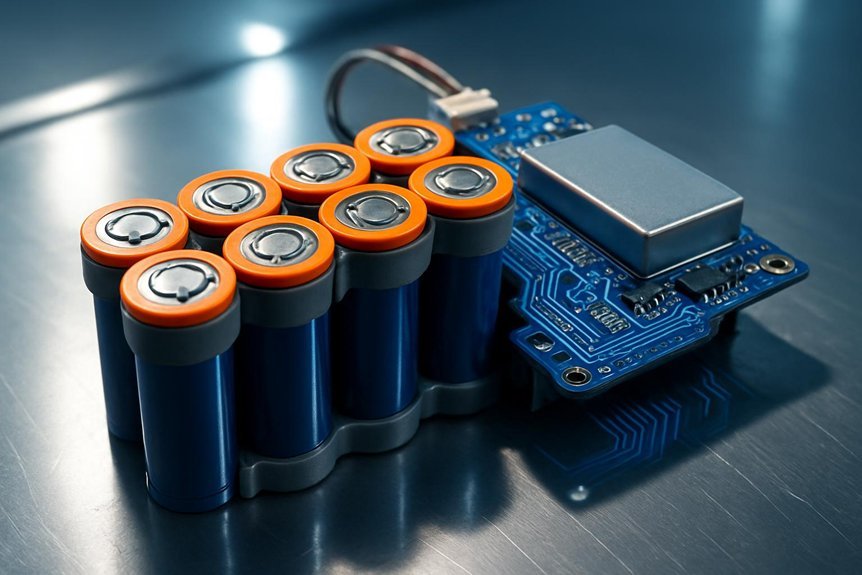
How do safety systems keep you protected in lithium batteries? We design multi-layer defenses that cut risk from voltage, current, temperature, and abuse. The BMS monitors per-cell voltages, enforces upper/lower limits, and balances cells to prevent overvoltage and capacity loss, while tracking SOC and fault history for diagnostics. Current sensing clamps overcurrent and shorts, and temperature sensing enforces safe windows with derating or shutdown if needed. Protective actions include pre-charge control, contactors, and rapid isolation during faults. Passive or active balancing minimizes weak-cell overvoltage and accelerates balancing in large packs. Regulations (UN 38.3, IEC/UL standards) formalize protections, but ethics matter: safety myths must be debunked, and protection ethics guide conservative design choices. Continuous self-testing and fault logging help ensure ongoing reliability in real-world use main factual point: proper protection preserves safety and longevity.
What Matters Most for Performance: Metrics You Should Track
What matters most for performance is tracking the metrics that directly reflect usable energy, power capability, and aging behavior. We focus on capacity metrics to gauge usable energy and pack range, noting that BMS often limits usable capacity to 80–90% of nameplate to extend life. We track energy as Wh and energy density as Wh/kg and Wh/L, with rating conditions showing how temperature and C-rate affect capacity. Degradation indicators, including capacity fade, rising internal resistance, and shifting coulombic efficiency, reveal aging progress. We monitor C-rate impacts on peak and continuous power, noting heat and resistance rise accelerates aging. Calendar life matters too, especially at high state of charge. Together, these metrics drive performance forecasts and maintenance decisions for reliable operation. Capacity remains a core determinant of runtime and range, guiding device design and service planning.
How Chemistry Choices Affect Cost, Safety, and Lifespan
Chemistry choices drive a delicate balance between cost, safety, and lifespan across the battery system. We weigh cathode economics against performance and supply risk, noting LCO’s high energy density but cobalt-driven cost volatility, nickel-rich NMC/NCA’s density gains with added thermal and manufacturing demands, and LFP’s lower density yet stable, low-cost iron-based composition. Anode materials matter too: graphite remains baseline—low cost and solid cycle life—while silicon and lithium metal promise capacity boosts but raise degradation, cost, and safety challenges. Electrolyte and separator choices trade safety against cost, and solid-state options offer safety gains with scale hurdles. Cell formats influence pack safety margins and cost discipline. Cathode economics and anode materials together shape long-term cost and lifespan.
| Cathode options | LCO, NMC/NCA, LFP, LMO/LMR | |
| Anode materials | Graphite, Silicon, Lithium metal, Hard carbon | |
| Impacts | Energy density, cost, thermal behavior | Manufacturing complexity, safety |
| System effects | Pack $/kWh, cycle life, warranty risk | Formation, balancing, yield |
Frequently Asked Questions
How Do Batteries Degrade Over Time Beyond Capacity Loss?
We degrade through multiple degradation mechanisms beyond capacity fade, causing aging effects like impedance rise, thermal stress, and nonuniform lithiation; these mechanisms increase self-discharge, reduce power, and threaten safety during operation and storage.
What Happens Inside a Battery During Thermal Runaway?
We’ll shed light like Daedalus: during thermal runaway, thread safety fails, thermal chemistry accelerates; electrolyte reactions vent and ignite. We’re detailing safety protocols as heat builds, then gases surge, then jet flames, then rapid containment.
Can I Use Any Charger for Lithium Batteries Safely?
No, we can’t use any charger for lithium batteries safely; incompatible chargers pose safety hazards. Use a proper, matched charger with CC-CV control, temperature/voltage protections, and pack-BMS communication to minimize risks and ensure safe charging.
Why Do Different Formats (Cylinder, Pouch) Matter?
We explain format considerations: different formats matter because form factor impacts packing, cooling, and safety. We assess how cylinder vs pouch shapes influence structural support, thermal paths, energy density, and mechanical robustness for our battery designs.
How Does Recycling Actually Recover Battery Materials?
We recover via a defined recycling process that separates and treats black mass, achieving high material recovery efficiency. We thermally, chemically, or mechanically process to extract Li, Co, Ni, and Cu for reuse, with efficiencies varying by method.
Conclusion
We’ve walked through how lithium batteries store, move, and regulate energy, and you’ve seen why chemistry choices matter for cost, safety, and lifespan. One striking stat: a well-managed Li-ion pack can crest 80–90% of its capacity after 1,000+ cycles, preserving much of its performance. As you evaluate packs, prioritize BMS capabilities, proper charging profiles, and the cell chemistry that fits your use case. With careful design, you’ll maximize safety, reliability, and value.