We examine how lightweight lithium batteries shift mobile performance by boosting gravimetric energy density, reducing pack weight, and expanding thermal margins. Our approach is systematic: compare chemistries, packaging, and interconnects; quantify trade-offs between energy, weight, and cost; and assess real-world impacts on form factors. As we assemble the picture, practical questions arise—how far can we push weight without compromising safety or cycle life? We’ll explore these dynamics as we proceed.
Key Takeaways
- Lightweight lithium reduces device weight, improving runtime, thermal margins, and user ergonomics without sacrificing performance.
- Higher energy density enables smaller, thinner packs, freeing space for other components and enabling sleeker form factors.
- Optimized packaging and interconnects cut mass while maintaining safety, reliability, and structural integrity.
- System-level trade-offs balance weight, cooling, and cost to sustain peak performance under real-world workloads.
- Lifecycle and sustainability considerations (cycle life, recycling, second-life) enhance total cost of ownership and environmental impact.
Why Lightweight Lithium Matters for Mobile Devices
Lightweight lithium matters for mobile devices because weight directly influences energy efficiency, usability, and performance. We, as researchers and practitioners, quantify how even small mass reductions translate into longer runtimes and better thermal margins. Our approach blends weight optimization with rigorous material science, examining cell chemistries, packaging, and structural components to identify nonessential mass without compromising safety or durability. We map trade-offs between gravimetric energy density, cycle life, and mechanical strength, documenting incremental gains from optimized interconnects, lightweight casings, and reduced filler volumes. By measuring impacts on device form factors and user experience, we establish benchmarks that guide design choices. This systematic analysis ensures that every gram contributes meaningfully to overall efficiency, reliability, and practical performance.
How Energy Density Drives Real-World Runtime
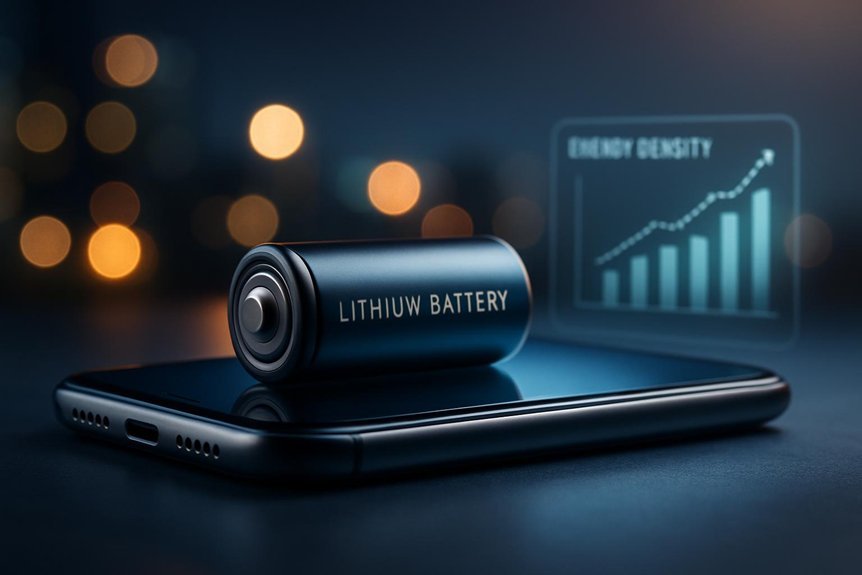
Energy density isn’t just a label on a spec sheet; it directly shapes how long a device runs between charges. We translate energy density into real-world runtime by mapping capacity to usage patterns, then aligning discharge profiles with user expectations. Higher energy density means more energy stored per gram, but practical runtime depends on load, duty cycle, and peak current demands. Battery chemistry governs how efficiently that energy is drawn, influencing voltage sag, heat generation, and cycle life. We examine charging protocols to ensure safe, repeatable performance without premature degradation. By modeling runtime against typical workloads, we identify where marginal gains in energy density produce meaningful improvements and where diminishing returns appear. This disciplined view helps designers balance capacity, safety, and thermal limits for consistent, predictable operation.
Battery Weight vs. Device Weight: The Trade-Off

We weigh how reducing battery weight affects overall device performance and user experience, balancing gains in runtime against added system complexity and cost. We’ll analyze weight reduction impact, unpack system-level trade-offs, and illustrate with real-world use scenarios to show where gains may or may not translate to meaningful benefits. By framing these factors clearly, we invite readers to contemplate how battery choices influence the entire device rather than just the cell itself.
Weight Reduction Impact
The relationship between battery weight and overall device mass is a fundamental design constraint: reducing battery weight can lower the total system weight, but it may also alter form factor, thermal behavior, and user-perceived performance.
We frame weight reduction as a series of trade-offs, not a single win, linking chemistry, packaging, and cooling to real-world use.
- We assess mass savings against thermal headroom and chassis rigidity
- We quantify impact on runtime, peak performance, and user experience
- We map how form factor shifts affect cooling paths and hand feel
This systematic view helps us gauge mobile efficiency, guiding material choices, architecture, and validation tests with precision. By staying analytical, we separate weight reduction opportunities from unintended consequences, ensuring that gains translate to meaningful device benefits.
System-Level Trade-Offs
System-level trade-offs emerge when balancing battery weight against overall device mass, because smaller packs don’t exist in isolation—they influence chassis design, cooling paths, and user perception of heft. We approach weight optimization by mapping how each gram shifts mass distribution, center of gravity, and thermal paths. Our analysis tracks trade-offs between pack density, enclosure stiffness, and heat dissipation routes, because tighter packaging can tighten tolerances but may require more robust cooling. We quantify device ergonomics impacts, such as grip comfort, balance during use, and fatigue over time, to ensure improvements don’t degrade handling. We also consider battery packaging constraints, connector placement, and serviceability, recognizing that marginal gains in energy density can yield disproportionate benefits or penalties downstream. Clear metrics guide decisions, balancing performance, reliability, and user experience.
Real-World Use Scenarios
How does adding weight to a battery shift the balance between device performance and user experience in real-world use? We answer by weighing trade-offs with a structured lens. Increased battery weight often raises energy capacity, improving endurance and peak performance, yet it can burden handling, ergonomics, and form factor. We evaluate battery chemistry implications, pack integration, and thermal management to quantify benefits against penalties. Recycling costs enter as a factor in lifecycle optimization, influencing total ownership economics and sustainability.
- We compare energy density gains to ergonomic penalties, considering use-case demands
- We map device weight changes to user-perceived performance, endurance, and cooling needs
- We integrate lifecycle considerations, including recycling costs and end-of-life disposal
Packaging for Slim, Durable Form Factors
| Material | Geometry | Performance |
|---|---|---|
| Aluminum | Thin-walled | High stiffness |
| Polymer | Multi-wall | Lightweight |
| Composite | Sandwich | Enhanced rigidity |
| Assembly | Seal | Cost/Manufacturability |
| Adhesive | O-ring | Scalable |
Safety Features That Don’t Add Bulk
We’ve optimized lightweight packaging and seals in the previous section, and that groundwork directly supports safety features that won’t add bulk. We analyze how to prevent failures without extra mass, focusing on proactive design and materials. Our approach emphasizes predictable behavior under stress, rapid fault isolation, and passive protection that remains unobtrusive. We also consider environmental interactions, ensuring stability in real-world use scenarios. Key mechanisms include modular containment, fail-safe venting, and controlled inert environments. By integrating these elements, we reduce risk without compromising form factor. – Implement thin air collapse prevention via internal venting tuned to vent at precise thresholds – Use inert packaging concepts to minimize chemical reactivity risks – Apply compact position sensors and thermal management that stay discrete and lightweight
Longevity, Cost, and Sustainability in Mobile Batteries
We systematically assess how longevity metrics—such as cycle life, calendar life, and degradation rates—translate into practical performance for mobile use. We also weigh cost against sustainability, focusing on total cost of ownership, material sourcing, and end-of-life options. This balanced view helps readers understand trade-offs and identify metrics that matter most for reliable, eco-conscious devices.
Longevity Metrics Clarity
What reliability benchmarks truly matter for mobile batteries, and how do longevity, cost, and sustainability intersect to define a practical standard? We frame longevity metrics clearly, then align them with our clarity goals, ensuring transparent performance expectations for readers and users alike. We quantify cycle life, calendar life, and degradation rate under typical usage, tying them to real-world impact on device uptime and total cost of ownership. We compare accelerated tests to field data, identifying which metrics predict real reliability. Our approach balances precision with practical interpretation, avoiding abstract abstractions.
- Defined longevity metrics tied to user scenarios
- Clear degradation thresholds and update cadence
- Transparent tradeoffs among endurance, cost, and environmental impact
Cost and Sustainability Balance
How can we balance longevity, cost, and sustainability when selecting mobile batteries, given the tradeoffs users actually experience? We approach this analytically, weighing durability metrics against total ownership costs and environmental impact. We compare upfront price, cycle life, and energy density to real-world usage patterns, then quantify maintenance needs, replacement frequency, and potential downtime. We emphasize the lifecycle view: manufacturing footprint, energy efficiency, and end-of-life handling. Sustainability isn’t only about recycling rates; it includes second-life opportunities and responsible design for repair. We also scrutinize disposal ethics, ensuring batteries meet safety and regulatory standards while minimizing hazardous waste. By aligning performance targets with usage scenarios, we offer a transparent framework for decision-making that balances reliability, total cost of ownership, and environmental responsibility.
Real-World Performance: Heat, Power, and Reliability
Real-world performance hinges on how heat, power delivery, and reliability interact under typical mobile usage. We examine tradeoffs in live conditions, where ambient temperature, load spikes, and duty cycles determine outcomes. Our focus stays analytical: how temperature margins influence cycle life, how peak power affects transient devices, and how failure modes emerge under stress. We also consider non-battery factors shaping results, such as energy sourcing and policy contexts. This lens highlights broader implications beyond chemistry alone.
- Alternative fuels, not batteries, could redefine energy strategies under performance constraints.
- Political implications and regulatory barriers shape testing standards, rollout timing, and certification processes.
- Reliability targets must align with user expectations, device firmware, and supply chain resilience to avoid performance cliffs.
Applications by Form Factor: Phones, Wearables, Drones
Which form factor dominates design choices across devices? We approach this by grouping devices into phones, wearables, and drones, then comparing power, weight, and enclosure constraints. In phones, we prioritize compact pack depth and high energy density, enabling all‑day use without bulk. Wearables demand ultra-lightweight cells and flexible form factor innovations to fit bands and clothing interfaces. Drones emphasize peak power delivery and rapid discharge sequencing, where energy density and thermal stability govern flight time and safety. Across each category, we evaluate tradeoffs between cycle life, protection, and integration with internal architectures. Weight optimization emerges as a unifying goal, driving thinner cells and thinner pack assemblies. This framework clarifies opportunities for form factor innovation while preserving reliability and safety margins.
Choosing a Mobile Battery Chemistry: NMC, LFP, and More
Choosing a mobile battery chemistry means weighing energy density, safety, cycle life, and cost across the form factors we just examined. We compare NMC, LFP, and alternatives by matching performance to device demands, verifying how each chemistry supports compact chemistry goals and a slim design. Our approach is systematic: quantify energy density, analyze thermal management needs, and evaluate longevity under real-world use.
- NMC offers high energy density but moderate thermal stability.
- LFP emphasizes safety, longer cycle life, and lower cost.
- Alternatives balance specific metrics, often trading energy density for durability or form factor compatibility.
We prioritize a clear choice framework, linking chemistry traits to device envelope, ensuring our selections maintain lightweight benefits without sacrificing reliability or safety.
Trends Driving Further Weight Reduction in Lithium Batteries
What trends are pushing lithium battery weights down, and how do they translate into practical gains for mobile devices? We examine material advances, cell design, and manufacturing efficiency to reveal a cohesive weight-reduction path. Energy density gains enable smaller pack volumes without sacrificing runtime, while improved weight scaling preserves performance as we shrink components. We prioritize high-energy chemistries, advanced electrodes, and thinner separators to reduce mass per stored energy. In tandem, automated production and modular packaging trim ancillary mass, including cooling and housings. The result is a leaner system with preserved capacity, driving longer device lifetimes and performance headroom. Table below clarifies the dimensions shaping this trend.
| Area | Impact | Benefit |
|---|---|---|
| Energy density | Higher per-volume energy | Smaller packs |
| Weight scaling | Proportional mass reduction | Thinner, lighter packs |
| Manufacturing | Process gains | Lower unit cost and mass |
Frequently Asked Questions
How Does Battery Disposal Impact Lightweight Lithium Sustainability?
We analyze disposal impact meticulously, showing how improper end-of-life handling worsens the sustainability footprint, while proper recycling reduces it; our systematic approach demonstrates that responsible disposal substantially lowers environmental burden and enhances overall sustainability footprint.
Can Ultra-Light Cells Compromise Charging Speed in Modest Temps?
We answer: yes, ultra-light cells can modestly slow charging dynamics in cooler temps, though improvements in materials mitigate this. We analyze thermal behavior, internal resistance, and charge protocol, then guide readers on optimal charging practices for stability.
Do Lightweight Chemistries Affect Ruggedized Device Performance?
To put it plainly, yes—lightweight chemistries can influence ruggedized performance. We systematically assess impacts on shock tolerance, vibration resilience, and thermal stability, concluding that carefully chosen chemistries maintain rugged specs while saving weight.
Are There Hidden Costs to Ultra-Thin Battery Integration?
We’d say yes: hidden costs accompany ultra thin integrations, impacting cooling, safety margins, and long term sustainability. We systematically weigh benefits against risks, detailing implementation pitfalls, supply chain fragility, and total cost of ownership for durable, lightweight devices.
How Do Warranties Cover Lightweight Battery Failures?
We explain that warranty coverage typically addresses failure scenarios caused by manufacturing defects; implications exclude user damage. We analyze systematically, noting exclusions, claim processes, and replacement timelines, while emphasizing disposal sustainability and clear documentation of failure causes and remedies.
Conclusion
We chart this journey like travelers on a featherweight ship, our compass the balance between energy and mass. Each choice—chemistry, packaging, safety—trim sails without sinking cargo, steering toward longer runtimes and leaner devices. As we weigh weight against performance, the hull stays sturdy with smarter designs; as systems integrate, power stays steady. The destination is clear: lighter, safer, more reliable batteries that propel mobile life forward without dragging it down.