Over 70% of residential energy storage projects rely on 48V platforms to balance safety, efficiency, and modular scalability. We’ll examine how BMS monitoring, thermal management, and safety controls translate into reliable performance and end-of-life recyclability, guiding our choices for inverters, DC architectures, and system sizing. With rigorous data on voltage, impedance, and SOC, we can pinpoint fault risk and lifecycle value—and we’ll show you where gaps still require attention as we push toward robust, safe implementations.
Key Takeaways
- 48V lithium packs balance safety, weight, efficiency, and modularity for solar, homes, microgrids, and commercial storage.
- Safety-focused design includes thermal management, fault detection, isolation, venting controls, and predictive health monitoring.
- BMS tracks voltages, temperatures, SOC, impedance, and provides fast fault isolation for reliable operation.
- System integration requires matching 48V batteries to inverters and DC architectures with proper protection coordination.
- Data-driven validation confirms performance across temperature, aging, and operating conditions for lifecycle reliability.
What Are 48V Lithium Batteries, and Why They Matter for Solar Storage
What are 48V lithium batteries, and why do they matter for solar storage? 48V lithium battery packs are high-energy storage systems designed to efficiently store solar-generated electricity for homes, microgrids, and commercial installations. We select this voltage to balance safety, weight, and system efficiency, enabling modular scaling and easier integration with inverters and safety controls. Our focus is on 48V safety, incorporating rigorous thermal management, fault detection, and robust electrical isolation to minimize risk during charging, discharge, and fault events. We analyze cycle life, depth of discharge, and temperature impact to assess lifecycle value, guiding maintenance schedules and replacement planning. Data-driven testing supports standardized performance claims, while fail-safe architectures protect assets and occupants across diverse operating conditions.
48V vs. Lower or Higher Voltage: Choosing the Right System
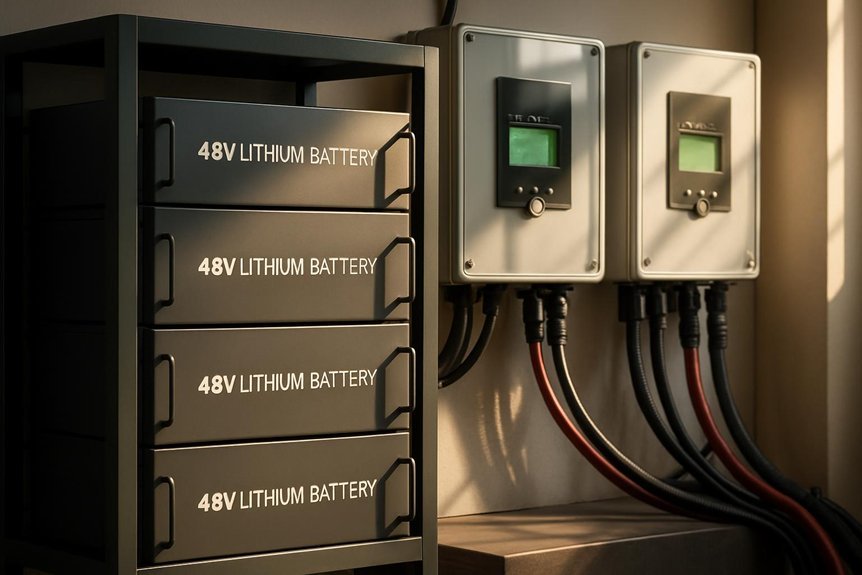
Choosing the right system voltage means balancing safety, efficiency, and cost across your solar or energy-storage deployment. 48V packs offer a favorable mix of high energy density and manageable electrical clearances, but lower voltages can reduce wiring losses and simplify protection schemes, while higher voltages can boost inverter efficiency and scalability for larger sites. We assess voltage scaling implications for system design, conductor sizing, and fault management, ensuring safety margins remain robust. We consider user comfort through consistent performance, reduced derating, and clear operational guidance, aligning with data-driven sizing and standards compliance.
- Impact of voltage scaling on wiring topology and protection coordination
- Inverter efficiency trends across 48V, lower, and higher voltage regimes
- Safety margins, insulation requirements, and clearance planning
- System reliability, maintenance ergonomics, and fault response
- Cost-per-watt and lifecycle implications for different voltage choices
Chemistry, BMS, and Safety Specs for 48V Packs
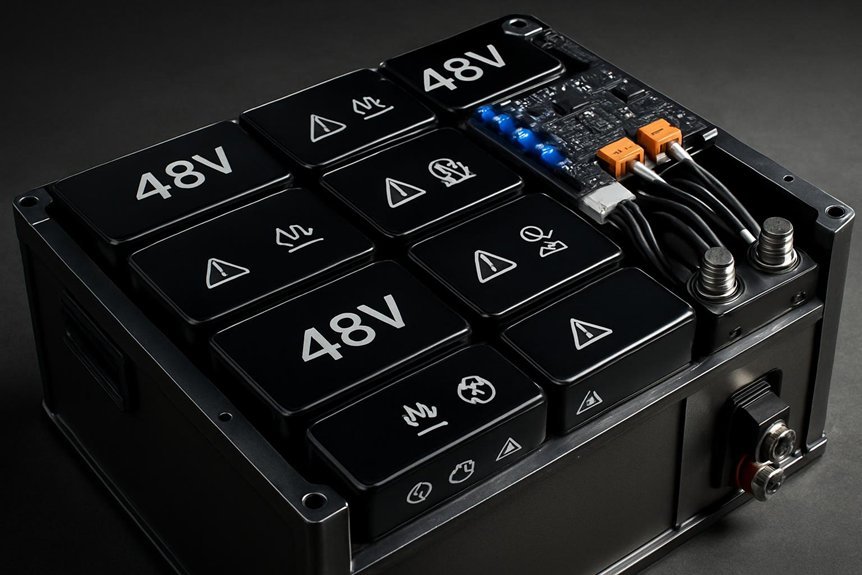
Are 48V packs safe, reliable, and cost-effective enough for sustained solar and energy-storage operations? We answer yes, with careful chemistry, robust BMS design, and strict safety specs. Our focus is on cells rated for cycle life and calendar life, with chemistries that balance energy density, thermal stability, and reliability under 48V system demands. A properly engineered BMS monitors cell voltages, temperatures, state of charge, and impedance, executing fast fault isolation and safe rebalancing. Safety specs include robust short-circuit protection, overcharge/overdischarge guards, and thermal runaway mitigation. We verify durability via vibration testing and packaging durability assessments to ensure enclosure integrity, gasket performance, and containment under operational shocks. Data-driven validation confirms consistent pack performance across temperature, SOC, and aging, reducing pilot risk and lifecycle cost.
Matching 48V Batteries to Inverters and DC Architectures
We must guarantee the 48V battery system voltage aligns with the inverter’s input range to prevent efficiency losses or protection triggering. We’ll assess DC architecture compatibility, including series/parallel configurations, grounding, and surge handling, to maintain safe, reliable operation. Prioritizing system safety, we’ll quantify voltage margins, current limits, and protection schemes to guide proper matching and prevent mismatches.
Battery-Inverter Voltage Match
How do 48V battery systems align with inverter input ranges and DC-architecture requirements to ensure safe, efficient operation? We approach matching through defined voltage windows, charger tolerance, and protection schemes. We test for nominal plus tolerance, surge handling, and ripple suppression to prevent inverter stalls and overheating. Our data-driven checks confirm that small mismatches don’t degrade lifespan when within spec, yet mismatches trigger overvoltage or undervoltage faults. We prioritize thermal derating, cable sizing, and fusing to preserve safety margins in off grid dynamics and unrelated topic contexts that may influence performance. Clear documentation of operating envelopes supports maintenance and fault diagnosis, reducing downtime and risk.
- Define acceptable input voltage window per inverter model
- Verify DC link compatibility and surge rating
- Assess thermal margins under load
- Confirm polarity, grounding, and protection scheme
- Document operating envelopes for maintenance and audits
DC Architecture Compatibility
DC architecture compatibility requires a precise match between 48V battery outputs and inverter DC buses, ensuring the nominal voltage, tolerance, and surge capabilities align with the inverter’s input specifications. We assess voltage bands, DC-link stability, and transient response to avoid misfiring or voltage collapse. Our approach prioritizes safety margins, connector integrity, and protection schemes that prevent arc events during fast-rising transients. Detailed compatibility data informs selection of compliant inverters, battery management systems, and cabling standards, reducing heat buildup and efficiency losses. We also consider system topology—series/parallel configurations, busbar sizing, and fault isolation. This alignment supports robust microgrid policy integration and facilitates urban farming deployments seeking reliable, scalable energy storage with governed performance targets.
System Safety Considerations
System safety hinges on harmonizing 48V battery packs with inverter inputs and DC architectures to prevent fault propagation and ensure reliable operation. We examine fault modes, protection schemes, and sequence of operation to minimize cascading failures. Our approach relies on data-driven tests, including impedance, short-circuit, and thermal analysis, to validate compatibility and response times. We emphasize proper isolation, monitoring, and shutdown triggers to maintain safe states under abnormal conditions. Through consistent standards, we align wiring, fusing, and grounding with inverter specifications, ensuring predictable behavior during grid events and startup. This is not an unrelated topic, but a practical safety focus. off topic aside. We present concrete criteria, not marketing claims, for robust system safety and dependable performance.
- Aligned protection coordination between battery, DC bus, and inverter
- Clear isolation and grounding strategy with verified fault pathways
- Verified fuse and breaker sizing matching inverter input currents
- Comprehensive thermal management and thermal runaway mitigation
- Documentation, labeling, and maintenance plan to sustain safety over time
Sizing a 48V Storage System: Capacity, Power, and Runtime
We’ll start with Capacity Planning Metrics to ensure our 48V storage meets projected loads with an appropriate safety margin. We’ll compare runtime requirements against available power, evaluating tradeoffs between higher capacity and charging/discharge limits to avoid thermal and safety risks. Our data-driven approach flags critical thresholds for voltage, depth of discharge, and inverter efficiency to guide precise, reliable system sizing.
Capacity Planning Metrics
To size a 48V storage system effectively, we start with three core metrics—capacity, power, and runtime—each tied to your load profile and performance goals. We frame capacity by usable energy, de-rating for depth of discharge, and temperature effects, then align power with inverter sizing and peak draw, and confirm runtimes under critical and average conditions. We ground decisions in data: historical load, daily cycling, and worst‑case scenarios, capturing uncertainties with safety margins. Two word discussion ideas to guide evaluation are cycle depth and electrolyte viscosity, which influence performance and aging. Clear targets drive hardware choices, control strategies, and maintenance plans, ensuring reliability and safe operation within thermal envelopes.
- Define usable capacity after de-rating
- Match peak power to inverter and cables
- Include contingency runtime for outages
- Integrate temperature and aging factors
- Document safety and charging/venting protocols
Runtime and Power Tradeoffs
Balancing runtime and power is the heart of sizing a 48V storage system, since usable energy and peak draw drive how long and how hard the system must deliver energy. We analyze energy budgeting to determine usable capacity versus expected loads, ensuring safety margins for worst‑case conditions. We translate load profiles into power envelopes, then map these to inverter and battery limits to avoid overcurrent and overheating. Our approach emphasizes runtime forecasting to predict system behavior across typical and extreme days, guiding capacity and C‑rate choices. We prioritize conservative derating for temperature, aging, and fault scenarios, verifying that peak discharges remain within thermal and electrical tolerances. Clear metrics enable transparent tradeoffs between longer runtimes and higher instantaneous power, with documented safety and performance margins.
48V Safety, Thermal Management, and Longevity
What are the key safety, thermal management, and longevity considerations for 48V lithium batteries used in solar and energy storage systems? We approach these topics with data-driven rigor, emphasizing safety considerations and thermal management. We quantify failure modes, monitor SOC/SOH, and compare cooling strategies to minimize thermal runaway risk. Durability hinges on cell chemistry, pack design, and battery management system accuracy, which drive longevity forecasts and maintenance intervals. We emphasize redundancy, fault isolation, and clear diagnostic thresholds to sustain reliability across seasons and loads. Operational safety hinges on venting, short-circuit protection, and防火 measures to meet standards. Regular thermal profiling, warranted operating temperatures, and scheduled conditioning cycles improve cycle life and performance.
- Safety considerations and fault diagnostics
- Thermal management strategies and cooling efficiency
- State of health monitoring and SOC/SoC accuracy
- Thermal runaway prevention and venting controls
- End-of-life planning and recycling readiness
Installation and Wiring Practices for 48V Storage
Are you ensuring every connection is engineered for reliability and safety? In this section, we detail installation and wiring practices that minimize resistance, thermal buildup, and fault propagation. We emphasize correct gauge selection, torque specs, and termination methods for 48V packs, including stringing, busbars, and junction boxes. We prioritize enclosure integrity, accessible labeling, and adherence to relevant standards, with data-driven checks on contact resistance and insulation.
We address routing to avoid loose cables, vibration, or stray topic contamination, and we prescribe separation from incompatible components to prevent arcing. We require proper bonding, grounding, and enclosure venting, plus systematic inspection protocols during assembly. Finally, we document test steps for continuity, insulation, and leakage currents to ensure safe, maintainable installations that support long-term performance.
Monitoring and Fault Diagnosis for 48V Packs
Effective monitoring and fault diagnosis for 48V packs hinge on real-time data and systematic analysis to prevent failures and extend life. We implement a disciplined protocol that tracks electrical signatures, thermal trends, and state-of-health metrics, then flags anomalies before damage occurs. We emphasize concrete monitoring intervals and clearly defined fault indicators to standardize responses, minimize ambiguity, and accelerate corrective actions. Data fusion from BMS, thermography, and current sensors informs maintenance windows and safety interlocks, reducing risk during operation and service. We maintain rigorous documentation and traceability, ensuring reproducible fault judgments and prioritized interventions.
Effective real-time monitoring of 48V packs uses integrated data to anticipate faults, guide maintenance, and ensure safe operation.
- Real-time telemetry and logging cadence aligned with operating conditions
- Thresholds and fault indicators tied to pack architecture
- Baseline drift and anomaly detection across modules
- Predictive maintenance triggers based on trend analysis
- Safe isolation procedures when faults are detected
Cost, Efficiency, and Lifecycle Value of 48V Storage
Why consider cost, efficiency, and lifecycle value when deploying 48V storage? We, as engineers, quantify system cost per usable kWh, factoring capital, installation, and balance-of-system fixtures. Efficiency metrics—round-trip and parasitic losses—drive energy yield vs. degradation risk under real-world duty cycles. Lifecycle value combines calendar and cycle life, end-of-life recovery, and warranty support, ensuring levelized cost of storage over project horizons. We compare modules, inverters, and thermal management for heat-related derating that reduces efficiency and accelerates aging; safety margins protect against thermal runaway and fault propagation. Avoid irrelevant topic distractions, focusing on data-driven payback and resilience. Beware stray assumption pitfalls, validating with manufacturer curves and field performance. Our approach prioritizes robust, safe, economically sound 48V storage deployments.
Frequently Asked Questions
How to Recycle or Dispose of 48V Lithium Packs Responsibly?
We recycle 48V packs through certified e-waste programs, adhering to recycling regulations and safe handling, and we mitigate disposal hazards with trained staff and proper labeling; we prevent fires, manage electrolyte risks, and document compliant outcomes for every shipment.
Can 48V Systems Support Microgrid Islanding Safety?
We can, but with strict islanding safety and microgrid standards; we’ll verify data, maintain coordination, and assess thresholds. We align safety, stay rigorous, and ensure islanding safety across 48V systems while adhering to documented standards.
Do 48V Packs Require Special Charging Adapters?
We do: 48V packs require specialized chargers to guarantee proper voltage compatibility, charging profiles, and safety interlocks. We’ll verify voltage compatibility, monitor temperature, and adhere to standards to prevent faults and safeguard system reliability.
What Warranties Cover 48V Battery Performance Degradation?
Indeed, warranties vary by model, but we typically offer a limited warranty covering performance degradation within a defined timeframe and DoD. We guarantee warranty coverage for specified cycle life and capacity retention, backed by data-driven, safety-focused terms.
How to Diagnose Parasitic Loads on 48V Systems Quickly?
We diagnose parasitic loads quickly with targeted parasitic load diagnostics and 48v system troubleshooting, prioritizing safety and data-driven steps, including shutoff sequencing, ammeter validation, and load profiling to pinpoint phantom drains without compromising system integrity.
Conclusion
We’ve mapped the terrain of 48V lithium storage with safety as our compass and data as our guide. By harmonizing chemistry, BMS, and thermal control, we sketch systems that behave predictably under load and aging. Our recommended practices—proper sizing, robust wiring, vigilant monitoring, and rigorous fault diagnosis—translate into safer, longer-lasting deployments. In short, a disciplined, measurement-driven approach yields reliable energy, resilient performance, and safer solar storage for the long haul.