Ensuring the safe charging of lithium batteries is essential to prevent potential hazards such as thermal runaway or damage. We recognize that proper handling, compatible equipment, and environment control are key components of this process. By following established safety protocols, we can greatly reduce risks and prolong battery life. Understanding these rules forms the foundation of safe usage, but specific measures and best practices are indispensable for thorough protection—details that are essential as we explore this subject further.
Key Takeaways
- Use compatible, approved chargers with built-in safety features and avoid third-party or counterfeit equipment.
- Monitor battery temperature and charge levels regularly to prevent overheating and overcharging.
- Store batteries in a cool, dry, non-conductive environment, away from flammable materials.
- Handle batteries carefully to avoid physical damage that can lead to thermal runaway.
- Never leave charging batteries unattended and disconnect once fully charged.
Understanding Lithium Batteries and Their Safety Risks
Although lithium batteries are widely used due to their high energy density and efficiency, understanding their safety risks is essential for proper handling and charging. The core of these risks lies in their battery chemistry, which involves lithium-ion intercalation within electrodes. This chemistry makes batteries susceptible to thermal runaway if damaged or improperly charged, potentially leading to fires or explosions. Implementing strict safety protocols, such as using appropriate protective equipment, avoiding physical damage, and maintaining proper storage conditions, is critical. Recognizing the inherent vulnerabilities related to battery chemistry helps prevent hazardous incidents. Proper knowledge of these safety risks ensures safe handling, reduces the chance of malfunctions, and prolongs battery lifespan, making it imperative for anyone working with lithium batteries.
Choosing the Right Charger for Your Lithium Battery

Selecting an appropriate charger requires careful consideration of compatibility with your lithium battery’s chemistry and capacity. We must guarantee the charger’s specifications match the manufacturer’s recommended charging voltage and current to prevent safety hazards. Precise adherence to ideal charging parameters maximizes battery lifespan and maintains safety standards.
Charger Compatibility Considerations
Ensuring charger compatibility is essential for the safe and efficient operation of lithium batteries. Proper selection involves verifying that the charger’s specifications align with the battery’s requirements, particularly regarding battery voltage matching. To achieve this, consider the following:
- Confirm the charger’s voltage output matches the battery’s nominal voltage.
- Ensure the charger’s current rating does not exceed the battery’s maximum charge rate.
- Check that the charger’s connector type and polarity are compatible.
- Verify the charger’s protection features, such as overvoltage and short circuit safeguards, support safe charging.
Failure to match these parameters can lead to overheating, reduced battery lifespan, or hazardous conditions. Precise charger compatibility is critical for maintaining battery integrity and safety during charging.
Optimal Charging Specifications
How can we determine the most suitable charging specifications for a lithium battery to maximize safety and performance? The key is aligning the charger’s voltage, current, and charging protocol with the battery’s manufacturer specifications. Properly calibrated charging speed ensures ideal battery lifespan by preventing stress and overheating, which can degrade cells prematurely. Using a charger with adjustable current settings allows us to control charging rate, minimizing thermal risks and extending overall durability. Additionally, selecting chargers with built-in protections—such as overvoltage and overcurrent shutdown—further safeguards the battery. Precise adherence to these specifications enhances charging efficiency, preserves capacity, and maintains safety standards, ultimately boosting the battery’s functional lifespan and performance reliability over time.
Always Charge in a Safe Environment
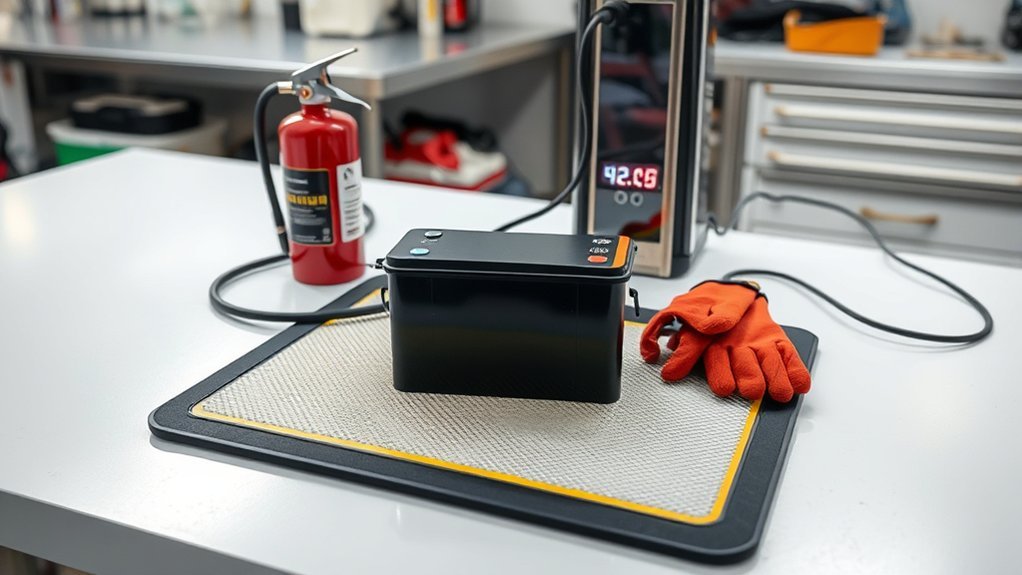
Charging lithium batteries in a safe environment is essential to prevent potential hazards. Proper setting reduces risks of thermal runaway, fire, and damage, thereby extending battery lifespan. When considering a charging station, guarantee:
- The station is placed on a non-flammable, stable surface to prevent accidental tipping or fire hazards.
- It is located in a well-ventilated area to dissipate heat generated during charging.
- The environment is free of moisture, dust, and flammable materials to minimize the risk of short circuits and fires.
- The station is equipped with temperature monitoring and automatic shutoff features to prevent overheating.
Adhering to these considerations ensures safe operation, enhances battery longevity, and maintains the integrity of the charging process.
Avoid Overcharging and Undercharging Your Battery
To guarantee peak battery performance and safety, we must carefully monitor charging levels and avoid both overcharging and undercharging. Using the correct charger prevents voltage fluctuations that can damage the cell chemistry, while preventing full discharges helps maintain battery health. Adhering to these practices reduces the risk of thermal runaway and extends the battery’s lifespan.
Monitor Charging Levels
Have you ever considered the importance of closely monitoring your lithium battery’s charge levels? Maintaining optimal charge prevents overcharging and undercharging, directly influencing battery lifespan and charging speed. To achieve this, we recommend:
- Using a precise battery monitor to track real-time voltage and current.
- Setting alerts for reaching maximum safe charge thresholds.
- Avoiding prolonged partial charges that can degrade capacity.
- Ensuring the charger cuts off automatically once fully charged.
Consistent monitoring helps optimize charging cycles, preserving battery health and ensuring consistent charging speed. Overcharging accelerates capacity loss, while undercharging can lead to capacity fade and reduced lifespan. Precise oversight enables efficient energy use, minimizes risks, and extends the overall service life of your lithium batteries.
Use Proper Chargers
Why is selecting the right charger essential for maintaining lithium battery health? Using a compatible, high-quality charger guarantees ideal charging speed and prevents overcharging or undercharging, both of which can degrade battery lifespan. Proper chargers regulate current and voltage precisely, reducing stress on the battery cells. Overcharging accelerates capacity loss and increases thermal risks, while undercharging can lead to incomplete cell balancing and reduced performance. By employing chargers designed specifically for lithium batteries, we maintain consistent charging parameters, safeguarding the battery’s longevity. Accurate regulation minimizes the risk of thermal runaway and extends overall lifespan. To sum up, choosing the proper charger is critical for preserving battery health, maximizing charging speed, and ensuring safe operation.
Avoid Full Discharges
Proper charger selection helps guarantee that lithium batteries are charged within safe voltage ranges, reducing the risk of damaging full discharges or overcharges. Avoiding full discharges is essential to preserve battery lifespan and optimize charging speed. To achieve this:
- Maintain charge levels above 20%, preventing deep discharges that degrade capacity.
- Use chargers with voltage cutoff features to prevent accidental over-discharge.
- Monitor battery status regularly with compatible tools for early warning signs.
- Implement charging routines that keep batteries within the recommended voltage window.
Adhering to these practices minimizes stress on the cells, prolongs overall lifespan, and assures consistent charging speed. This approach safeguards your investment while optimizing performance and safety.
Use Approved Charging Devices and Cables
Using only approved charging devices and cables is essential to guarantee the safety and reliability of lithium battery charging. Certified chargers are designed to match the battery’s voltage and current specifications, preventing overcurrent or overvoltage conditions that can compromise battery capacity and reduce the number of charging cycles. Using incompatible cables or unapproved chargers increases the risk of electrical faults, overheating, and potential fires. Properly certified devices ensure consistent charging performance, maintaining the battery’s integrity over its lifespan. This prevents premature capacity loss and extends the number of effective charging cycles. Adhering to approved charging equipment is a critical safety measure that safeguards both the battery’s functionality and user safety, guaranteeing peak performance and longevity.
Keep an Eye on Battery Temperature During Charging
Monitoring battery temperature during charging is essential to prevent overheating and guarantee safety. Excessive temperature can lead to battery overheating, compromising integrity and risking failure. Effective temperature regulation involves observing specific signs:
- Sudden temperature spikes indicating rapid heating.
- Temperatures exceeding manufacturer-recommended limits.
- Uneven heating across the battery surface.
- Persistent warmth during extended charging periods.
Don’t Leave Batteries Charging Unattended
Leaving lithium batteries charging unattended considerably increases the risk of accidents, including thermal runaway, fires, or explosions. Continuous monitoring is essential to detect abnormal temperature rises or swelling that could indicate a malfunction. Unattended charging can also hinder effective charging station etiquette, as it prevents timely intervention or assistance if issues arise. We recommend always staying nearby or utilizing smart chargers with safety shutoff features to minimize risk. Proper practices include disconnecting batteries promptly once fully charged and avoiding battery recycling at unattended stations. Ensuring attentive supervision reduces hazards, preserves safety standards, and maintains the integrity of the charging environment. Ultimately, responsible charging behavior is vital to prevent catastrophic failures and uphold safety in all battery handling scenarios.
Store Lithium Batteries Properly When Not in Use
Proper storage of lithium batteries when not in use is essential to prevent damage, maintain safety, and extend battery lifespan. Appropriate battery storage minimizes risks associated with thermal runaway and capacity degradation. When storing, follow these safety precautions:
- Keep batteries at a partial charge, ideally around 30-50%, to reduce stress on the cells.
- Store in a cool, dry environment with temperatures between 20°C and 25°C, avoiding extreme heat or cold.
- Guarantee batteries are placed in non-conductive, insulated containers to prevent accidental short circuits.
- Regularly inspect stored batteries for swelling, corrosion, or damage, and dispose of compromised units appropriately.
Adhering to these guidelines ensures safe battery storage practices, mitigating potential hazards and prolonging battery life.
Troubleshoot Common Charging Issues Safely
When troubleshooting common charging issues with lithium batteries, safety must remain our top priority. First, verify connections; loose or damaged cables can cause improper charging. Ensure the charger is compatible and in good condition—regular charger maintenance reduces risks. If charging anomalies persist, disconnect immediately, and inspect for overheating or swelling. In such cases, prioritize battery recycling protocols for disposal. Use the following table to identify issues:
| Symptom | Probable Cause | Solution |
|---|---|---|
| Slow charging | Dirty contacts | Clean and reassemble |
| Overheating during charge | Faulty charger | Replace charger |
| Battery swelling | Age or damage | Recycle battery safely |
Addressing these issues with precision minimizes hazards and maintains lithium battery safety during troubleshooting.
Follow Manufacturer Guidelines for Optimal Safety
To guarantee safety, we must always use chargers approved by the manufacturer and adhere to specified charging limits. Following the manufacturer’s instructions helps prevent overcharging and thermal risks. Strict compliance with these guidelines optimizes battery lifespan and minimizes safety hazards.
Use Approved Chargers
Using an approved charger is essential for guaranteeing lithium battery safety during the charging process. It ensures compatibility, reduces risk of overheating, and maintains battery integrity. Proper chargers also support battery recycling efforts by preventing damage that could lead to hazardous waste. To clarify, consider these points:
- Use chargers specified by the manufacturer to guarantee correct voltage and current.
- Verify the charger’s safety certifications to minimize fire and safety hazards.
- Avoid third-party or counterfeit chargers, which can cause short circuits or thermal runaway.
- Select chargers with built-in protection features to reduce environmental impact by preventing battery failure and hazardous waste.
Adhering to these guidelines promotes safety, prolongs battery life, and supports responsible disposal and recycling practices.
Adhere to Charging Limits
Adhering to manufacturer-recommended charging limits is essential for ensuring lithium battery safety and longevity. Exceeding specified voltage or current thresholds accelerates degradation, reducing battery lifespan. Maintaining proper charging limits also maximizes charging speed, preventing overheating and potential thermal runaway. Manufacturers define these limits based on rigorous testing to balance performance with safety. Ignoring these guidelines can lead to capacity loss, swelling, or catastrophic failure. Precise adherence ensures the battery operates within its designed parameters, preserving its structural integrity and functional lifespan. Regularly monitoring and respecting voltage and current restrictions minimizes risks associated with overcharging. By following these limits, users can maximize safety, sustain ideal charging speeds, and extend the overall service life of lithium batteries.
Follow Manufacturer Instructions
Following manufacturer instructions is essential for guaranteeing lithium battery safety and peak performance. Proper adherence minimizes risks such as overheating, fire, or explosion, and supports responsible battery recycling. To do this effectively:
- Use only recommended chargers and follow specified voltage and current limits.
- Store batteries in appropriate environments, avoiding extreme temperatures.
- Dispose of or recycle batteries according to manufacturer guidelines to reduce environmental impact.
- Regularly inspect batteries for damage or swelling, and replace if necessary.
Strict compliance ensures safety during use and disposal, preventing hazardous failures. It also promotes environmentally responsible practices by encouraging proper battery recycling, which reduces toxic waste and conserves resources. Following these instructions safeguards users and the planet, emphasizing the importance of manufacturer guidance in lithium battery management.
Frequently Asked Questions
Can I Use a Damaged Lithium Battery to Charge Other Devices?
We advise against using damaged lithium batteries to charge other devices due to safety risks. Instead, pursue proper battery repair, and utilize recycling programs to dispose of compromised batteries safely, preventing potential hazards or further damage.
What Signs Indicate My Lithium Battery Is Overheating During Charging?
We notice overheating if the battery temperature rises rapidly, accompanied by an overcharge warning, melting, swelling, or strange odors. Ironically, these signs signal it’s time to disconnect immediately, preventing potential hazards or failures during charging.
How Often Should I Replace My Lithium Batteries for Safety?
We recommend replacing lithium batteries every 2-3 years based on their battery lifespan and usage conditions. Following a consistent replacement schedule minimizes safety risks related to capacity loss, overheating, or potential failure, ensuring peak performance and safety.
Are There Specific Safety Protocols for Charging Large Lithium Battery Packs?
We follow strict safety protocols for charging large lithium battery packs, emphasizing robust battery management systems and dedicated charging infrastructure, ensuring safe, efficient operation, preventing overcharge, thermal runaway, and maintaining ideal performance during all charging procedures.
What Should I Do if My Lithium Battery Catches Fire During Charging?
If a lithium battery ignites during charging, we immediately disconnect power, carefully use a Class D fire extinguisher for metal fires, and prioritize battery disposal protocols, ensuring safety and preventing the fire from spreading further.
Conclusion
By following these safety rules, we’re creating a fortress around our lithium batteries, shielding them from the storms of thermal runaway and damage. Proper handling, vigilant monitoring, and respectful storage act as vigilant guardians, ensuring our energy sources remain stable and reliable. Think of these precautions as the compass guiding us safely through the dynamic landscape of battery technology, allowing us to harness power confidently and preserve the integrity of our devices with precision and care.