We picture a cart gliding across a sunlit course, the battery pack humming with precise chemistry behind the scenes. We know steady, proactive maintenance beats reactive fixes, so we’ll discuss how to monitor SOC, voltage, and temperature, choose the right charger, and establish a year‑round routine that minimizes deep discharges and high-rate charging. If we tune these variables correctly, we’ll uncover the subtleties that keep packs performing—but there’s more to optimize as seasons shift and storage approaches.
Key Takeaways
- Regularly charge to target full CV acceptance but avoid deep discharges to preserve cell health and range accuracy.
- Monitor voltage, temperature, and SOC continuously; use trend analysis to detect imbalances and aging cells early.
- Perform routine cell balancing and verify connections, bus bars, and insulation to prevent hotspots and failures.
- Follow seasonal care: cool storage in heat, preconditioning in cold, and document capacity trends and maintenance actions.
- Use a smart charger with temperature sensing, proper voltage, and ensure secure mounting plus grounding for safety and longevity.
How Golf Cart Lithium Batteries Differ
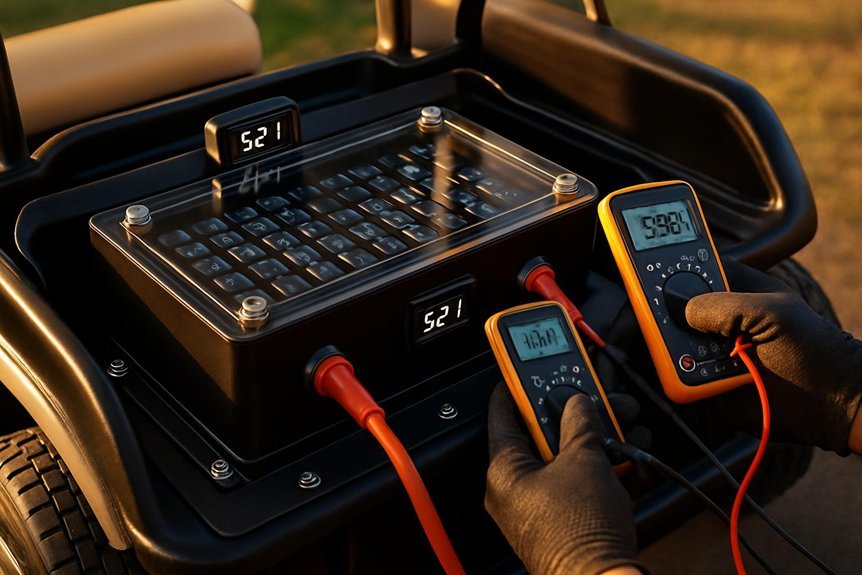
Lithium batteries for golf carts differ profoundly from traditional lead‑acid packs in chemistry, performance, and management. We, as technicians, examine cell chemistry, energy density, and thermal behavior to quantify advantages and constraints. Lithium chemistry provides higher usable capacity, flatter discharge curves, and faster charging, but requires active cell balancing and precise temperature control to prevent degradation. We monitor state of charge with coulomb counting and voltage recovery curves to optimize cycle life. Calibration routines become essential for accurate remaining‑range estimates and pack health assessment. Electrolyte differences drive distinct failure modes, including SEI growth, electrolyte oxidation, and cathode impedance shifts, which influence heat generation and aging profiles. Together, these factors define system architecture, BMS design, and protective thresholds critical for reliable, long‑term operation.
Build a Simple, Year-Round Maintenance Routine
We establish a concise, year-round routine centered on a regular charge schedule and clear seasonal cues to guide maintenance actions. By aligning charging intervals with pack state and ambient conditions, we can minimize capacity fade and maximize cycle life, using data-driven thresholds. We’ll outline practical steps readers can apply across seasons to sustain performance and safety.
Regular Charge Schedule
Do we need a simple, year-round routine for charging golf cart lithium batteries that minimizes wear and maximizes range? Yes, we do, and our schedule targets consistent acceptance of full CVs while avoiding deep discharge. We monitor state of charge (SOC) with a precision meter and keep cycling within 20–80% for daily use, topping to 100% only before long trips. We align charge timing with ambient temperature to optimize efficiency and minimize resistance growth. We track temperature, voltage, and current to detect anomalies early. Regular, controlled charging reduces impedance rise and extends life.
- Schedule daily top-offs during periods of stable temperatures
- Use chargers with automatic termination and temperature compensation
- Inspect for insulation basics and corrosion risks during each session
Seasonal Maintenance Cues
Seasonal cues shape how we tune our year-round maintenance routine, building on the regular charge schedule to preserve lithium battery health across varying conditions. We map monthly temperature and usage data to actionable steps, ensuring each season’s stresses are countered. In heat, we prioritize cooler storage windows, monitor state of charge to avoid extended high voltage exposure, and adjust charging voltage if advised by the BMS. In cold, we emphasize preconditioning, maintain modest SOC targets, and verify heater-enabled cycles don’t cause parasitic losses. In shoulder seasons, we simplify checks for infiltration risks and adjust ventilation. We document capacity trends, cycle counts, and calendar-based checks to detect drift early. Seasonal cues guide our routine, reducing storage pitfalls and sustaining performance through year-round operation.
Daily Habits to Preserve Golf Cart Battery Health
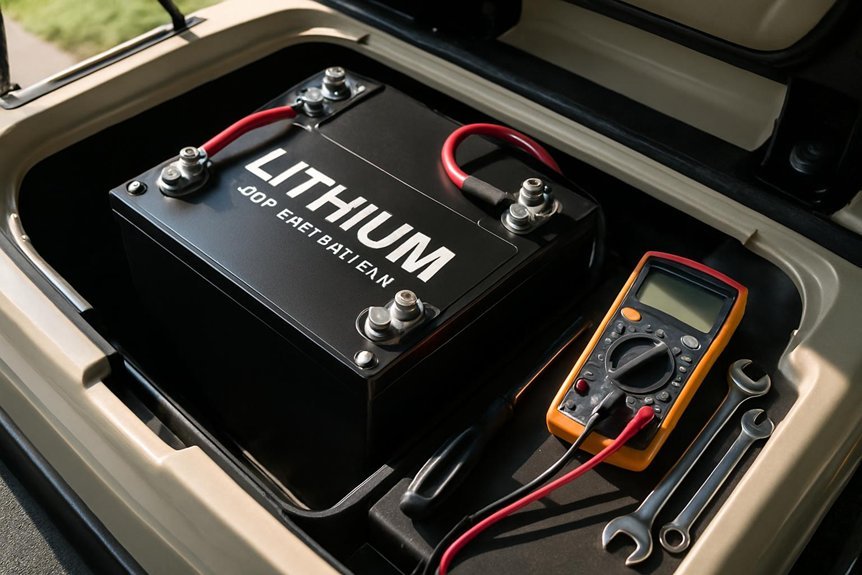
We follow a precise daily charging routine, ensuring we top off the pack after each use and avoid excessive high-rate sessions. We perform regular battery health checks—monitoring voltage, temperature, and state of charge—to detect early anomalies. By documenting these metrics, we maintain data-driven insights that guide adjustments to usage, charging, and maintenance practices.
Daily Charging Routine
Daily charging is essential to extending golf cart battery life and maintaining peak performance. We follow a disciplined maintenance routine to minimize sulfation and voltage drop, ensuring consistent capacity. Our approach centers on controlled charging windows, balanced by data-backed voltage targets and temperature considerations.
- Monitor state of charge during every use, restoring to 100% only when needed to prevent overcharging
- Schedule charging for cool ambient conditions and avoid continuous high-Current fast-charging
- Log temperature, voltage, andSOC trends to guide future charging decisions
These practices reduce idle drain and peak current stress, protecting pack integrity and prolonging cycle life. By adhering to a precise maintenance routine, we optimize efficiency, reliability, and overall golf cart performance without compromising safety.
Battery Health Checks
Even with a disciplined charging routine, we routinely verify key health indicators each day—specifically, electrolyte balance (for lead-acid) or cell voltages (for lithium), insulation integrity, and terminal cleanliness. Our Battery Health Checks target quantifiable metrics that map to overall reliability. We log voltage per cell group, open-circuit voltage after rest, and impedance trends to detect degradation. Visual inspections confirm corrrosion, seal integrity, and hose or conduit wear that could introduce moisture. We compare measured values against a defined maintenance schedule, flagging deviations beyond predefined thresholds for immediate diagnosis. We also document temperature differentials across modules, as overheating forecasts capacity loss. This disciplined cadence informs battery chemistry performance projections and topic-specific maintenance actions, prioritizing preventive maintenance and data-driven decisions to extend life and preserve safety.
How to Monitor Voltage, Temperature, and State of Charge
To guarantee peak performance and safety, we monitor voltage, temperature, and state of charge (SOC) continuously during operation and charging. We rely on monitoring sensors that feed real-time data to our battery Management System (BMS) and logging software, enabling rapid detection of deviations from healthy ranges. By analyzing voltage trends, we identify plate imbalances, aging cells, and impedance changes that affect capacity and safety. Temperature readings inform thermal management decisions, preventing thermal runaway and reducing aging. SOC estimates guide charging schedules and avoid deep discharges, extending cycle life.
We monitor voltage, temperature, and SOC in real time to safeguard performance and longevity.
- monitoring sensors feeding BMS and log software
- voltage trends analysis for early fault detection
- temperature and SOC alignment to optimize performance
Simple Charging Habits That Boost Battery Longevity
We can extend battery life by adopting simple charging habits that minimize stress on cells and balance SOC over time. We emphasize consistent input power, avoid deep discharges, and prefer top-off cycles to keep cells near 80–90% SOC during daily use. Maintaining a stable charge rate—within manufacturer spec—reduces impedance rise and heat. Calibrate timers and monitor pack temperature during charging; if temps exceed 45°C, pause charging until cooling. We dismiss charging myths that encourage frequent full charges or random high-current bursts, and we debunk battery myths about “fast” charging always preserving longevity.
| Practice | Expected Benefit | Key Metric |
|---|---|---|
| Consistent top-offs | Lower cycle stress | SOC variance |
| Temp-aware charging | Reduced impedance | Peak temp |
| Spec-aligned C-rate | Minimized heat | Charge efficiency |
Troubleshooting Battery Warning Signs and Quick Fixes
Are warning signs flashing on your golf cart battery system indicating trouble, or are they harmless indicators you can safely ignore? We approach these signals methodically, documenting symptoms, testing conditions, and likely causes before acting. We center on troubleshooting indicators and apply steps that minimize downtime while preserving cell integrity. Quick fixes focus on safe resets, connection integrity, and load checks, with an emphasis on reproducible results and measurable outcomes. We avoid guesswork by cross-checking voltages, current draw, and temperature trends against manufacturer specs. If symptoms persist, escalate to diagnostic tests and component verification rather than assumptive repairs.
Careful, methodical golf cart battery diagnostics: verify connections, balance cells, monitor temps, and confirm with manufacturer specs.
- Inspect for loose cables, corrosion, and loose bus bars
- Verify voltage per cell and overall pack balance
- Monitor temperature and charge/discharge curves
Which Charger and Accessories Do I Need?
What charger and accessories do we actually need to optimize a golf cart lithium battery system? We should target compatible DC output, matching voltage (typically 48V or 72V), and current ratings to avoid thermal runaway. Our recommended baseline includes a smart charger with cell-balancing, temperature sensing, and an automatic termination feature, plus a secure mounting solution to protect cables and prevent vibration damage. To maximize efficiency, choose chargers with high efficiency (≥90%), wide input compatibility, and firmware update support. For flexibility, include solar charging compatibility and portable adapters for field use, ensuring proper grounding and surge protection. Keep cable gauges appropriate for amperage, and document commissioning data: voltage, current, and temperature profiles during charge cycles.
Seasonal Care and Storage for Golf Cart Batteries
As seasons change, proper storage and seasonal care become as important as daily maintenance for golf cart lithium batteries, ensuring performance consistency and extending service life after periods of inactivity. We prioritize controlled temperature, stable SOC, and clean terminals to minimize degradation during downtime. For seasonal storage, we recommend charging to 70–80% state of charge and storing in a cool, dry environment away from direct heat sources. Monitor voltage weekly and perform a top-up if needed to maintain cell balance. We also insulate exposed connections and use corrosion protection where applicable to preserve contact integrity.
- Maintain 70–80% SOC before storage
- Store in cool, dry, ventilated area
- Inspect and top off periodically to prevent drift
When to Replace vs. Rebuild Your Golf Cart Battery Pack
Determining whether to replace or rebuild a golf cart battery pack hinges on measured performance, cost, and safety thresholds. We assess voltage sag, amp-hour capacity loss, and internal resistance aging to quantify remaining useful life. If pack health falls below 80% state of health with rapid degradation under load, replacement options become financially compelling, especially when downtime costs exceed capex. Rebuild viability depends on modular cell integrity, thermal performance, and pack balance, with a defined cycle limit to justify refurbishment. Weigh total cost of ownership, including warranty, labor, and recycling considerations. Prioritize safety checks for thermal runaway risk and electrolyte exposure. Communicate clearly with operators about expected reliability, aftercare, and performance targets, and document the rationale for chosen path to guide future maintenance planning.
Frequently Asked Questions
How Often Should I Test Individual Cell Voltages?
We test individual cell voltages weekly during charging cycles, adopting a strict testing cadence. We monitor each cell’s voltage actively, and our voltage monitoring confirms consistency, detects deviations early, and informs maintenance decisions for reliable, durable performance.
Can Lithium Batteries Be Charged Without a Controller?
We can’t safely charge lithium batteries without a controller; improper voltage management risks overheating and cell balance loss. For reliable battery charging, we recommend proper controller replacement, integrated BMS, and matched charging profiles to prevent overcharge or undercharge.
What Signs Indicate a Degraded BMS Function?
We’ll know degradation indicators when pack voltage sags, SOC readings drift, temperature faces abnormal highs, and BMS diagnostics flag faults. We observe current spikes and balancing failures. In short, consistent anomalies signal degraded BMS function.
Do Lithium Packs Tolerate Fast Charging Cycles?
We tolerate controlled fast charging within design limits; lithium packs exhibit limited fast charging tolerance with higher heat and stress. We caution high current charging cycles, monitor temps, and adhere to manufacturer guidelines for safe, repeatable performance.
Are There Lithium-Specific Adapters for Older Carts?
We do: yes, there are lithium-specific adapters for older carts, but compatibility concerns require checking voltage, connector type, and BMS compatibility before use. We’ll verify specs, then confirm safe integration and performance expectations.
Conclusion
We’ve walked through careful, data-driven steps to keep golf cart lithium packs healthy without stifling performance. Think of routine checks as a diagnostic heartbeat—steady, precise, and minimally invasive. By staying within recommended SOC bands, using temperature-aware charging, and documenting trends, you’ll avoid costly surprises and extend cycles. If a warning appears, address it with measured fixes before it escalates. In steady maintenance, the battery’s quiet endurance paints a reliable, long-lasting, high-performance picture.