You may not realize that safety margins in lithium chemistries are as much about management as chemistry. We evaluate safety with data-driven criteria, standard-driven tests, and rigorous BMS protections, not hype. Each chemistry offers tradeoffs in thermal stability, venting behavior, and abuse tolerance, so the safest choice hinges on use case and safeguards. Let’s weigh the numbers, compare standards, and consider practical containment—then decide what matters most for you.
Key Takeaways
- Lithium iron phosphate (LFP) cells offer robust thermal stability and lower risk of thermal runaway compared to higher-energy chemistries.
- Safety margins depend on robust BMS, protective housings, and proper thermal management integrated from design.
- NMC/NCA provide higher energy but require stronger safety controls, venting, and containment strategies.
- Seperators, electrolyte choices, and fail-safe designs are critical to prevent internal shorts and gas buildup.
- Standardized abuse and reliability testing (FMEA, UL/IEC/UN tests) validate safety across form factors and use cases.
What Makes a Lithium Battery Safe: Core Criteria
What makes a lithium battery safe? We examine core criteria with a data-driven lens, aligning to standards and testing results. We prioritize design, materials, and manufacturing controls that directly affect batteries and safety: robust thermal management, cathode and electrolyte choices, separators, and protective housings. We assess failure modes—thermal runaway, internal shorts, gas generation—and quantify likelihoods through accelerated aging and abuse testing. Reliability hinges on consistent fabrication, quality assurance, and traceability, not just nominal specifications. We weigh reliability tradeoffs among performance, cost, and safety margins, documenting failure rate targets and safety margins. Our approach emphasizes clear criteria, repeatable tests, and conformance to applicable standards, ensuring transparent, verifiable safety profiles for engineers, manufacturers, and users.
How to Choose Safety Criteria by Use Case
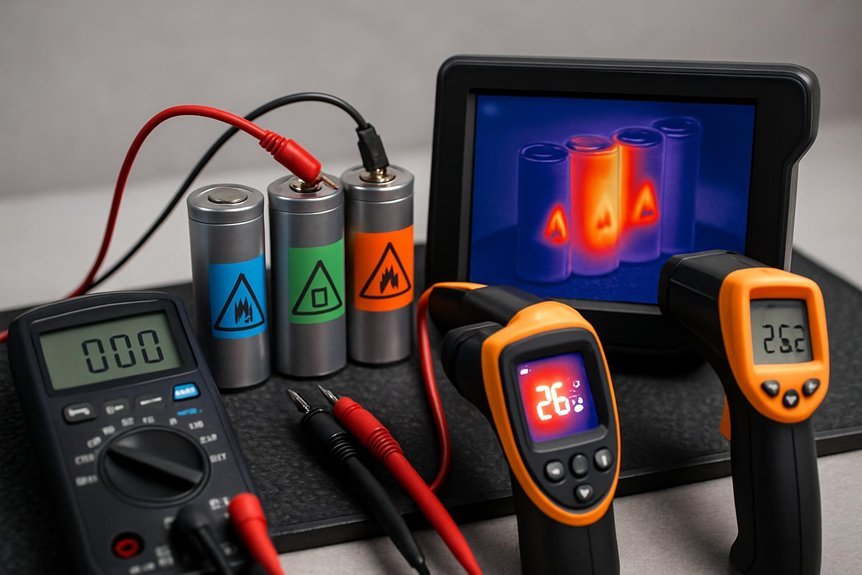
We map safety criteria to use-case risk factors, then align each criterion to expected operating conditions and failure modes. Our approach emphasizes data-driven benchmarks and standards-based thresholds that reflect real-world loads, environments, and duty cycles. We’ll compare safety criteria across applications to ensure consistent, auditable decisions that prioritize prevention and reliability.
Use-Case Risk Factors
How we choose safety criteria by use case hinges on identifying the specific risks, duty cycles, and environmental conditions the battery will face. We assess load profiles, charging regimes, and temperature ranges to quantify exposure to thermal runaway, gas generation, and mechanical stress. Our approach weighs failure modes by their likelihood and consequence, aligning tests with real-world scenarios rather than abstract norms. We prioritize standardized safety testing protocols, including abuse, overcharge, short-circuit, and vibration simulations, to validate protective mechanisms and integrity margins. Clear acceptance criteria emerge from hazard analysis, fault tolerance, and lifecycle expectations. By documenting failure thresholds and mitigation performance, we establish defensible safety claims that support regulatory alignment and risk communication for end users. This focus on use case risk strengthens our overall battery safety narrative.
Safety Criteria Mapping
Indeed, mapping safety criteria starts with aligning criteria to a defined use case and its exposure scenarios. We present a structured approach: identify hazards relevant to the use case, map standards and tests to each hazard, and quantify risk reduction with measurable metrics. We frame criteria around thermal behavior, abuse tolerance, fault tolerance, and degradation pathways, then validate through controlled testing and peer review. Tradeoffs are inevitable; we document low cost tradeoffs to distinguish essential safeguards from optional features. We emphasize lifecycle considerations, including cycling, storage, and recycling impacts on safety performance. User perceived safety matters too, so we correlate objective results with intuitive indicators. By aligning criteria to exposures, we ensure consistent risk controls, reproducibility, and compliance across battery chemistries and classifications.
Main Lithium Chemistries: Pros, Cons, and Safety
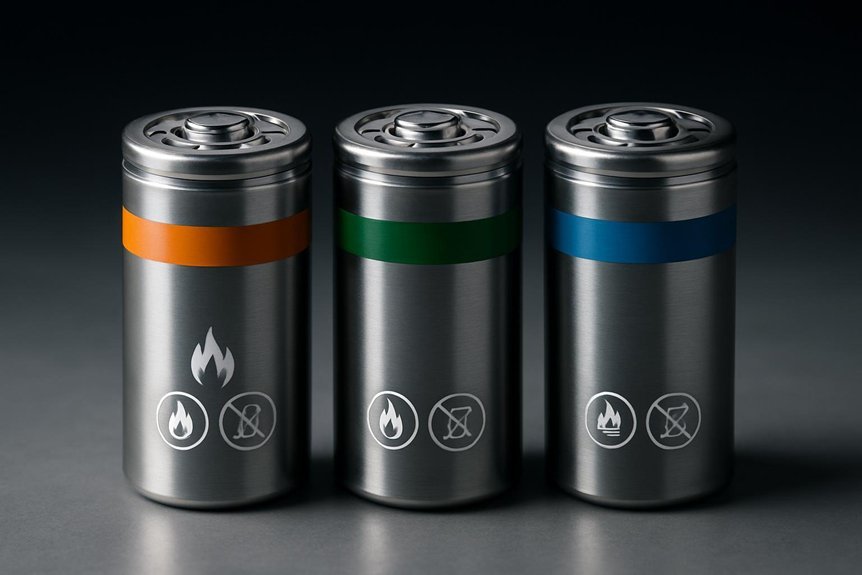
There are several mainstream lithium chemistries, each with distinct safety, performance, and handling profiles that affect suitability for different applications. We compare lithium iron phosphate (LFP), nickel manganese cobalt (NMC), and lithium nickel cobalt aluminum (NCA) by data-driven metrics: energy density, cycle life, and thermal response. LFP emphasizes battery safety and long lifecycle testing, with robust thermal stability but lower energy density. NMC and NCA offer higher energy density yet demand stronger safety controls and monitoring to mitigate dendrite formation and thermal runaway risks. Standards-oriented assessment highlights supply chain considerations, cycle degradation under real-world use, and required protection circuits. Across chemistries, we prioritize consistent safety margins, standardized testing, and transparent disclosure of performance claims to inform safe, reliable deployment.
Thermal Stability and Its Impact on Safety
What exactly happens inside a lithium battery when heat builds up, and why does that matter for safety? We examine thermal stability as a core safety metric: higher stability reduces failure likelihood, and predictable behavior under abuse aids standards compliance. Data show how temperature thresholds influence reaction rates, electrolyte decomposition, and electrode integrity, guiding safer chemistries and cell designs. When stability wanes, pathways to thermal runaway become more probable, increasing the risk of gas emission and external fire. Our assessment emphasizes repeatable, tested performance under standard conditions, with clear limits for charging, storage, and use. Compliance with safety standards hinges on robust thermal management and validated containment.
- 1) Temperature limits
- 2) Material stability
- 3) Containment efficacy
Safety Features in Battery Management Systems (BMS)
How do Battery Management Systems (BMS) enhance safety in lithium batteries, and what features matter most for reliability and compliance? We present data-driven, standards-aligned insights, focusing on reliability, protection, and traceability. A robust BMS monitors voltage, current, temperature, and state of charge, and enforces safe operating limits to reduce icing risk from temperature excursions. It also provides fault logging and battery designation tagging to support lifecycle tracking and regulatory compliance. Our assessment emphasizes redundancy, accurate balancing, and firmware update controls to mitigate single-point failures. Below is a quick reference to key features that matter for safety and documentation.
| Feature | Benefit |
|---|---|
| Real-time protection | Prevents over/under voltage, overcurrent, and thermal events |
| Diagnostics & logging | Enables traceability and incident analysis |
| Indication of battery designation | Supports compliance and inventory control |
Chemistry-Specific Safety Risks: Fire, Runaway, Leaks
Chemistry-specific safety risks in lithium batteries center on fire, thermal runaway, and leaks, and these hazards vary by chemistry and design. Across chemistries, we see distinct ignition and propagation tendencies, which informs our risk assessments and containment strategies. We rely on safety data, standardized testing, and industry guidance to quantify warnings and defenses. Our approach emphasizes preventing initiation, rapid detection, and effective mitigation, aligned with safety standards and proven fire suppression methods. We also assess leak risk to protect handling practices, storage protocols, and enclosure integrity.
- Fire initiation thresholds and rate of heat generation by chemistry
- Containment, detection, and fire suppression requirements per standards
- Leak, venting, and overpressure considerations with emergency response protocols
How Form Factor and Use Case Drive Safety Needs
We can see how form factor directly influences thermal management, mechanical protection, and enclosure integrity, which in turn shape safety margins and failure modes. We’ll compare use-case profiles—operational duration, environment, and handling—to quantify risk reduction and align with applicable standards. By anchoring decisions in data on form factor safety impacts and use-case risk, we guide safer selections for readers.
Form Factor Safety Impacts
Form factor shapes safety needs as much as chemistry does, because the physical size, shape, and how a device is used determine exposure to abuse, mechanical stress, and thermal buildup. We review how form factor influences risk, and how standards guide testing and prevention. Our approach is data-driven, prioritizing measurable outcomes from safety testing, failure modes, and environmental conditions.
- We quantify how enclosure volume, venting paths, and contact surfaces affect thermal runaway risk and mechanical insult, driving design choices aligned with safety standards.
- We align form factor with containment and isolation strategies to limit energy release and improve thermal management during abuse scenarios.
- We require rigorous, repeatable safety testing across use-case simulations to verify performance margins and regulatory compliance.
Use Case Risk Profiles
Use Case Risk Profiles translate form factor decisions into real-world safety outcomes by tying how a device is used to the likelihood and impact of abuse, misuse, and environmental exposure. We, as readers, benefit from a structured view that links form factor to incident potential, severity, and recovery options. Our assessment relies on empirical data from reliability testing and controlled stress studies, ensuring repeatable safety conclusions across scenarios. We emphasize standard-aligned criteria for enclosure integrity, thermal management, and external connectors, because any mismatch elevates risk during operational cycles, drops in performance, or accidental impacts. Environmental exposure—temperature, humidity, vibration—drives material compatibility and containment strategies. By modeling use-case profiles, we identify prioritized safeguards, verify with testing, and communicate clear safety requirements for manufacturers and users alike.
Protective Measures in Manufacturing: QA, Design Safeties
How do we safeguard lithium battery production from the outset? We implement rigorous protective measures and strong manufacturing QA to detect faults early, prevent recalls, and protect workers. Our approach is data-driven, standards-aligned, and continuously audited, with traceable decisions and measurable outcomes.
- Design safeties integrated early: fail-fast simulations, robust enclosure standards, and thermal management checks.
- Process QA checkpoints: incoming materials verification, in-process monitoring, and final inspection criteria tied to performance specs.
- Statistical discipline: sampling plans, defect rate targets, and corrective actions that prevent recurrence.
How to Evaluate a Battery for Safety in Practice
What criteria matter most when evaluating a battery for safety, and how do we apply them in practice? We focus on data-driven safety testing and formal risk assessment, then translate results into actionable controls. We assess material stability, thermal runaway resistance, and short-circuit safeguards, plus venting and containment reliability. We verify standards compliance (UL, IEC, UN) and document accepted test protocols, pass/fail criteria, and traceability. We integrate failure mode effects analysis (FMEA) into the evaluation, prioritizing high-risk scenarios and mitigation effectiveness. Below is a concise visualization of core ideas.
| Dimension | Practice |
|---|---|
| Thermal & Mechanical | Replicate worst-case conditions, monitor responses |
| Electrical & Chemical | Validate protection schemes, analyze reaction pathways |
Frequently Asked Questions
How Do Ambient Conditions Affect Lithium Battery Safety in Everyday Use?
Ambient conditions influence safety: ambient stability degrades with heat or cold, increasing thermal runaway risk. We monitor charging safety and hardware limits, enforce temperature thresholds, and minimize charging speeds to reduce infrastructure risk while maintaining performance.
What Is the Impact of Charging Infrastructure on Safety Risk?
We measure charging safety by infrastructure standards, noting that robust, well-regulated charging reduces risk; reliable infrastructure standards improve predictability, reduce faults, and lower thermal breaches, guiding users toward safer practices and consistent performance.
Are There Safety Differences Between Cylindrical and Prismatic Cells?
Cylindrical vs prismatic safety differences exist; our data show comparable thermal stability with design tradeoffs. We prioritize containment, venting, and cell chemistry. We assess standards, safety margins, and abuse testing to minimize risk for both form factors.
How Does Cycle Life Influence Long-Term Safety Performance?
We’ve seen cycle life strongly influence long term safety; better cycle life usually means slower degradation and fewer failure modes. In our tests, batteries with higher cycle life showed more stable thermal profiles, supporting safer long-term performance.
What Practical Signs Indicate Emerging Safety Issues?
We spot emerging safety issues through signs like rising temperatures, unusual odor, rapid capacity loss, and swelling; monitor for emerging thermal events and battery degradation patterns, prioritize safeguards, data logging, and standards-aligned responses to minimize risk.
Conclusion
We see safety as a layered, data-driven landscape. When we opt for LiFePO4, we’re choosing a cooler, steadier figure—less prone to runaway, with predictable venting and a longer cadence of life. Yet no chemistry stands alone; we pair it with robust BMS, rigorous QA, and sound thermal management. Picture a voltage-tuned fortress: materials tested to standards, housings engineered for abuse, and every cell monitored. Safety isn’t a single choice—it’s a holistic, performance-backed system.