You probably don’t know that tiny changes in voltage and temperature can accelerate aging more than full discharges. We’ll map how cycles, charging profiles, and storage conditions interact to slow capacity loss and raise impedance. We’ll share precise, data-backed practices you can use right away, from CC/CV charging to mid-range storage. If you aim for stability and longer life, stay with us as we outline actionable steps and the tradeoffs that matter for your setup.
Key Takeaways
- Monitor voltage stability, temperature, and impedance to predict battery endurance and guide maintenance actions.
- Maintain moderate temperatures, avoid deep or shallow cycles, and use consistent charging windows to extend life.
- Use chargers with proper CC/CV profiles, calibrate for target voltage ranges, and prevent overcharge or high-rate dumps.
- Store batteries at mid-range voltage (about 3.60–3.85 V per cell) in conditioned environments, and verify voltage after storage.
- Implement safety protocols for mishaps, log peak temps, and follow documented guidelines to minimize aging and ensure reliability.
What Affects Lithium Battery Health: Voltage, Temperature, and Cycles
Voltage, temperature, and cycle count are the primary levers that determine lithium battery health. We quantify impact with measurable indicators: voltage stability, internal resistance shifts, and capacity fade over cycles. In practice, voltage stability reflects how closely cell voltage stays within safe bounds under load and rest; deviations indicate degradation pathways accelerating. Temperature governs reaction kinetics, with elevated temps increasing parasitic reactions and lower temps reducing ion mobility, both narrowing usable range. Cycle impact captures how repeated charge-discharge events reduce usable capacity and raise impedance, often unevenly across cells. We monitor these metrics to predict endurance and schedule conditioning or replacement. By controlling operating voltage windows, maintaining moderate temperatures, and minimizing shallow or deep cycles, we sustain robust performance and longer lifespan.
Set Your Charging Routine Correctly
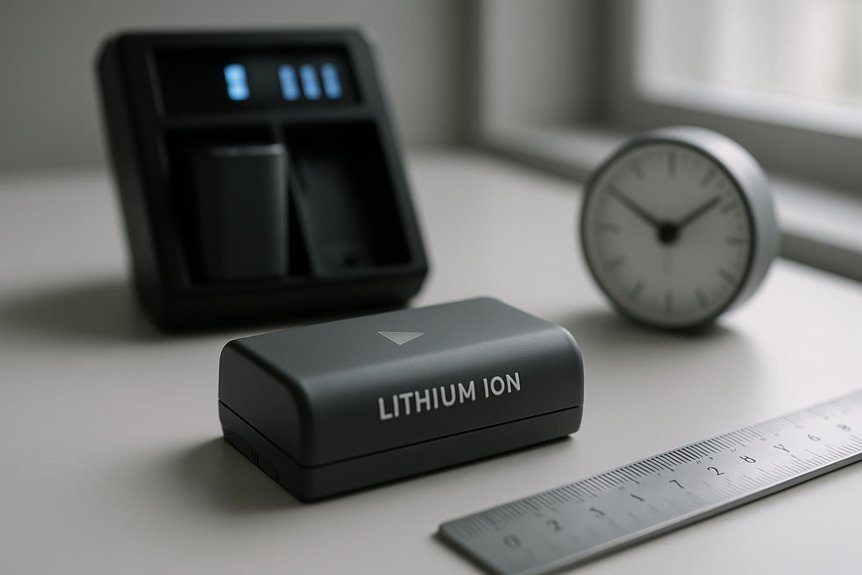
To extend lithium battery life, we establish charging routines that minimize stress on cells by enforcing safe, repeatable voltage windows and current limits. We design cycles around nominal charge goals, avoiding overcharge and high-rate dumps that encourage nickel plating and capacity fade. We monitor charge currents to stay within C-rates that balance heat and efficiency, while timing rest periods to prevent temperature spikes. Our protocol emphasizes consistent termination voltages and periodic verification of impedance drift to detect early degradation. We also document ambient effects, charging source quality, and cable losses to keep results reproducible. Table below summarizes targets and checks for robust charging routines.
| Target Voltage Window | Maximum Charge Current | Verification Checks |
|---|---|---|
| 3.0–4.2 V | ≤1C | Impedance, temp, log |
Store Lithium Batteries for Longevity
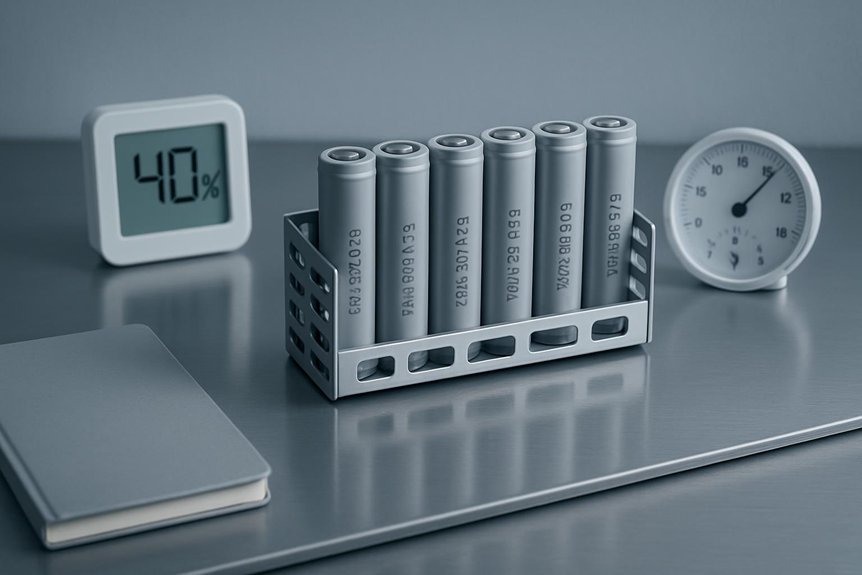
We’ll start by outlining optimal storage voltage ranges to minimize capacity loss over time. Temperature and voltage interact to shape longevity, so we’ll compare recommended storage voltages at different temperatures and quantify expected degradation. By framing these guidelines with concrete targets, we’ll set the foundation for consistent, data-driven storage practices.
Storage Voltage Guidelines
If you’re storing lithium batteries for longevity, maintaining an appropriate storage voltage is essential. We recommend targeting a mid-range level that minimizes SEI degradation and cathode cathodic loss, typically around 3.60 to 3.85 volts per cell for most Li-ion chemistries. We base this on balance between reduced electrolyte decomposition and remaining capacity, avoiding full-charge stress and deep-discharge damage. For pouch and cylindrical formats, use a calibrated charger with an exposure window that holds the cell group within ±0.05 V of the target. Monitor temperature, as excessive warmth accelerates battery aging even at optimal voltage. Store in a conditioned environment, away from extremes, and periodically verify voltage after storage intervals. Document voltage drift and adjust future storage cycles to sustain long-term performance.
Temperature Effects On Longevity
Extreme temperatures accelerate lithium battery degradation: high temperatures accelerate SEI growth and electrolyte aging, while low temperatures increase internal resistance and hamper chemical reactions, reducing usable capacity. We observe pronounced temperature sensitivity in capacity retention over cycles, with rate-dependent aging effects visible in calendar life. Our guidance: minimize heat exposure during storage and operation; avoid prolonged exposure above 40°C or below -20°C. Thermal management directly influences impedance rise, visible as higher IR and reduced C-rate tolerance. We quantify effects with accelerated aging tests showing DEH (differential entropy heat) correlations to cycle life. Storage in moderate, stable temperatures preserves electrolyte viscosity and cathode structure. Prioritize temperature control in packs, housings, and enclosures, and monitor ambient and surface temps. By limiting heat exposure, we preserve usable capacity and extend longevity.
Handle Heat, Spills, and Other Mishaps Safely
We’ll outline how we manage heat, respond to spills, and handle other mishaps with data-driven procedures. You’ll see concise steps for heat management, established spill response protocols, and safe mishap handling to minimize risk and rapid recovery. Our focus is on precise actions, measurable thresholds, and clear decision points for you to follow.
Heat Management Steps
What steps should we take to manage heat, spills, and other mishaps with a lithium battery? We begin with thermal boundaries: monitor cell temperature limits, log peak temperatures, and intervene before 60°C onset. Use external cooling when internal resistance rises, maintaining steady convection airflow across packs. Deploy heat sinks to draw excess heat away from high‑power cells, and ensure uniform contact with minimal impedance. Prioritize passive cooling in storage and active cooling during high discharge, avoiding localized hotspots. Isolate damaged modules quickly to prevent cascading failure, and verify that thermal throttling engages as designed. Record all deviations, assess heat transfer coefficients, and validate with controlled tests. Maintain clear pathways for air, prevent obstruction, and ensure sensors remain calibrated for reliable feedback.
Spill Response Protocols
Spill response must be rapid, precise, and systematized: we start by containing the spill at the source, isolating damaged modules, and deploying appropriate PPE. When a Li-ion event occurs, we initiate immediate area isolation, verify venting status, and activate containment procedures to prevent spread of electrolyte. We document spill volume, ambient temperature, and battery chemistry, then implement absorbent barriers and inert, non-sparking tools. Venting components are monitored for pressure changes; if thermal runaway appears, we deploy water mist cautiously to limit aerosolization, never spraying directly onto exposed cells. All responders wear PAPR and chemical-resistant gear, and we conduct post-event decontamination per manufacturer guidelines. Training focuses on rapid assessment, controlled neutralization, and accurate reporting, ensuring future improvements in spill response and containment procedures.
Safe Mishap Handling
Safe mishap handling requires disciplined, real-time decision-making to control heat, spills, and other incidents before they escalate. We’re focusing on containment, isolation, and rapid assessment to limit thermal runaway risk and electrical hazards. When a fault occurs, we implement predefined metrics: temperature rise thresholds, state-of-charge checks, and venting indicators to trigger cooling or shutdown sequences. Spill response protocols emphasize containment, non-conductive tools, and immediate isolation of affected modules to prevent cross-contamination. We document time-to-action statistics, detailing response intervals and outcomes to refine procedures. Personal protective equipment, ventilation standards, and spill kits are audited quarterly to maintain readiness. Training emphasizes scenario-based drills, objective triage, and clear communication to minimize exposure and damage. Sustained vigilance ensures safe mishap handling across all battery systems.
Choose and Use the Right Charger
Choosing the right charger is essential because using the wrong device can damage a lithium battery or reduce its lifespan. We select a charger by matching battery chemistry to appropriate charging standards, ensuring voltage, current, and termination methods align with the cell type. Our approach prioritizes chargers that provide proper CC/CV profiles, temperature monitoring, and protective features like overvoltage, overcurrent, and short-circuit safeguards. We verify compatibility with the device’s nominal voltage and recommended charging current to avoid accelerated aging. We favor certified, reputable units that disclose active balancing and timing controls. We avoid universal adapters that lack explicit charging profiles. By adhering to documented battery chemistry guidelines and standard charging curves, we minimize heat generation and capacity loss, while maximizing cycle life and safety in real-world use.
Quick Routines for Long-Term Battery Reliability
Are you looking to maximize a lithium battery’s lifespan with simple, repeatable habits? We’ll implement quick routines that boost long term reliability without overcomplicating usage. Routine-driven practices reduce degradation by stabilizing voltage, current, and temperature profiles during cycles. We target consistent charge windows, avoid deep discharges, and monitor internal temperature limits with calibrated thresholds. Data shows modest, repeatable adjustments yield measurable capacity retention over time, especially when paired with environment control and firmware-aware charging. Below, we present a compact guide and table to reinforce discipline and traceability.
| Area | Action | Expected Benefit |
|---|---|---|
| Charging | Stay within 20–80% when possible | Minimized stress, slower aging |
| Temperature | Keep ambient 20–25°C | Reduced parasitic loss |
| Discharge | Avoid deep cycles | Preserves energy density |
| Monitoring | Log voltages, temps | Early fault detection |
| Maintenance | Schedule periodic checks | Sustained reliability |
Frequently Asked Questions
How Often Should I Calibrate My Battery Indicator?
We calibrate every 100 cycles to maintain calibration frequency and guarantee accurate readings, because this routine preserves indicator accuracy and confidence in remaining capacity, informing our decisions. We monitor drift, confirm results, and adjust as needed with precise methods.
Can Battery Health Recover After Deep Discharge?
We can’t guarantee full recovery after deep discharge; recovery potential depends on pack chemistry and depth. We caution that deep discharge risks include capacity loss and cell imbalance, but some cells may rebound with proper conditioning and balanced charging.
Do Lithium Batteries Hate Cold Storage?
Yes, cold storage stresses lithium batteries, but controlled cold slows degradation; we manage temperature and SOC. We discuss battery chemistry implications, stating that extreme cold reduces capacity temporarily, while proper storage minimizes cycle loss and maintains usable life.
What Signs Indicate Imminent Battery Failure?
We notice warning signs like rapid capacity drop and swelling, so we monitor voltage sag and impedance rise to spot imminent battery failure; avoid calibration myths, and track battery degradation with precise, data-driven diagnostics we trust.
Is Firmware Updates Impact Battery Longevity?
Firmware updates can influence longevity if they optimize power management; however, improper updates may disrupt calibration. We’ve observed firmware longevity improvements when calibration accuracy increases, but calibration impact can also temporarily skew reported state of health and usage metrics.
Conclusion
We cradle our battery like a patient instrument, charting its health as a quiet pulse. Voltage, temperature, and cycles are signatures we read—each data point a lighthouse guiding our routine. We set CC/CV rhythms, keep SOC between 20–80, and store at a calm 3.6–3.85 V per cell. We guard against heat and mishaps, choosing chargers with balance and protection. In steady, measured steps, reliability grows, a cadence of longevity echoing through every discharge and renewal.