We understand battery degradation stems from intertwined chemical, mechanical, and operational factors. SEI growth drains cyclable lithium and raises interfacial impedance, while mechanical cracking exposes fresh surfaces that fuel parasitic reactions. Impurity interactions and gas formation accelerate aging, and active material loss reduces capacity. Distinguishing cycling vs. calendar aging helps frame how temperature, SOC, and C-rate push long-term fade. We’ll examine materials, coatings, and operating conditions to reveal where deterioration originates and what to monitor next.
Key Takeaways
- SEI formation and growth consume cyclable lithium, causing irreversible capacity loss and higher interfacial impedance.
- Temperature, cycling, and calendar aging drive SEI evolution, gas generation, and mechanical degradation through cracking and repair.
- Material choices trade energy density for longevity, with Ni-rich cathodes, high-novel chemistries, and Li-metal enabling faster aging pathways.
- Operating conditions (SoC, C-rate, temperature) interact to accelerate fade via lithium loss, plating, and SEI/CEI thickening.
- Diagnostics (impedance, DC/AC metrics, DVA/ICA) and design choices (cell chemistry, formats) are essential to identify and mitigate degradation mechanisms.
What Drives Battery Degradation: Foundational Mechanisms
What drives battery degradation at its core is a network of interdependent reactions at the electrode–electrolyte interface and within the active materials themselves. We trace SEI formation and growth, where electrolyte reduction consumes cyclable lithium, causing irreversible capacity loss and interfacial impedance rises that limit power in early cycles. The SEI evolves from organic-rich to inorganic-rich compounds with temperature and cycling, altering transport and stability, while mechanical cracking and repair expose fresh surfaces, triggering ongoing parasitic reactions. Impurity reactions, aided by water and HF, accelerate instability and gas generation. Active material loss arises from lithium inventory depletion and cathode/anode degradation, including particle cracking, delamination, and surface films that block ion access. Disorder microstructure and impurity reactions thus keyly shape degradation pathways.
Distinguishing Cycling vs. Calendar Aging and How It Unfolds

Distinguishing cycling from calendar aging hinges on how and when capacity fade and impedance rise arise. We separate effects by definition: cycling aging stems from repeated charge–discharge stress, while calendar aging arises during storage with no net current, driven by time, temperature, and SOC. In practice, both occur and interact, yet they display distinct kinetics: calendar fade often follows Arrhenius-like temperature dependence and non-linear time laws (power-law or stretched-exponential), whereas cycling fade scales with cumulative throughputs and DoD, accelerated by high C-rates and voltage windows. We quantify with capacity loss, coulombic efficiency, and resistance growth. Calendar aging hints include SOC sensitivity near full charge and storage temperatures, while spacing effects reflect how temperature and SOC exposure durations influence reaction rates and SEI dynamics over time. Accurate models couple calendar and cycle mechanisms for robust lifetime predictions. Dataset also shows significant cell-to-cell variability under identical conditions, underscoring the need for probabilistic approaches.
Material Choices and Chemistries That Influence Longevity
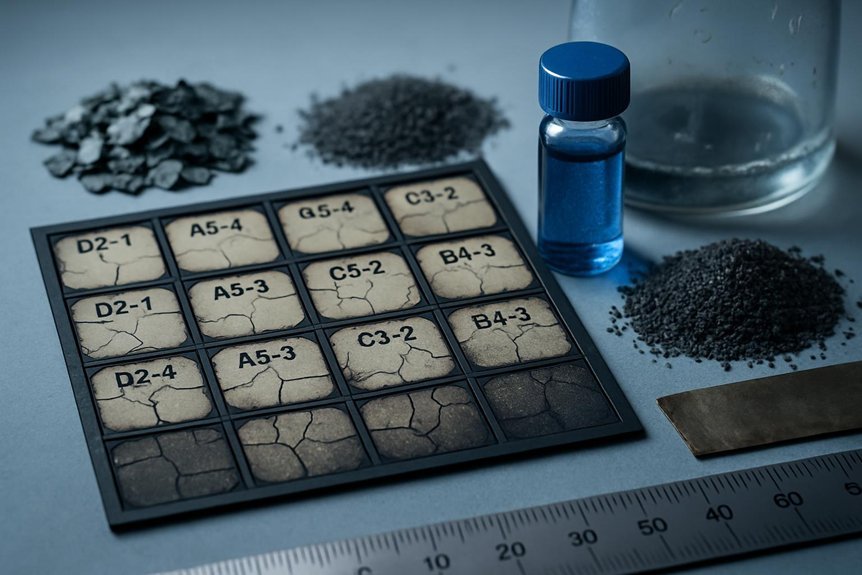
We summarize how chemistry choices trade off energy, stability, and lifetime, showing that high-Ni NMC/NCA boosts capacity but increases structural risk and aging. Spinel and olivine offer robustness with lower energy density, while Li-rich and anion-redox cathodes enable higher potentials but suffer irreversible losses that shorten cycle life. Doping, coatings, and advanced SEIs can mitigate degradation modes, yet introduce costs and complexity that influence overall longevity. High-energy lithium-metal batteries can enable practical, high-energy-density designs for electric vehicles, but present distinct degradation pathways that must be managed through material design and interfacial control.
Chemistry Tradeoffs Summarized
How do material choices shape battery longevity across anode, cathode, and electrolyte chemistries? We analyze tradeoffs that drive degradation, balancing capacity, stability, and safety. Anodes: graphite offers stable SEI with low first-cycle loss; lithium metal provides high capacity but severe dendrite and SEI reformation risk; silicon composites boost capacity yet suffer volumetric expansion and rapid SEI growth; LTO delivers long life but modest energy density. Cathodes: Ni-rich NMC raises energy at the cost of structure stability and metal/oxygen loss; LFP excels in durability but lower energy; high-voltage oxides and spinels trade capacity for stability; NASICON-like chemistries emphasize robustness yet face conductivity limits. Electrolytes: conventional salts enable broad use but incur HF and SEI erosion; additives and fluorinated formulations improve interfaces; solid electrolytes reduce leakage yet pose interfacial challenges.
| Anode option | Cathode option | Electrolyte option |
|---|---|---|
| Graphite | Ni-rich NMC | Conventional carbonate |
| Lithium metal | LFP | High-concentration electrolyte |
| Silicon composites | High-voltage oxides | Fluorinated additives (FEC) |
| LTO | Spinel | Solid electrolytes |
| Hard carbon | NASICON-like | Localized-high-concentration |
In practice, material choices must account for aging mechanisms such as SEI growth and dendrite formation, which influence long-term reliability and cost. Main factual point This tradeoff framework helps forecast lifecycle performance under real operating conditions.
Material-Performance Balances
Material choices and chemistries shape longevity through trade-offs between energy, stability, and interfacial durability. We examine how porous cathodes and granular anodes influence cycle life, rate capability, and degradation pathways. Higher-energy cathodes accelerate structural changes and surface reactions, while microstructure controls diffusion, hot spots, and SEI growth. Granular anodes reduce localized stress but increase interfacial area, amplifying electrolyte decomposition unless stabilized. Stability enhancers—coatings and dopants—mitigate dissolution, yet may impede ionic transport if overdone, stressing balance. Elevated voltages exacerbate electrolyte oxidation and transition-metal loss, underscoring the need for compatible chemistries and architectures. Ultimately, performance longevity arises from synergistic optimization across material form, interfacial layers, and electrolyte formulation to temper reactivity without sacrificing energy density.
- porous cathode effects on interfacial durability
- granular anode morphology implications
- coatings and dopants trade-offs
- electrolyte compatibility with high-energy chemistries
Operating Conditions That Accelerate Fade: Temperature, SOC, C-Rate
We show how operating conditions drive fade, starting with temperature, SOC, and C-rate as intertwined stressors. We quantify how high temperatures accelerate SEI growth and electrolyte decomposition, while low temperatures raise resistance and lithium plating risk, with thermal cycling and gradients amplifying local aging. We then link SOC and C-rate to mechanical and electrochemical degradation, noting that high SOC and fast charging accelerate parasitic reactions and impedance growth, especially under demanding thermal or current transients.
Temperature Effects On Fade
Temperature is a dominant driver of both calendar and cycle fade, with temperature shifts accelerating or decelerating degradation pathways in distinct ways. We observe low-temperature plating risks and high-temperature SEI growth shaping capacity loss, impedance rise, and safety concerns. Ionic conductivity falls with cooling, elevating overpotentials; at high temperatures, SEI and electrolyte oxidation accelerate, consuming cyclable lithium. Non-uniform temperatures create localized aging, heating hotspots, and uneven degradation across cells. Charge acceptance lengthens in cold conditions, while elevated temperatures with high SoC dramatically speeds fade. Mechanical stress from non-uniform lithiation at low T further cracks active material. Overall, temperature governs reaction kinetics, diffusion, and mechanical stability, dictating calendar vs. cycle fade balance.
- low temperature plating risks
- high temperature SEI growth
- uneven thermal gradients and hotspots
- temperature–SoC synergy on fade
SOC and C-Rate Impacts
SOC and C-rate strongly shape aging trajectories by dictating how much cyclable lithium remains, how fast side reactions proceed, and where mechanical stresses concentrate. We examine SOC extremes and C rate impact through well‑established patterns: narrow SOC windows boost cycle life, but high SOC or deep low-SOC cycling amplifies SEI growth, lithium loss, and mechanical stress. High SOC accelerates oxidative decomposition and transition‑metal dissolution, while prolonged low SOC heights copper corrosion risk and, with rapid charging, potential lithium plating. High C-rates raise overpotential, promoting plating, heating, and fracture, and drive thicker SEI/CEI layers, impairing transport. Moderate cycling (C/2 to 1C) minimizes these effects, but repeated high‑rate bouts still degrade impedance and capacity. In practice, balancing SOC windows with controlled C rates yields the best long‑term retention.
How to Diagnose Degradation: Metrics and Tests You Can Use
How can we reliably diagnose degradation? We target precise metrics and controlled tests to map aging mechanisms to observable signals. We monitor usable capacity, SOH, and DCIR trends; rising resistance signals power fade and heat concerns, while Coulombic efficiency drift reveals SEI growth or electrolyte loss. ICA and DVA pinpoint active material loss and lithium inventory shifts, and ICA/ICA-like analyses separate material vs. kinetic limits. Impedance, EIS, PITT, and GITT quantify Rct, Cdl, diffusion changes, and diffusion coefficients, linking impedance fingerprints to aging modes. We acknowledge insufficient data barriers and avoid impedance-driven overinterpretation; cross-check with ICA, DVA, and rate tests to ensure coherence. Unrelated topic data should not bias interpretation. Continuous, protocolized testing under known conditions sustains comparability.
- Capacity vs. nameplate tracking (Ah/Wh)
- Cycle-rate and calendarized tests for fade per cycle
- Impedance and diffusion diagnostics (EIS, PITT, GITT)
- ICA/DVA for material vs. lithiation shifts
Strategies to Extend Battery Life: Design, Use, and Maintenance
Design choices and operational practices set the foundation for prolonged battery life. We tailor chemistry and cell format to maximize cycle life, favoring LFP over NMC where possible, and select cylindrical or robust pouch designs to minimize mechanical stress. We optimize electrode thickness and porosity to balance energy density with ion transport, and apply additives and coatings to curb SEI growth and metal dissolution. Thermal management is essential: uniform cooling, proper spacing, and temperature control reduce hotspot‑driven aging. Our BMS enforces SoC windows (≈10–20% floor, ≤90–95% cap), adaptive charge rates, active balancing, and temperature‑aware control. We model aging and adjust profiles, aiming for stable SoH. For use and storage, we maintain 15–35 °C and moderate SoC, using reliability metrics to monitor health and guide interventions.
Frequently Asked Questions
How Does SEI Growth Specifically Impact Long-Term Capacity Fade?
SEI growth directly accelerates long-term capacity fade by continuously consuming cyclable lithium and expanding impedance, while SEI chemistry shifts toward more insulating layers; dendrite formation can exploit vulnerable SEI, causing localized loss and accelerated degradation.
Can a Battery Recover Capacity After Temporary High-Temperature Exposure?
Yes, we can see temperature rebound and some capacity recovery after brief high-temperature exposure. Short-term gains may vanish with cooling, but partial restoration in voltage and available capacity is common, though irreversible loss persists with longer or hotter events.
What Role Does Lithium Plating Play in Early-Cycle Degradation?
Lithium plating accelerates early-cycle degradation, reducing Coulombic efficiency by measurable tenths to percentage points. We find that plated lithium worsens solid electrolyte interaction, elevating impedance and promoting SEI growth, deterring capacity retention from the outset.
Do All Cathode Chemistries Age at the Same Rate Under Identical Use?
Not all cathode chemistries age at the same rate under identical use. Cathode aging interacts with anode dynamics, temperature, and SOC, producing chemistry-specific impedance and capacity loss profiles that differ despite identical stressors we apply.
How Reliable Are BMS Estimates of Remaining Life in Practice?
We’d say BMS estimation is surprisingly variable; reliability metrics often show wide confidence bands. It’s not flawless, but we quantify uncertainty with bounds, calibrations, and frequent updates to improve remaining-life predictions for readers like you.
Conclusion
We’ve traced the threads of degradation: SEI and gas, cracks and contaminants, loss of lithium, and calendar wear. This tells us precisely where to intervene, from design choices to operating discipline. We must monitor temperature, SOC, and C-rate, measure impedance, capacity fade, and energy efficiency, then adapt. By combining robust materials, smart coatings, and careful usage, we slow aging. We stay vigilant, systematic, and surgical, safeguarding longevity through informed, iterative optimization.