Imagine a large-scale solar energy storage system operating without a BMS, where uneven cell voltages lead to premature failure and safety risks. This scenario underscores the importance of understanding how a Battery Management System can influence performance and safety. By examining the differences between lithium batteries with and without a BMS, we can better determine whether implementing one is a necessary step for your application’s reliability and security.
Key Takeaways
- A BMS monitors and balances individual cells, extending battery life and ensuring safe operation, unlike no BMS which risks uneven aging.
- Using a BMS reduces safety hazards like thermal runaway and fires, whereas no BMS increases these risks.
- BMS maintains consistent voltage, temperature, and current, improving efficiency and reliability; without it, performance degrades faster.
- Implementing a BMS involves higher upfront costs but offers long-term savings through reduced maintenance and longer battery lifespan.
- Without a BMS, there’s a greater chance of irreversible damage, safety incidents, and premature battery failure.
What Is a Battery Management System (BMS) and How Does It Work?
A Battery Management System (BMS) is an essential electronic circuit that monitors and controls the performance of a lithium battery pack. It guarantees ideal operation by regulating charge and discharge cycles, preventing overcharging or deep discharging, which directly impacts battery lifespan. By accurately balancing individual cells, the BMS maintains uniform voltage levels, reducing the risk of capacity degradation over time. This proactive management minimizes the need for costly replacements or repairs, thereby influencing overall cost implications. Additionally, the BMS provides real-time data on temperature, voltage, and current, enabling precise control and diagnostics. Without a BMS, batteries are more prone to uneven wear and potential failure, resulting in reduced lifespan and higher long-term costs. Consequently, integrating a BMS is crucial for extending battery durability and controlling expenses.
Key Benefits of Using a BMS in Lithium Batteries
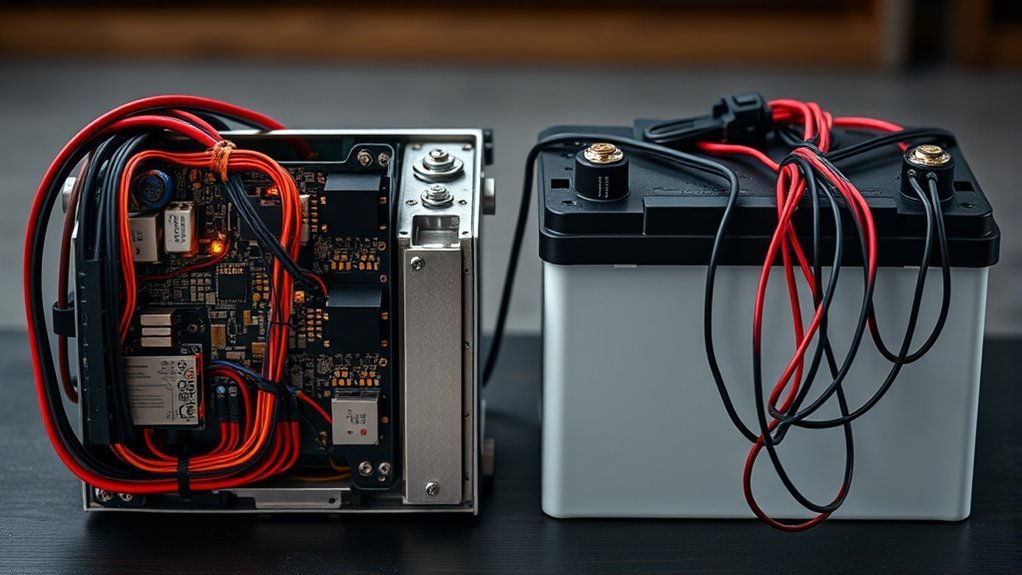
Implementing a Battery Management System (BMS) in lithium batteries offers several critical advantages that directly impact performance and longevity. A BMS guarantees ideal cell balancing, preventing overcharging and deep discharging, which greatly extends the battery’s lifespan. By continuously monitoring voltage, current, and temperature, it reduces the risk of thermal runaway and other safety hazards, maintaining consistent operation. While the initial cost implications of integrating a BMS might seem high, the long-term savings are substantial, as it mitigates premature battery failure and reduces maintenance expenses. Overall, a BMS enhances reliability, maximizes efficiency, and safeguards investments, making it an essential component for maximizing the value and durability of lithium battery systems.
Risks and Challenges of Operating Lithium Batteries Without a BMS

Operating lithium batteries without a Battery Management System exposes them to significant risks that can compromise safety and performance. Without BMS oversight, uneven charge and discharge cycles may occur, accelerating battery degradation and reducing overall battery longevity. Over time, this inefficiency leads to capacity loss and a shorter service life, increasing the frequency and cost of replacements. Additionally, the absence of voltage and temperature regulation heightens the risk of thermal runaway and potential fires, posing safety hazards. The cost implications are substantial, as unprotected batteries often require more frequent maintenance, monitoring, and early replacement. Furthermore, neglecting proper management can result in irreversible damage and safety incidents, underscoring the critical importance of a BMS in ensuring both the longevity and safe operation of lithium batteries.
Comparing Performance and Safety: Lithium Batteries With vs Without BMS
When comparing lithium batteries with and without a Battery Management System (BMS), it becomes evident that the presence of BMS considerably enhances both performance and safety. A BMS guarantees balanced cell voltages, preventing overcharging and deep discharging, which directly extends battery lifespan. Without a BMS, uneven charge distribution accelerates degradation, reducing longevity and increasing the risk of failure. From a safety perspective, BMS-equipped batteries monitor critical parameters continuously, mitigating thermal runaway and other hazards. Although adding a BMS incurs higher initial costs, it reduces long-term maintenance and replacement expenses, impacting overall cost implications favorably. Ultimately, BMS integration promotes consistent performance, safer operation, and a more economical lifecycle, making it essential for reliable lithium battery applications.
How to Decide Whether a BMS Is Necessary for Your Lithium Battery Application
Determining whether a BMS is necessary hinges on understanding the specific demands and risks associated with your lithium battery application. Factors like operational environment, load variability, and safety requirements influence this decision. A BMS can extend battery lifespan by preventing overcharge and deep discharge, but it also introduces initial cost implications. Here’s a quick comparison:
| Criterion | With BMS | Without BMS |
|---|---|---|
| Battery lifespan | Longer, due to voltage and temperature regulation | Shorter, risk of damage from imbalance |
| Cost implications | Higher upfront, potential savings long-term | Lower initial cost, higher risk of failure |
| Safety and reliability | Enhanced safety features | Increased safety risks |
Assess these factors carefully to decide if a BMS aligns with your application’s safety, performance, and budget needs.
Frequently Asked Questions
Can a Lithium Battery Function Safely Without a BMS Long-Term?
Without a BMS, lithium batteries risk safety issues like overcharging or overheating, which can cause damage or fires. Although it lowers initial costs, long-term safety and reliability are compromised, making a BMS essential for responsible battery management.
How Does BMS Impact the Lifespan of a Lithium Battery?
Studies show BMS can extend lithium battery lifespan by up to 40% through optimized charge management, enhancing battery safety. We find that a robust BMS prevents overcharging and deep discharges, essential for maintaining long-term health and performance.
Are There Specific Applications Where a BMS Is Unnecessary?
We find that in applications prioritizing minimal battery weight and rapid charging, a BMS might be unnecessary, as the system’s lightweight design and fast charge cycles reduce complexity, but always consider safety and longevity implications before excluding a BMS.
What Are the Cost Differences Between Batteries With and Without BMS?
Think of batteries as vehicles: those with BMS are like well-maintained cars, costing more upfront but reducing long-term maintenance. Without BMS, initial costs are lower, but potential battery failure increases maintenance expenses, affecting overall cost comparison.
How Do BMS Features Vary Between Different Lithium Battery Brands?
We find BMS features vary by brand reliability and battery compatibility, with some brands offering advanced fault detection, temperature regulation, and balancing, while others provide basic protections; careful selection guarantees ideal safety and performance tailored to specific applications.
Conclusion
In summary, choosing a lithium battery without a BMS is like sailing a ship without a compass—you’re risking catastrophic failure and safety hazards that could end in disaster. The BMS is the ultimate safeguard, ensuring peak performance, longevity, and safety. Ignoring it isn’t just a small oversight; it’s a gamble with the potential to compromise your entire system’s integrity. For reliable, efficient, and safe operation, incorporating a BMS isn’t optional—it’s essential.