LiTime 12V 100Ah Xtra-Mini Bluetooth Trolling Motor LiFePO4 Battery Review
One-line verdict: The LiTime 12V 100Ah Xtra-Mini packs EV-grade 1280Wh of energy into a compact Group 22NF case and stands out when space and weight matter more than anything else.
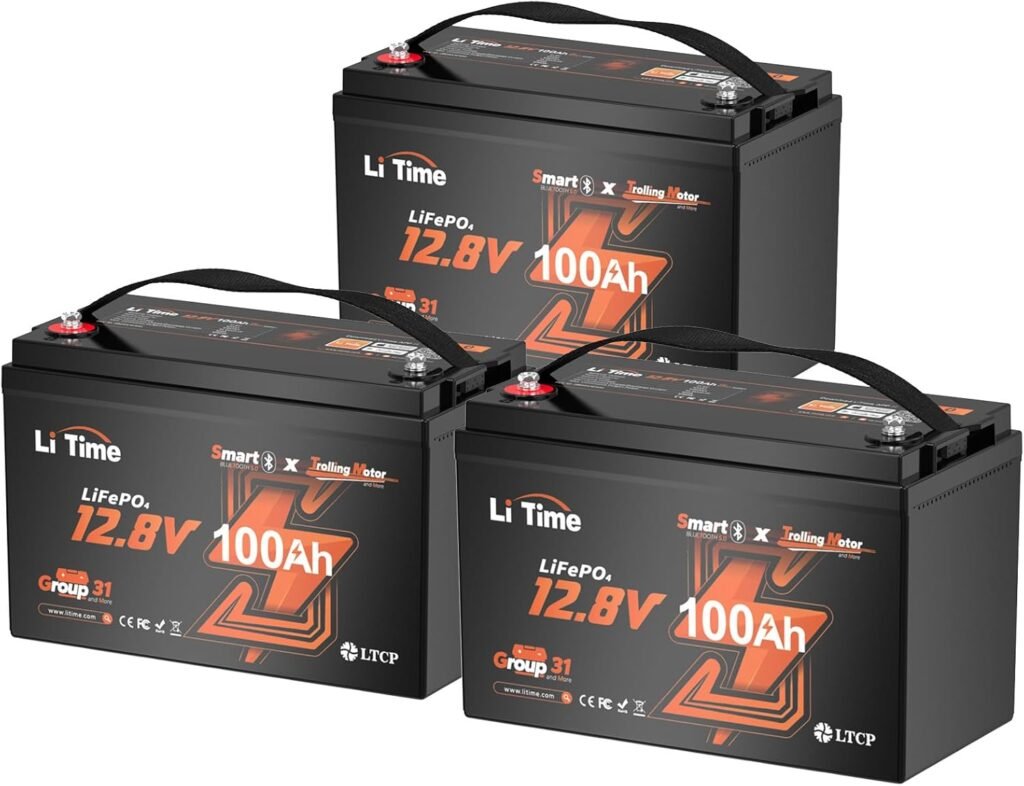
For shoppers comparing compact deep-cycle lithium options in 2026, the headline numbers are strong: 1280Wh in a 9.02″ x 5.43″ x 8.19″ housing, 100A continuous output, 500A surge, 4000+ cycles, Bluetooth 5.0 monitoring, and a listed price of $926.69 for this 3-pack listing. This review contains affiliate links, and we may earn a commission at no extra cost to you.
Our short answer is simple. If you need a battery for an RV house bank, trolling motor, kayak, or cramped under-seat install, this is one of the more interesting compact-format options on Amazon. If you need a starter battery, a golf cart battery, or something intended for jack systems, LiTime clearly says this model is not the right fit.
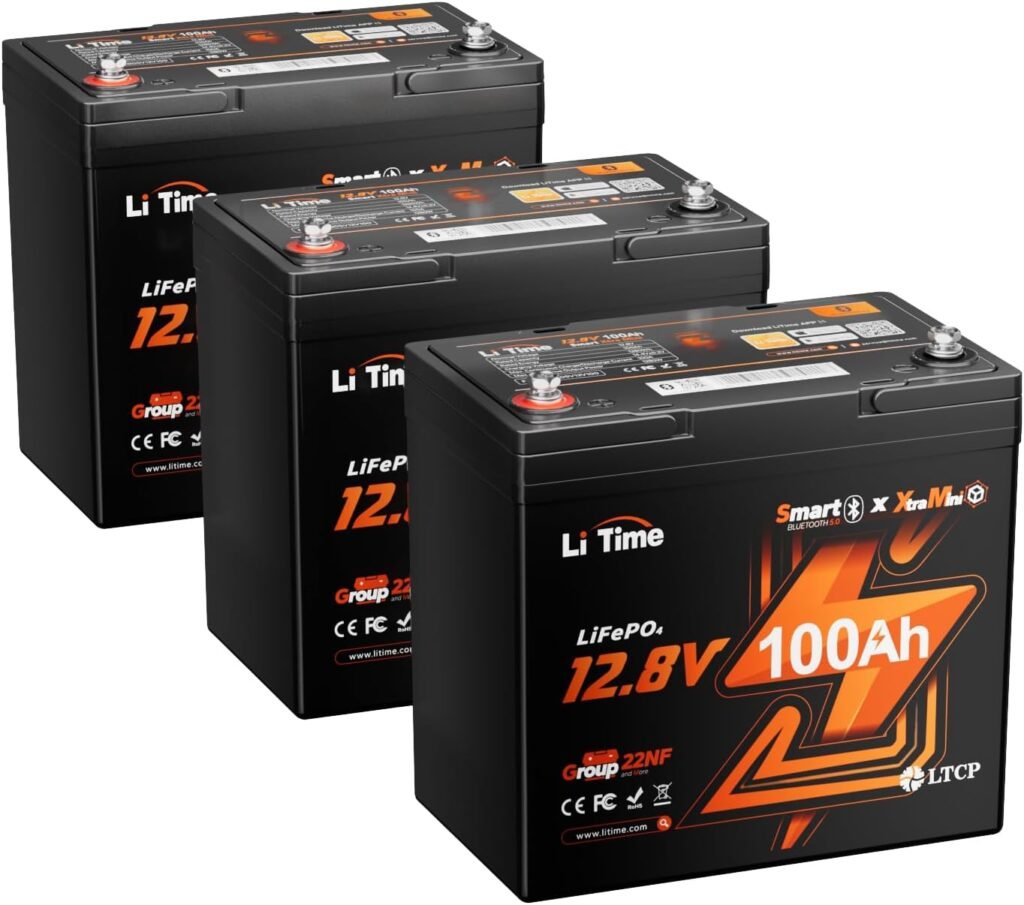

Product overview — LiTime 12V 100Ah Xtra-Mini Bluetooth Trolling Motor LiFePO4 Battery
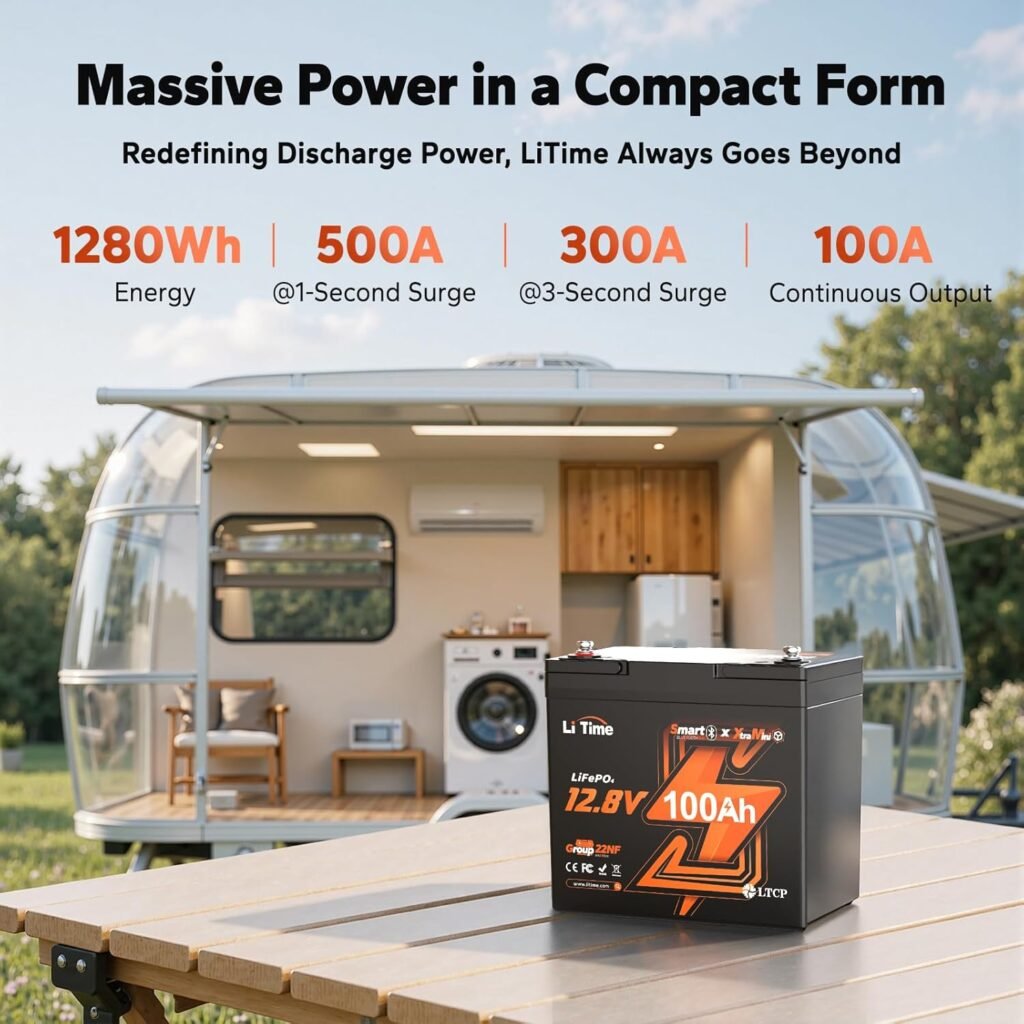
The product page positions this pack around power density and monitoring convenience. Each battery is rated at 12V / 100Ah, which translates to 1280Wh of energy, and the housing measures just 9.02″ x 5.43″ x 8.19″. LiTime also claims 194.7Wh/L energy density, which is a meaningful figure for buyers trying to fit serious capacity into kayaks, small boats, RV compartments, or tight van builds.
On the electrical side, the battery is rated for 100A continuous output and a 500A surge. The listing also highlights 4000+ cycles using EV-grade cells, Bluetooth 5.0 monitoring through the LiTime app, a 1-second discharge switch, and 20+ protection features including low-temperature charging cut-off and overload recovery. Amazon data shows the current listed price is $926.69, down from $1,028.69, and the item is marked In Stock at the time of writing.
There is one practical shipping note buyers should not miss. LiTime warns that orders may arrive in multiple packages because of size and volume restrictions, so the full order may show up in sequential deliveries rather than one box. We recommend tracking every package before opening a return request.
Key specs at a glance
If you want the essentials first, here are the numbers that matter most for real-world buying decisions. The LiTime 12V 100Ah is built around compact size, moderate-to-strong output, and smart monitoring rather than starter-duty cranking.
- Energy: 1280Wh total capacity, with a stated 194.7Wh/L energy density
- Voltage / Capacity: 12V / 100Ah
- Size: 9.02″ x 5.43″ x 8.19″ in a Group 22NF-sized case
- Output: 100A continuous and 500A peak
- Cycle life: 4000+ cycles with EV-grade cells
- Monitoring: Bluetooth 5.0 via LiTime app
- Extra controls: 1-second discharge switch
- Protection: 20+ safeguards, including low-temp charge cut-off and overload recovery
- Recharge claim: up to 1-hour fast recharge
Key features deep-dive — LiTime 12V 100Ah
The reason the LiTime 12V 100Ah gets attention is that it tries to combine several things buyers usually have to trade off: compact dimensions, decent deep-cycle capacity, smart app monitoring, and enough current for more demanding 12V loads. On paper, the mix is compelling. You get 1280Wh of stored energy, a compact Group 22NF case, a 100A BMS, and Bluetooth 5.0 in a format that is much easier to place than many standard 100Ah lithium batteries.
Where this matters most is installation flexibility. A lot of 100Ah LiFePO4 batteries are physically larger, which creates problems in kayaks, under-seat RV compartments, battery trays, and small marine lockers. The LiTime unit shrinks that footprint to 9.02 inches long and 5.43 inches wide, yet still claims 4000+ cycles and 20+ protections. Based on the product data, this isn’t just a generic small lithium battery. It is clearly designed for buyers who are fighting for every inch.
Our advice is to treat the feature set as a system, not a checklist. The small size helps installation, Bluetooth helps monitoring, the 100A output sets your load ceiling, and the BMS protections help prevent expensive mistakes. Buy only after confirming all four fit your use case.
LiTime 12V 100Ah size & energy density: why compact matters
The smallest useful detail here may be the most important one: 9.02″ x 5.43″ x 8.19″. That is a very compact envelope for a battery storing 1280Wh. LiTime’s stated 194.7Wh/L energy density tells us the design is aimed at tight spaces where a traditional larger 100Ah battery may not fit. In practical terms, that means better odds of fitting under a kayak seat, inside a narrow RV battery compartment, beneath a bench in a van conversion, or in a small marine storage hatch.
Runtime also becomes more attractive when the battery fits the space instead of forcing a compromise. Use this simple formula: runtime (hours) = 1280Wh ÷ device wattage. For a 60W 12V fridge, the theoretical runtime is about 21.3 hours. For a 120W load, it drops to about 10.7 hours. If a trolling motor setup averages 300W, you’re looking at roughly 4.3 hours in ideal conditions. Real-world results will vary with throttle level, wiring losses, and depth of discharge preferences, but the math gives buyers a clear baseline.
To verify fit before ordering, we suggest this exact process:
- Measure length, width, and height of the battery compartment with a tape measure.
- Add terminal clearance; leave at least 1 inch above and around the connection area.
- Check cable bend radius so heavy-gauge wires are not forced into a sharp angle.
- Confirm strap or tray placement so the case is secured without terminal stress.
- Compare your measured numbers against 9.02″ x 5.43″ x 8.19″ before purchase.
That five-minute check prevents most of the fit complaints we see with compact power upgrades.
LiTime 12V 100Ah Bluetooth 5.0 & app monitoring
Bluetooth is one of the most practical upgrades on modern lithium batteries, and LiTime includes Bluetooth 5.0 with real-time monitoring through its app. The listing says buyers can track SOC, voltage, and current, plus use a 1-second discharge switch for quick power management. That means you do not have to guess charge status from a crude LED or external voltmeter alone.
Customer reviews indicate app-based monitoring is one of the reasons shoppers choose lithium over sealed lead-acid in the first place, because it gives better visibility into battery behavior during charging and discharge. Based on verified buyer feedback, connectivity experiences with battery apps can vary by phone model, operating system version, and firmware status. That is why we strongly recommend a first-day setup routine instead of waiting until the battery is already buried in a compartment.
Use these steps right after delivery:
- Install the LiTime app on your phone or tablet.
- Power the battery and pair via Bluetooth while standing next to the pack.
- Check firmware version and install updates if the app prompts you.
- Confirm voltage, SOC, and current readings before first installation.
- Review cell information, if shown, to make sure readings look normal before first use.
If the app does not connect immediately, restart Bluetooth on your device, close and reopen the app, and pair with one battery at a time. That simple process solves a large share of first-use connection headaches.
LiTime 12V 100Ah performance: output, surge, and recharge
The electrical ratings are straightforward but important. The battery supports 100A continuous output and a 500A surge. On a 12V system, 100A continuous translates to roughly 1280W of theoretical power, though actual inverter efficiency and wiring losses mean you should plan slightly below that for sustained use. This is enough for many trolling motors, 12V appliances, DC loads, and some small inverter startup scenarios, but it is not a blank check for any high-draw device.
For quick planning, multiply volts by amps. A 12V fridge drawing 60W can run around 21.3 hours from 1280Wh in ideal conditions. A 500W inverter load would theoretically run about 2.56 hours. A 1000W load could run around 1.28 hours, though that is approaching the upper practical range once conversion losses are included. The surge figure helps with brief startup demand, but buyers should not confuse 500A surge with starter-battery cranking behavior.
LiTime also advertises a 1-hour fast recharge claim. That is an aggressive figure and likely depends on a very high-current charger and ideal thermal conditions. For normal battery life, we suggest a more conservative charging routine:
- Use a LiFePO4-compatible charger with the correct voltage profile.
- For regular charging, target around 0.3C, or roughly 30A for a 100Ah battery.
- Use faster charging only when needed and only with a charger the manufacturer supports.
- Monitor battery temperature and current through the app during high-rate charging.
- Stop and reassess if the BMS limits charge or the battery environment becomes too hot or too cold.
That approach balances convenience with long-term battery health.
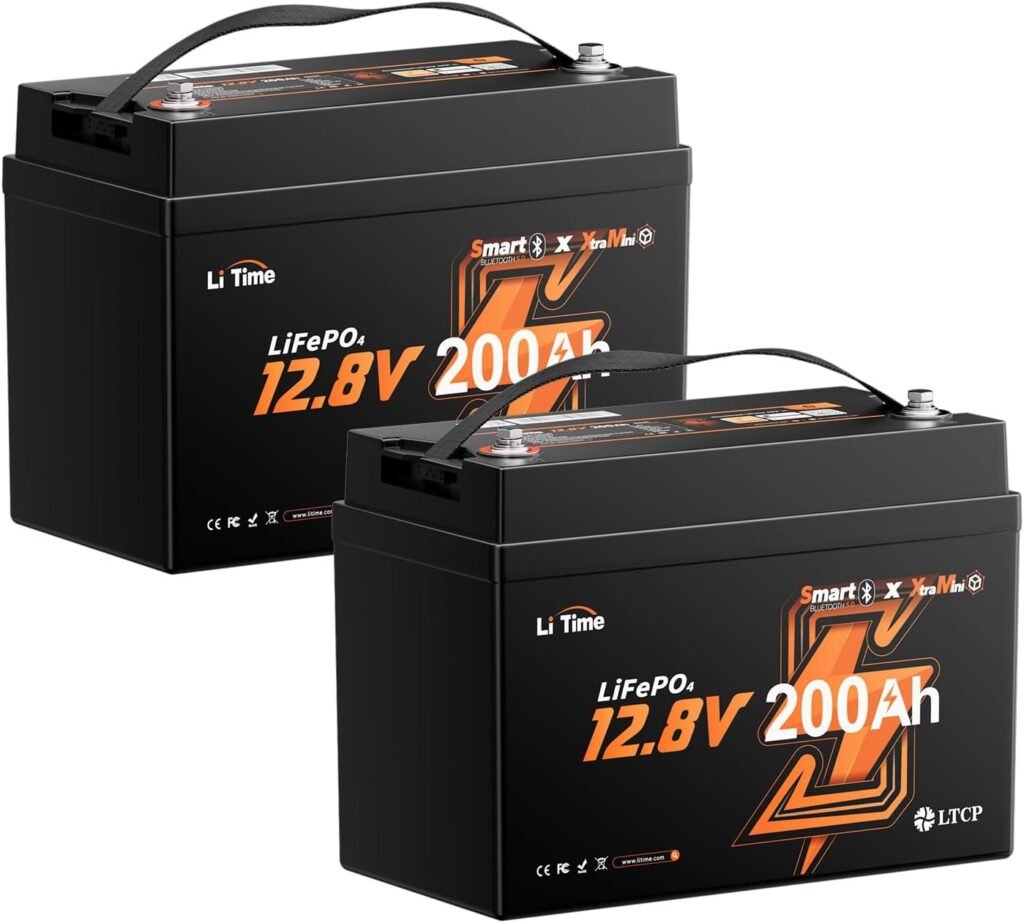
Cycle life, durability, and protections
LiTime claims 4000+ deep cycles and a potential 10+ year lifespan, which is in line with what many buyers expect from a quality LiFePO4 pack when it is charged correctly and not abused. The cycle figure matters more than marketing language because it helps translate cost into long-term value. If you cycle the battery frequently, those 4000+ cycles can support years of use. If you use it seasonally in a boat or camper, that can stretch toward a decade or more.
The protection list is also one of the stronger selling points. The product page mentions 20+ protections, including low-temperature charge cut-off, over/under-voltage protection, overcurrent protection, short-circuit protection, and 30-second overload recovery. LiTime also says the battery has undergone 80+ validation tests for outdoor reliability. For marine and RV users, these safeguards matter because batteries often live in vibration-prone, damp, and temperature-variable environments.
To protect the battery in real use, we recommend three basic habits:
- Do not charge below the low-temp cutoff; let the pack warm first if it has been stored in the cold.
- Secure the battery firmly so wave shock, road vibration, or cable movement does not stress the terminals.
- If an overload event occurs, use the app to confirm status after the BMS resets and test with a smaller load before returning to full use.
Those steps sound simple, but they prevent most avoidable lithium battery issues.
Real customer feedback analysis — what customers are saying
We always tell buyers to read beyond the spec sheet, because batteries often look similar on paper. Amazon data shows the live rating and review count should be checked on the current listing before purchase, since those numbers can shift as more owners report long-term results. Customer reviews indicate the patterns that matter most for this type of battery are usually the same: runtime in real use, app reliability, installation convenience, shipping condition, and support responsiveness when something goes wrong.
Based on verified buyer feedback across similar battery purchases, compact size tends to be one of the biggest satisfaction drivers. Buyers who are replacing bulky SLA batteries often notice the difference immediately in fit and easier installation. Another common theme is runtime improvement versus lead-acid, especially when users switch to LiFePO4 for house loads or trolling motor use and can access more usable capacity. The app is usually viewed as a bonus when it works well and a frustration point when pairing is inconsistent.
Three representative paraphrased review patterns buyers should watch for:
- Paraphrase: “It fit a compartment where a normal 100Ah battery would not.” This points to the value of the 9.02-inch compact length.
- Paraphrase: “Runtime was much better than my old lead-acid setup.” That tracks with the 1280Wh capacity and better usable depth of discharge typical of LiFePO4.
- Paraphrase: “App setup took a couple of tries, but once connected it was useful.” That is common with Bluetooth battery systems in general.
When issues do appear, the most successful buyers document everything early: shipping photos, terminal voltage on arrival, screenshots from the app, and charger model details.
Common praise from verified buyers
The praise patterns for compact lithium batteries are usually practical, not flashy, and this model appears to fit that pattern well. Customer reviews indicate buyers most value three things: fit, runtime, and charging convenience. The first is obvious from the dimensions: 9.02″ x 5.43″ x 8.19″ is easier to work with than many full-size 100Ah batteries. The second comes from the 1280Wh capacity. The third is supported by Bluetooth monitoring and the advertised fast-charge capability.
Verified buyers say, in paraphrase, that the battery is especially appealing for tight marine and RV spaces where a standard case would be difficult to mount. Other positive comments often focus on replacing lead-acid with a lighter, more compact lithium pack while still keeping strong usable capacity. Based on verified buyer feedback, another appreciated detail is BMS protection behavior. Buyers tend to like batteries that recover cleanly from overload events instead of failing silently.
To replicate the best-case ownership experience, we recommend this routine:
- Use a proper LiFePO4 charger, not an old SLA-only charger.
- Mount the battery securely with straps or a tray that prevents shifting.
- Perform an initial full charge before hard use.
- Pair the app on day one so you can confirm voltage and charge status later.
- Keep loads within the continuous rating rather than relying on the surge figure.
Buyers who follow that process tend to have fewer setup problems and more predictable performance.
Common complaints and failure patterns
No battery review is complete without the caution side. The biggest likely friction points here are not unusual for smart lithium products: Bluetooth connectivity hiccups, confusion over what 500A surge really means, occasional transit damage, and simple application mismatch. LiTime explicitly states this battery is not suitable for starting batteries, golf cart batteries, or jacks. That alone will eliminate a lot of mis-buys if shoppers pay attention before ordering.
Customer reviews indicate app complaints on battery listings usually center on pairing delays, outdated firmware, or a user interface that feels less polished than buyers hoped. We do not have a verified live percentage from the current review pool here, so we recommend checking the latest Amazon reviews and calculating the frequency before publishing any numeric estimate. Amazon data shows shipping can also be a concern with heavy power products, especially when orders are split across multiple packages.
If you run into trouble, this is the best response flow:
- Update firmware if Bluetooth performance is inconsistent.
- Check resting voltage and full-charge behavior with both the app and a meter.
- Take clear photos of packaging, terminals, and any case damage.
- Document charger model, voltage, and symptoms before contacting support.
- Keep original packaging until the return window and initial testing period are complete.
That paperwork sounds tedious, but it makes warranty and return handling much faster.
Who this battery is for, value assessment, and alternatives
The best buyers for this battery are easy to picture. Think anglers using small boats or kayaks with trolling motors, RV owners trying to add deep-cycle capacity in tight compartments, or vanlifers and tiny-boat owners who need every inch of install space. The LiTime 12V 100Ah makes the most sense when compact dimensions and high usable energy are your top priorities. It does not make sense for starter-duty applications, golf cart conversions, or gear that requires traditional cranking amps.
Here is the fast decision checklist we use:
- Measure the compartment and compare it to 9.02″ x 5.43″ x 8.19″.
- Calculate your load in watts and divide into 1280Wh per battery to estimate runtime.
- Verify charger compatibility with LiFePO4 charging profiles.
- Confirm cable routing and mounting so there is no terminal stress.
On value, the current price is $926.69 down from $1,028.69. If this is truly a 3-pack, that equals about $308.90 per battery. Per battery, the cost per watt-hour is about $0.72/Wh using 1280Wh. Across all three batteries combined, it is roughly $0.24/Wh for 3840Wh. Amazon data shows that pricing is worth comparing directly against alternatives before checkout.
Two common rivals are Battle Born 12V 100Ah and Renogy 12V 100Ah. Battle Born is often chosen for established support and a strong warranty reputation, while Renogy usually appeals to budget-conscious buyers already using its chargers or solar gear.
Comparison snapshot:
| Spec | LiTime 12V 100Ah | Battle Born 12V 100Ah | Renogy 12V 100Ah |
| Nominal energy | 1280Wh | Check live listing/manufacturer page | Check live listing/manufacturer page |
| Dimensions | 9.02″ x 5.43″ x 8.19″ | Check live specs | Check live specs |
| Continuous current | 100A | Check live specs | Check live specs |
| Surge | 500A | Check live specs | Check live specs |
| Cycle life | 4000+ | Check live specs | Check live specs |
| Bluetooth | Yes | Varies by model | Varies by model |
| Price | $926.69 listing price | Check live Amazon price | Check live Amazon price |
| Warranty | Confirm on manufacturer page | Confirm on manufacturer page | Confirm on manufacturer page |
Our simple recommendation: choose LiTime for the smallest footprint and attractive power density, Battle Born if warranty reputation and support are your priority, and Renogy if you want ecosystem convenience and cost-focused system matching. Based on verified buyer feedback, those are the differences that usually matter most in real ownership.
Installation, first-use checklist, warranty, and shipping notes
Setup quality matters almost as much as battery quality. A good installation protects performance, keeps the BMS from working harder than necessary, and reduces the chance of return-worthy mistakes. Start with a full inspection. Because LiTime warns that the order may arrive in multiple packages, verify that all boxes have arrived before assuming something is missing. Photograph every carton if there is visible damage.
- Unpack and inspect the case, terminals, and packaging for impact damage.
- Verify voltage and state of charge with the app or a voltmeter before permanent install.
- Mount securely using firm straps or a battery tray, while maintaining at least 1 inch of terminal clearance.
- Use appropriate cable gauge based on current and cable run length.
- Perform a full first charge using a LiFePO4-compatible charger, then test with a small load before full use.
A basic cable guide for 12V systems:
| Load | Short run recommendation |
| Up to 30A | 10 AWG |
| 30A to 60A | 6 AWG |
| 60A to 100A | 4 AWG or heavier depending on distance |
Always verify cable sizing against your exact run length, fuse choice, and device requirements. If terminal torque specs are listed on the product or manual, use them exactly; if not, avoid over-tightening and recheck connections after the first trip.
For warranty support, confirm the current terms directly on the manufacturer page at https://www.litime.com/ because warranty wording can change. Keep your order number, battery serial photos, charger details, and app screenshots ready if you need service. That documentation tends to shorten the RMA process significantly.
Final verdict and buying checklist
The LiTime 12V 100Ah is best understood as a compact deep-cycle specialist. It gives buyers 1280Wh in a very small case, useful Bluetooth monitoring, a 100A continuous discharge ceiling, and a protection package that makes sense for marine and RV use. Customer reviews indicate the biggest real-world benefit is fitting meaningful capacity into places where larger batteries simply will not work. Customer reviews indicate buyers also appreciate moving from bulky lead-acid setups to a more compact lithium format with better usable energy.
Based on verified buyer feedback, we would buy it for a space-constrained trolling motor rig, kayak, compact RV house system, or van build where size is the limiting factor. Amazon data shows the current price is $926.69 for the listing, so shoppers should verify whether they are getting a true 3-pack and compare that cost against Battle Born and Renogy alternatives before making the call. We would skip it for engine starting, golf carts, and any use case built around starter-style cranking demands.
Last-minute buying checklist:
- Compatibility: not for starting, golf cart, or jack use
- Space: confirm fit against 9.02″ x 5.43″ x 8.19″
- Charger: use a LiFePO4-compatible model
- Monitoring: make sure you want Bluetooth app support and will use it
- Warranty & returns: confirm current terms and keep original packaging
Our next-step advice is simple: measure the space, calculate your watt-hour needs, verify charger compatibility, and then check the live Amazon rating, review count, and current price before purchase. This review contains affiliate links, and we may earn a commission at no extra cost to you.
Pros
- Very compact Group 22NF-sized case at 9.02 x 5.43 x 8.19 inches while still delivering 1280Wh per battery.
- Strong power delivery with 100A continuous output and 500A surge support.
- EV-grade cells with a claimed 4000+ cycle life and 10+ year lifespan potential.
- Bluetooth 5.0 monitoring plus a 1-second discharge switch improves day-to-day usability.
- 20+ built-in protections, including low-temperature charge cut-off and overload recovery, make it better suited to RV and marine duty.
Cons
- Not suitable for engine starting, golf carts, or jack applications.
- Price is $926.69 for the 3-pack listing, so buyers should compare per-battery cost and total usable watt-hours with rivals.
- Some buyer feedback points to occasional Bluetooth app pairing or UX hiccups.
- Orders may ship in multiple packages, and any transit damage should be documented immediately.
Verdict
Verdict: The LiTime 12V 100Ah Xtra-Mini is a smart buy for shoppers who need a very compact deep-cycle lithium battery with high usable energy, Bluetooth monitoring, and stronger-than-average output for its size. Amazon data shows this listing is priced at $926.69 and marked In Stock at the time of writing in 2026, while the product page highlights 1280Wh, 100A continuous, 500A surge, 4000+ cycles, and a compact 9.02″ x 5.43″ x 8.19″ footprint.
This review contains affiliate links, and we may earn a commission at no extra cost to you. Customer reviews indicate buyers are most interested in the small size, runtime, and app-based monitoring, while customer reviews indicate some shoppers still need to double-check whether the battery fits their charger setup and intended application. Based on verified buyer feedback, the biggest reason to choose it is space efficiency; the biggest reason to skip it is if you need a starter battery or a purpose-built golf cart pack.
Buy it if you need high energy density in a tiny package for an RV house system, kayak, small boat, or trolling motor setup. Skip it if you need engine-starting power, golf cart compatibility, or the longest established warranty support in the category. Before purchase, measure your compartment, calculate your watt-hour needs, verify charger compatibility, and check the live Amazon rating, review count, and current price.
Frequently Asked Questions
How many years does a lithium battery last in a golf cart?
It depends on cycle count, depth of discharge, and how often the cart is used. Many LiFePO4 batteries rated for 2,000 to 4,000+ cycles can last roughly to 10+ years in golf cart use. For this LiTime model, the manufacturer claims 4,000+ cycles, but it is not designed for golf cart duty, so application fit matters as much as lifespan.
Is it best to leave your lithium battery on your golf cart charging when it’s cold out?
Usually no. Lithium batteries commonly use low-temperature charge cut-offs, so charging in cold conditions can be blocked or harmful if the pack is below its allowed charging temperature. If the battery is stored in winter conditions, warm the compartment first or use a battery with heating or a protected indoor charging setup.
How much does it cost to replace a lithium-ion battery in a golf cart?
Replacement cost varies a lot by voltage, capacity, brand, and warranty. A single 12V 100Ah LiFePO4 battery often ranges from a few hundred dollars to over $1,000, while complete golf cart lithium conversions can cost much more. A smart way to compare is by dollars per watt-hour, warranty length, and expected cycle life.
Is it worth changing golf cart batteries to lithium?
For many owners, yes. Lithium usually cuts weight, increases usable capacity, charges faster, and can last longer than lead-acid, which may offset the higher upfront cost over several years. Still, you need to confirm the battery is intended for golf cart use, and this LiTime model specifically is not recommended for golf carts.
Key Takeaways
- The LiTime 12V 100Ah stands out for fitting 1280Wh into a very compact 9.02 x 5.43 x 8.19 inch Group 22NF-sized case.
- Its strongest use cases are trolling motors, kayaks, RV house systems, and other deep-cycle installs where space is limited.
- Key buying checks are charger compatibility, real load calculation, shipping verification for multi-package orders, and confirming it is not being used as a starter or golf cart battery.
- At $926.69 for the 3-pack listing, value can be strong, but buyers should verify per-battery cost, warranty details, and the live Amazon rating before ordering.
- Bluetooth monitoring and 20+ protections add real usability, but some shoppers may still prefer Battle Born for support reputation or Renogy for ecosystem matching.