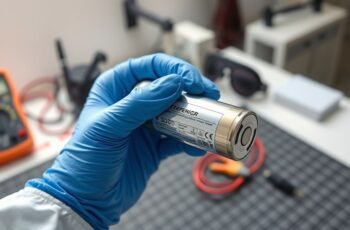
We start with calm physics and then unleash chaos, because a small defect can flip a safe cell into a self-heating cascade. We’ll examine how internal shorts, SEI breakdown, and gas buildup drive runaway, then map how heat moves through packs and triggers organics to react. With data on triggers, signals, and containment, we’ll frame practical prevention and response strategies that keep escalating risks within bounds—but the next detail may surprise you.
Key Takeaways
- Battery thermal runaway is a self-accelerating, exothermic process inside a cell where internal heat triggers a feedback loop of reactions, raising temperature rapidly.
- Initiation often starts with internal shorting and SEI/electrolyte breakdown around 90–150°C, advancing through separator softening and catalyst-driven reactions.
- Late-stage heat comes from cathode oxygen release reacting with electrolyte, with heat and gas spreading to neighboring cells and pack interiors.
- Propagation relies on conduction, convection, and gas dynamics within packs, influenced by spacing, barriers, and venting, accelerating spread.
- Early warning signals include rapid temperature rise, sudden voltage drops, cell imbalance, and gas emissions (H2, CO/CO2, VOCs) alerting to onset.
What Is Battery Thermal Runaway
Battery thermal runaway is a self-accelerating, exothermic chain reaction inside a cell that drives a rapid temperature rise. We describe it as a cascade: internal decomposition triggers heat release, which spurs further decomposition in a positive feedback loop that ends in failure modes. Early SEI and electrolyte breakdown occur around 80–200°C, followed by separator melting and accelerated anode/cathode reactions near 150–210°C (higher for LFP, lower for some chemistries). In the late stage, cathode oxygen release reacts with electrolyte, producing most heat and gas. Total energy and heat flux exceed cooling, enabling propagation through conduction between cells and to pack interiors. Gas mixtures include flammable hydrocarbons, hydrogen, CO, CO2, and HF in certain chemistries, posing combustion, toxicity, and corrosion risks. Cell chemistry governs energy release and failure modes. New factual point about heat transfer Conduction between cells and into the pack interior drives the rapid spread of heat beyond a single cell, accelerating the overall process.
What Triggers Runaway: Defects, Abuse, and Aging
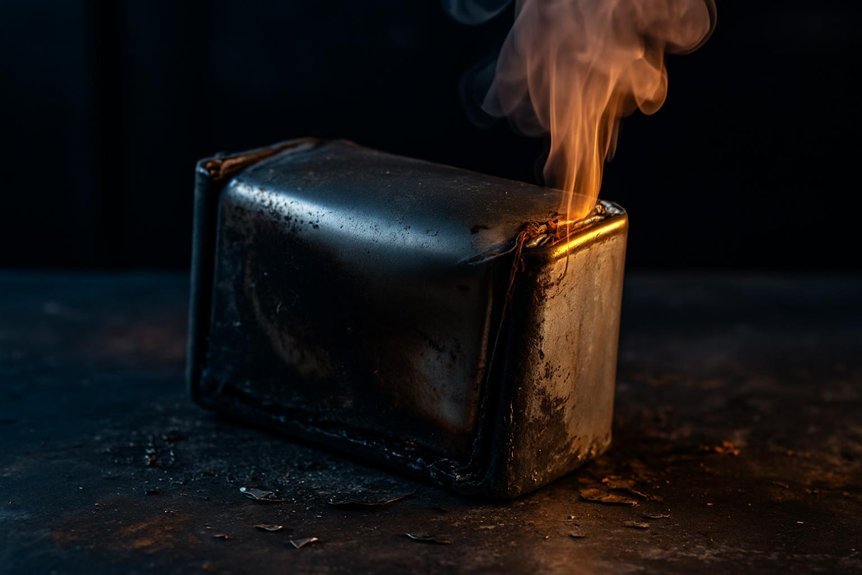
We have from our prior discussion that thermal runaway is a self-accelerating, exothermic cascade, but the initiation hinges on defects, abuse, and aging that create the first spark. We detail how internal defects—separator pinholes, coating non-uniformity, and metallic contamination—initiate local shorts, raise hotspots, and accelerate heat. Electrical abuse—overcharge, deep discharge, and fast charging—drives lithium plating, reactive oxygen release, and large instantaneous heat, while cell-to-cell imbalances focus stress. Mechanical abuse—puncture, crush, and delamination—creates direct contact paths and localized heating. Thermal abuse—extreme temperatures and poor cooling—exacerbates SEI breakdown and self-heating. Aging effects—SEI growth, microcracks, and dendrite progression—increase resistance and hotspot likelihood. Collectively, non electrode degradation and non thermal processes set the stage for runaway initiation.
How It Unfolds: Step-by-Step Runaway Mechanism
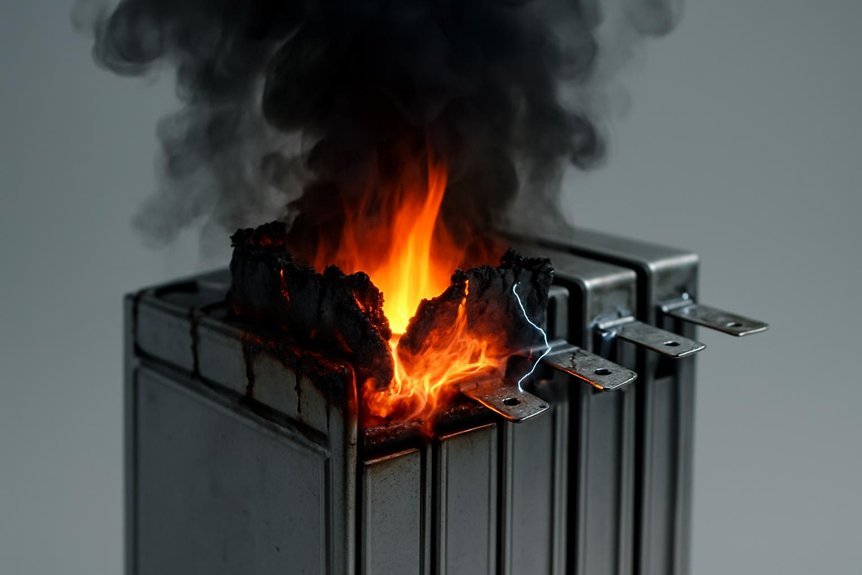
How does a thermal runaway unfold step by step? We trace initiation to propagation with precise timing. Localized internal short causes rapid Joule heating within milliseconds to seconds, pushing hotspot temps toward 120–150°C, triggering separator softening and potential shorting through melted polymer. SEI decomposition accelerates heat release and reactive species generation, while gas formation raises local pressure, amplifying mechanical failure. In the exothermic cascade, electrolyte oxidation and solvent decomposition emit volatile gases; cathode lattice oxygen release adds exothermic load; anode reactions further heat the system, and SEI breakdown exposes fresh surface, boosting reaction rates. Net heat generation overtakes dissipation, driving runaway. Heat then propagates via conduction through stacks and internal convection, with geometry affecting spread. Cell-to-cell, radiant and gas-driven heating can ignite neighbors; timing depends on SOC, design, and cooling. Li-ion battery safety dynamics underpin the whole process to drive rapid understanding and safer engineering choices.
Early Warning Signals to Watch: Temp, Voltage, and Gas Signs
What early signals should we monitor to spot thermal runaway risk before it escalates? We track temp, voltage, and gas data as integrated indicators of evolving failure. Temperature signals include SEI onset around 90–120 °C, separator/packwise concerns ~130–180 °C, rapid surface rise >5–10 °C/min, and hot spots >10–20 °C across a cell. Voltage signs cover sudden drops >100–200 mV, overvoltage charging, and rising cell imbalance (>50–100 mV), plus persistent leakage currents. Gas signatures span H2 early emissions, CO/CO2 rises, VOCs, and flammable gas mixtures. Multimodal correlation, SOS-like 0–100 indices, and regulatory compliance framing enhance reliability. Economics considerations emphasize cost of sensors and risk-based thresholds; regulatory compliance dictates documented monitoring and response protocols. Table below illustrates signal triads and timing. Thermal indicators help flag imminent risk before visible signs emerge, enabling proactive shutdown or mitigation strategies.
How Heat Spreads in Packs: Propagation Between Cells
We can summarize how heat couples between cells and propagates through modules by examining conduction across contact interfaces, convection within enclosures, and radiative exchange across small gaps. Data show that packing density, tab alignment, and material choices create low-impedance pathways that thermally couple neighboring cells, while enclosure airflow and vent events can either accelerate or throttle spread. We’ll also consider mitigations like spacing, barriers, and modular layouts that disrupt these pathways to reduce cascade risk.
Thermal Coupling Between Cells
Thermal coupling between cells in a pack is governed by multiple heat-transfer pathways that operate simultaneously, with conduction through contacts and structural interfaces often dominating at tight clearances. We quantify conduction via thermal contact resistance at tabs, cases, and frames, while convection within air gaps appears when clearances exceed a few millimeters. Radiation becomes relevant at elevated runaway temperatures, enabling gap transfer without contact. Gas-phase transport of hot decomposition products hastens propagation in confined enclosures, introducing reactive species alongside heat. Humidity modeling and micro porosity effects influence moisture-driven heat transfer and gas diffusion, respectively, altering local heat flux. Localized insulation placement, spacing, and barrier materials shape initiation delay and peak temperature, while vertical and lateral conduction govern multi-directional spread in tight versus open geometries. Pack topology and cooling interfaces modulate overall susceptibility and propagation speed.
Propagation Modes In Modules
Propagation between cells hinges on how heat migrates from a initiating cell into its neighbors, with conduction through contact interfaces often dominating short-range transfer while convection and radiation contribute at larger gaps. We observe initiation effects shaping direction and speed: center-initiated events yield bidirectional, faster spread (example: 12-cell pouch ~107 s), whereas edge initiations propagate more slowly or unidirectionally (example: ~338 s). Local venting and proximity to high-SOC cells amplify heat flow, creating hot corridors. SOC influence is decisive: higher SOC lowers onset time, increases reaction enthalpy, and elevates HRR, producing stronger flames and larger jets that intensify propagation. Heat transfer modes—conduction, convection, and radiation—together determine inter-cell coupling, with venting-driven gas dynamics accelerating the process.
Mitigation Through Spacing Barriers
Can spacing and barriers meaningfully slow heat transfer between cells in packs, or is their effect limited to delaying the inevitable? We assess mitigation through spacing barriers with data-driven precision. Thermal conduction through solid contacts contributes 15–30% of heat transfer in dense 18650 arrays, and contact resistance varies with surface flatness and pressure, shaping hotspots. Increasing spacing by a few millimeters reduces conductive flux nonlinearly, while thermal bridges via interconnects can accelerate spread along connections. Radiative and convective pathways remain significant; flame impingement and buoyant plumes can heat neighbors, with open-air tests showing downstream heat from flaming ejecta. Barriers—ceramic fiber, stainless steel, intumescent inserts—slow propagation by up to ~30× in some configurations, though rarely stop it. In sealed modules, radiation can dominate preheating, emphasizing spacing and material emissivity effects.
Key Materials That Influence Safety
We examine how catalyst materials and safety-driven coatings shape thermal behavior, tying material choice to ignition risk, heat generation, and SEI stability. Data show catalysts can alter decomposition pathways and gas evolution rates, while coatings suppress parasitic reactions and improve interfacial resilience under abuse. Together, these elements influence threshold temperatures for runaway and the effectiveness of flame retardants, warranting precise, quantified evaluation across chemistries.
Catalyst Materials Effects
How do catalyst materials shape safety outcomes in Li-ion cells? We show that catalyst surfaces, exposed after delithiation, drive solvent oxidation rates and heat flux, tying electrolyte stability directly to cathode activity. Higher nickel content amplifies catalytic sites, accelerating decomposition and rapid heat release, while Ni-rich oxides release lattice oxygen that sustains exothermic reactions. Cathode coatings are not the focus here, but surface-related mechanisms reveal that dopants and crystal engineering reduce accessible catalytic centers, lowering instantaneous heat generation. Oxygen evolution coupled with electrolyte breakdown elevates peak temperatures, narrowing safety margins in high-SOC packs. Thermal propagation correlates with cathode composition, so nickel-rich chemistries demand stricter controls on SOC, spacing, and barriers to limit runaway velocity and overall hazard.
Safety-Driven Coatings
In safety‑driven coatings, thin ceramic layers on separators and high‑temperature polymers balance heat resistance with ion transport. We evaluate how coating durability and binder adhesion shape performance under abuse, using ceramic and polymer options, plus intumescent additives and conductive layers. Ceramic coatings reduce shrinkage by 20–60 °C and improve dimensional stability, while high‑temperature polymers maintain integrity above 300 °C, extending operability. Trade‑offs appear as increased interfacial impedance and potential pore blockage at high loadings, and delamination risks if adhesion is weak. Flame retardants and conductive layers can enhance safety but may impact electrochemical compatibility. Below, we present a concise matrix linking materials to safety outcomes and key metrics.
| Material class | Safety impact | Key metric |
|---|---|---|
| Ceramic coatings | Thermal stability, puncture strength | coating durability, binder adhesion |
| High‑T polymers | Heat resistance, electrolyte affinity | ionic conductivity |
| Flame retardants | Heat delay, HRR reduction | exotherm onset, HRR |
Safety Systems That Mitigate Risk in Packs
Safety systems in packs combine rapid sensing, decisive control actions, and robust physical design to prevent and contain thermal events. Our BMS monitors per-cell voltages with ±1–5 mV precision and uses high-speed current sensing to detect shorts, enabling immediate limiting and contactor opening. SoC/SoH estimation reduces cell stress by avoiding harmful windows, while 20–50 mV imbalance thresholds trigger intervention. Distributed temperature sensing informs cooling modulation and derating above 45–55 °C, and hardware interlocks plus watchdogs guarantee fail-safe isolation within milliseconds to seconds. Thermal management integrates liquid cold plates, directed air, and PCM buffering to maintain ΔT <5–10 °C and seconds-to-minutes of delay during heat events. Mechanical design—cell spacing, barriers, venting, and shields—limits propagation. Battery aging and manufacturing QC influence initial cell variance and long-term reliability.
Real-World Testing and Incident Insights
We summarize real-world test findings and incident insights to frame how propagation and failure patterns emerge in practice. Our review highlights evidence from large stationary, EV, BESS, and transport incidents, showing how SOC, spacing, vent gas, and external heat drive rapid escalation and cascading failures. We’ll discuss detection approaches, timing of precursors, and how observed failure modes inform risk assessment and mitigation in deployments.
Real-World Test Findings
Real-world full-scale EV battery pack tests reveal that thermal runaway can propagate from a single cell to adjacent cells, often engulfing entire packs within minutes. We quantify propagation, combustion, and gas release to illustrate real-world risk. Our measurements show rapid jet flames, substantial mass loss, and high heat fluxes that reshape safety envelopes for nearby equipment and personnel.
- Pack-scale jet flames reaching several meters and substantial mass loss up to 80% in scale-up tests
- Gas release volumes far exceed single-cell events, with CO, CO2, H2, and HF detected and exposure thresholds challenged
- Mechanical triggers yield fragmentation and secondary ignition hazards, emphasizing SOC and design dependencies
These findings emphasize scale effects and propagation mechanics, while avoiding unrelated topic, off topic discussion to maintain technical focus.
Incident Insight Highlights
How do real-world tests inform our understanding of incident dynamics in lithium-ion battery fires? We synthesize incident data across residential, EV, ESS, transport, and consumer electronics to map triggers, outcomes, and escalation. Charging indoors and balcony charging repeatedly initiates thermal runaway in residential settings, while punctures and post-crash abuse drive EV pack failures. ESS overcharge and poor thermal management show how cascading failures start with a single cell. Transportation and shipping breakages propagate flame through packaging, and consumer electronics recalls highlight manufacturing defects and high-rate charging risks. Fire behavior reveals rapid heat release, toxic gas emission, and high radiation, elevating evacuation and suppression challenges. We also consider market forces: battery marketing and consumer incentives shape usage patterns and risk awareness, influencing incident exposure and reporting.
Propagation and Failure Patterns
Propagation unfolds through distinct, data-driven pathways that govern how a single-cell event escalates to multi-cell involvement. We observe that conduction, convection, and radiation drive cell-to-cell spread, while mechanical damage and internal shorts create hot spots that accelerate propagation. Gas jetting and vent particulates can ignite neighbors or heighten thermal exposure, and module layout critically sets speed and directionality.
- Battery pack ethics guide risk-aware design, testing, and disclosure.
- Procurement policies constrain material quality, cell chemistry choices, and supplier certifications to reduce triggering conditions.
- Fire safety requirements shape venting strategies, enclosure integrity, and response protocols.
We emphasize SOC and chemistry effects, aging, and tight packing as key risk amplifiers, with center initiation often yielding faster escalation.
Practical Prevention: Early Detection and Response
Practical prevention hinges on early detection and rapid response, leveraging multi-signal sensing to spot precursors before thermal runaway progresses. We deploy temperature monitoring across cell, module, and pack levels, with thermocouples, RTDs, and fiber-optic sensors to shrink detection time to seconds in lab tests. Voltage and impedance anomalies, captured by high-resolution BMS telemetry, can precede events by minutes to hours. Gas emissions from electrochemical and photoionization sensors signal incipient propagation, while acoustic and ultrasonic data reveal mechanical faults and internal shorts. Multi-sensor fusion with anomaly scoring improves true positives and lowers false alarms versus single signals. Our BMS power delivery and predictive algorithms push lead times; targeting manufacturing defects and balancing cells reduces localized over-stress and containment needs. Dynamic charging, fault tiers, and redundant telemetry enhance resilience.
What To Do During a Thermal Event or Fire
During a thermal event or fire, we act swiftly to protect lives and limit damage: evacuate the area, call emergency services, and establish an exclusion zone while isolating the device to prevent propagation. We follow evidence-based steps to reduce risk and enable responders to manage heat, gas, and potential reignition.
- Evacuate >100 feet, confirm occupants are safe, and communicate hazards to responders.
- Call emergency services, report battery type, location, and HF/CO emissions as applicable.
- Isolate the device, shut nearby electrical sources if safe, and establish cooling-focused containment.
Color palette of flames and smoke informs visibility and shelter decisions; social media aspects require rapid, accurate updates to avoid misinformation while coordinating with authorities.
Frequently Asked Questions
How Do Dendrites Differ From Manufacturing Defects in Causing Runaway?
Dendrite formation causes runaway later in life via cycling-related internal shorts, localized hot spots, SEI degradation, and rising resistance, whereas manufacturing defects trigger immediate, single-point faults with abrupt heat and early infant failures.
Can a Single Cell Trigger a Pack Fire Without External Heat?
Yes, a single cell can ignite a pack fire via an internal short, acting like a spark that, if heat and coupling paths exist, propagates rapidly; we observe rapid venting, heat transfer, and neighbor cell ignition in tests.
Do All Chemistries Share Identical Runaway Temperatures and Signs?
No. Runaway temperatures and signs differ by chemistry; we observe signs differences in onset, heat release, gas profiles, and voltage patterns, so absolute thresholds aren’t identical across chemistries, though trends remain consistent within each chemistry group.
What Is the Most Effective Emergency Protocol On-Site During a Fire?
We follow strict emergency protocols, prioritizing on site safety, then containment and cooling. We coordinate ICS, deploy large-volume water, drone-assisted tactics, monitor temps, log SOC/BMS data, and ventilate to minimize toxic emissions and reignition risks.
How Reliable Are Machine-Learning Warnings Across Different Pack Designs?
We’re traversing this like a tightrope, and our warnings are only as reliable as the design variety. Across pack designs, dendrite formation signals shift; thermal modeling helps, but cross-architecture accuracy drops without domain adaptation or multisensor fusion.
Conclusion
We’ve mapped the chain from defect to discharge with data-backed precision, and yet a quiet coincidence keeps reframing risk. In labs, a single anomalous reading mirrors a field incident, reminding us that probability isn’t passion—it’s pattern. When a pack’s temp, voltage, or gas deviates, our response must be swift and calibrated. By aligning sensors, protocols, and training, we reduce consequences we could scarcely anticipate, turning near-misses into safer, repeatable outcomes.